

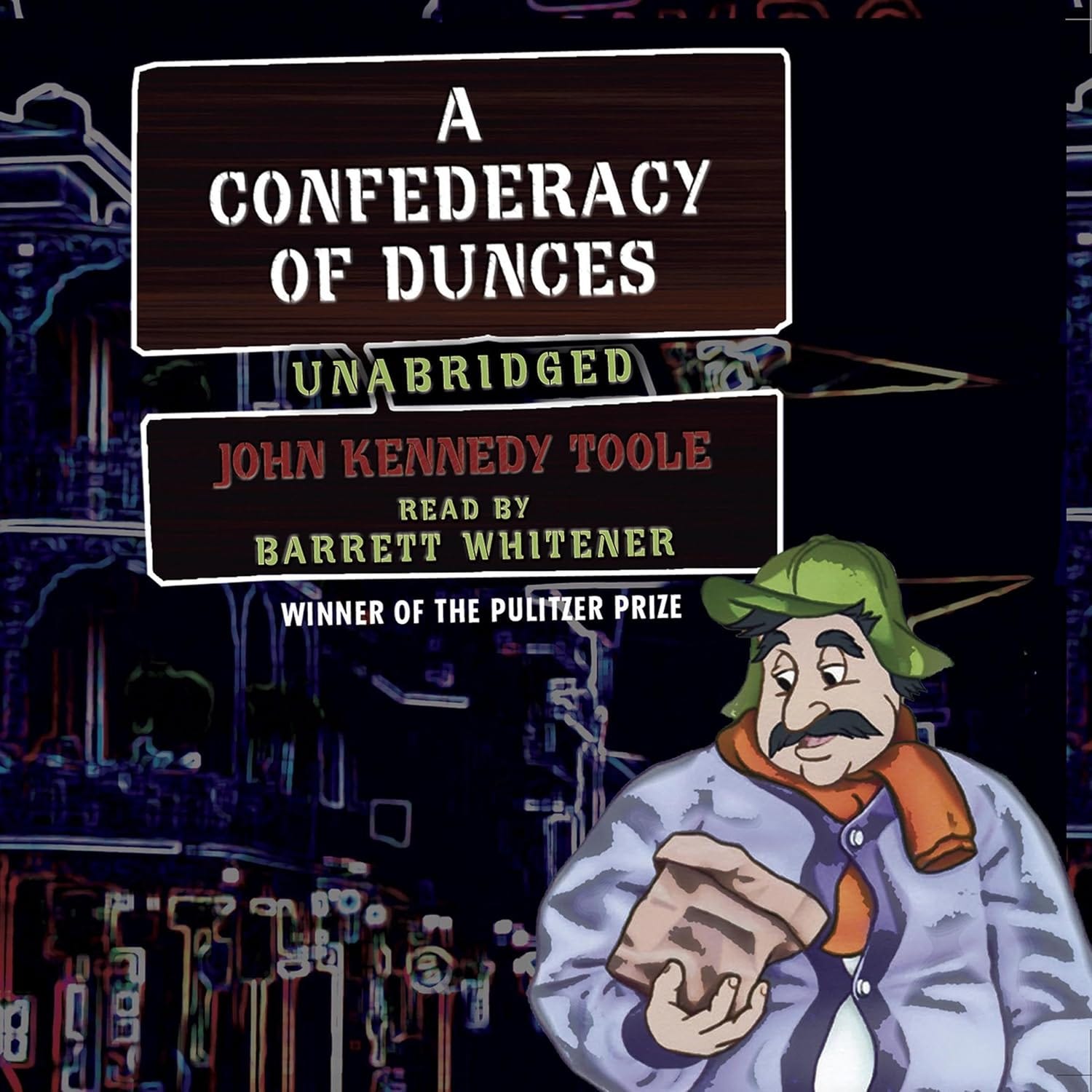
There is a precise medical description at the center of John Kennedy Toole’s A Confederacy of Dunces that deserves to be taken seriously before it is laughed at. Ignatius J. Reilly does not suffer from anxiety, or depression, or existential dread. He suffers from a pyloric valve that “periodically closes in response to the lack of a proper geometry and theology in the modern world.” The valve responds to modernity. It is, in the strictest sense, a diagnostic instrument—a body cataloguing the failures of a civilization.
This is not a joke. Or rather, it is a joke that contains a serious proposition: that a person sufficiently devoted to an older order of meaning would be physiologically reactive to the contemporary world, that sensitivity to ugliness is not merely aesthetic but somatic. The comedy of A Confederacy of Dunces depends entirely on the reader holding this proposition at exactly the right distance—close enough to feel its truth, far enough to see its absurdity. Toole constructs the entire novel at this distance and never flinches from either direction.
The question the novel poses, and refuses to answer, is whether Ignatius is wrong.
The Problem of the Right Critic
He is wrong about nearly everything in practice. He is a thirty-year-old man who has never held a job for more than a few weeks, who eats his employer’s merchandise, who falls off cutting tables, who incites factory revolts that collapse the moment the workers realize their leader is a man who may be wanted by police and who tumbled from the platform during his own pre-battle address. He is the sort of person who writes letters to strangers on company stationery calling the recipient “Mongoloid Esquire” and threatening “the sting of the lash,” then files the carbon. His mother loves him and he repays her by consuming everything she has.
But he is right—or at least not obviously wrong—about the quality of the world he inhabits. The television programs are vulgar. The movies are offensive. The organizational logic of every institution he encounters is genuinely insane: Levy Pants hires a man who cannot alphabetize; the NOPD deploys Patrolman Mancuso into a bus station bathroom in red beard and ballet tights; Paradise Vendors employs vendors who eat the inventory. The world Ignatius despises is, on its merits, despicable. His critique is accurate. His response is catastrophic. Toole never lets either half of this equation go.
The novel’s formal genius is its refusal to validate the obvious escape from this paradox. One exits the paradox by declaring: Ignatius is simply insane, his medieval worldview is delusional, his critique is invalidated by his dysfunction. But Toole blocks this exit. He gives Ignatius the novel’s most precise and sustained intelligence. The journal entries—”The Journal of a Working Boy, or Up from Sloth”—are not gibberish. They are, in their own register, acute. The observation that the valve closes because it thinks it is “living in a dead organism” is not a mad sentence. It is a diagnosis. Ignatius is not wrong that something is wrong. He is simply an unusable instrument for correcting it.
This is the distinction that separates A Confederacy of Dunces from mere satirical comedy: the target of Toole’s wit is not the medieval mind but the gap between correct perception and catastrophic execution. Ignatius sees clearly. He acts disastrously. These two facts coexist without resolving into each other, and Toole insists on their simultaneous truth for three hundred pages.
The Shadow Protagonist
The novel’s deepest structural intelligence lives not in Ignatius but in Burma Jones.
Jones is deployed as a parallel consciousness, a character whose situation is the logical, material equivalent of Ignatius’s cosmic complaint—but without the luxury of metaphysics. His constraint is stated with mathematical precision: “If I quit, I get report for being a vagrant. If I stay, I gainfully employ on a salary not even starting to be minimum wage.” This is not Boethius’s wheel of fortune. This is a labor trap, historically specific, racially structured, economically exact. Jones knows what it is. He names it “modern slavery.”
The comparison Toole constructs between Jones and Ignatius is the novel’s most unsettling move. Both men are trapped by systems that use them and discard them. Both are sharp observers of their captivity. Both develop philosophies of endurance—Ignatius through medievalism, Jones through sardonic detachment behind his sunglasses, his cigarette smoke rising like commentary on everything beneath it. The difference is that Ignatius’s mother funds his captivity, while the state enforces Jones’s. Ignatius can leave when Myrna arrives. Jones cannot leave until he finds evidence that gives him leverage.
Toole built this parallel with care. And yet the novel never fully commits to examining it. Jones is brilliant and politically clear-eyed. He is also rendered in a dialect more phonetically exaggerated than any other character’s speech—a choice Walker Percy’s foreword praises as artistically successful, specifically citing Toole’s achievement of “a superb comic character of immense wit and resourcefulness, without the least trace of rastus minstrelsy.” Whether Percy’s assessment holds is a judgment the contemporary reader cannot make passively. Toole gives Jones clarity of analysis and restricts the register in which he can express it. Whether this is the novel’s limitation or its subject—the way American culture licenses certain voices and circumscribes others—is a question the text raises without answering. The evidence is in the novel. The interpretation belongs to the reader, and readings will differ.
The Factory Revolt
The novel’s most misread sequence is the Crusade for Moorish Dignity.
Ignatius descends into Levy Pants’s factory and genuinely attempts social action. His crusade has coherent premises: the workers are underpaid, the foreman is a chronic alcoholic, the conditions are abysmal. The factory women sew their own evening gowns on company time. The coal furnaces devour cutting tables for fuel. No one in authority has cared about these people for two decades.
The revolt fails not because the cause is wrong but because the workers, with entirely sound judgment, decline to follow a man who tumbles from a cutting table during his own pre-battle speech, whose film equipment breaks immediately, and whom someone has identified as possibly wanted by police. This is not a failure of the workers. It is a failure of the instrument. The workers return to their machines. The cross Ignatius built remains on the office wall. The forged letter to Abelman remains in the outbox.
This is Toole’s central satirical proposition: that the critique of injustice is not itself sufficient, that the critique may be correct and the critic useless, and that the uselessness of the critic does not retroactively validate the injustice. The factory workers have genuine grievances. They will not be addressed. The resolution of the novel’s plot—Jones exposes Lana Lee, Mancuso gets a promotion, Ignatius escapes in a Renault—leaves the factory entirely unaddressed. Nobody got a raise. Toole doesn’t pretend otherwise. The comedy never quite obscures this fact, which is why the novel lingers after the laughter fades.
What the Ending Refuses
The final movement of the novel refuses catharsis twice.
First: the ambulance. Mrs. Riley makes the only rational decision available to her. She cannot pay Abelman. She cannot manage Ignatius. She has found a man—Claude Robichaux, decent and stable—who might give her security. She calls Charity Hospital. The ambulance passes the Renault in the dark, its red light splashing briefly over the escaping car. Ignatius watches it disappear. He feels insulted that they sent only a Cadillac. He had expected something more formidable.
This is a perfect comic beat. It is also a moment of genuine sadness. His mother tried to help him. He is escaping her help. She will return to a house with a Celtic cross in the front yard and a do-not-disturb sign on an empty bedroom door. The novel, which has been merciless toward Ignatius for three hundred pages, allows itself one beat of tenderness here—not for Ignatius, but for her.
Second: Myrna. The final image—Ignatius pressing her pigtail to his mustache, breathing deeply, his valve opening at last over the salt marshes—is framed as relief, as release, as something approaching freedom. U.S. 11 stretching north. Toole even permits the verb: the valve opened. It has been sealed for the entire novel. Now it opens.
But the reader has spent three hundred pages watching Ignatius. The valve opens because he is escaping consequences, not because he has changed. He is already, in the final paragraph, treating Myrna as an instrument—”how ironic,” he thinks, kissing the pigtail—already reorganizing his gratitude into manipulation. He will be terrible to her. He will exhaust her causes and her patience. The Renault will eventually stop somewhere in the American night, and whatever happens next will be another chapter of the journal.
Toole died before he could write it. His mother spent eight years finding someone to publish the one chapter she had.
The Biographical Shadow That Won’t Leave
Walker Percy’s foreword installs Toole’s suicide as an interpretive frame before the first page of fiction. The reader cannot encounter Ignatius’s comic misery without knowing that the man who invented him died by his own hand at thirty-two, that his mother carried the manuscript through years of rejection, that the novel was nearly lost. Every moment of Ignatius’s isolation is slightly shadowed by the author’s isolation. Every joke about a world hostile to genuine intelligence echoes differently once you know that the man who wrote it concluded the world was too hostile to survive.
Whether this enriches or contaminates the reading is a question the novel puts before every reader without answering. But it explains something about why the comedy never fully satisfies—why the laughter always has a catch in it. Toole understood from the inside that a correct perception of the world’s vulgarity is not sufficient protection against the world. The valve knows the right things. The organism built around it knows how to survive. These two facts are not reconcilable.
Toole built an entire comedy out of that gap.
Then he stepped into it.
Tags: A Confederacy of Dunces, John Kennedy Toole, Ignatius J. Reilly, Boethian comedy, New Orleans grotesque