

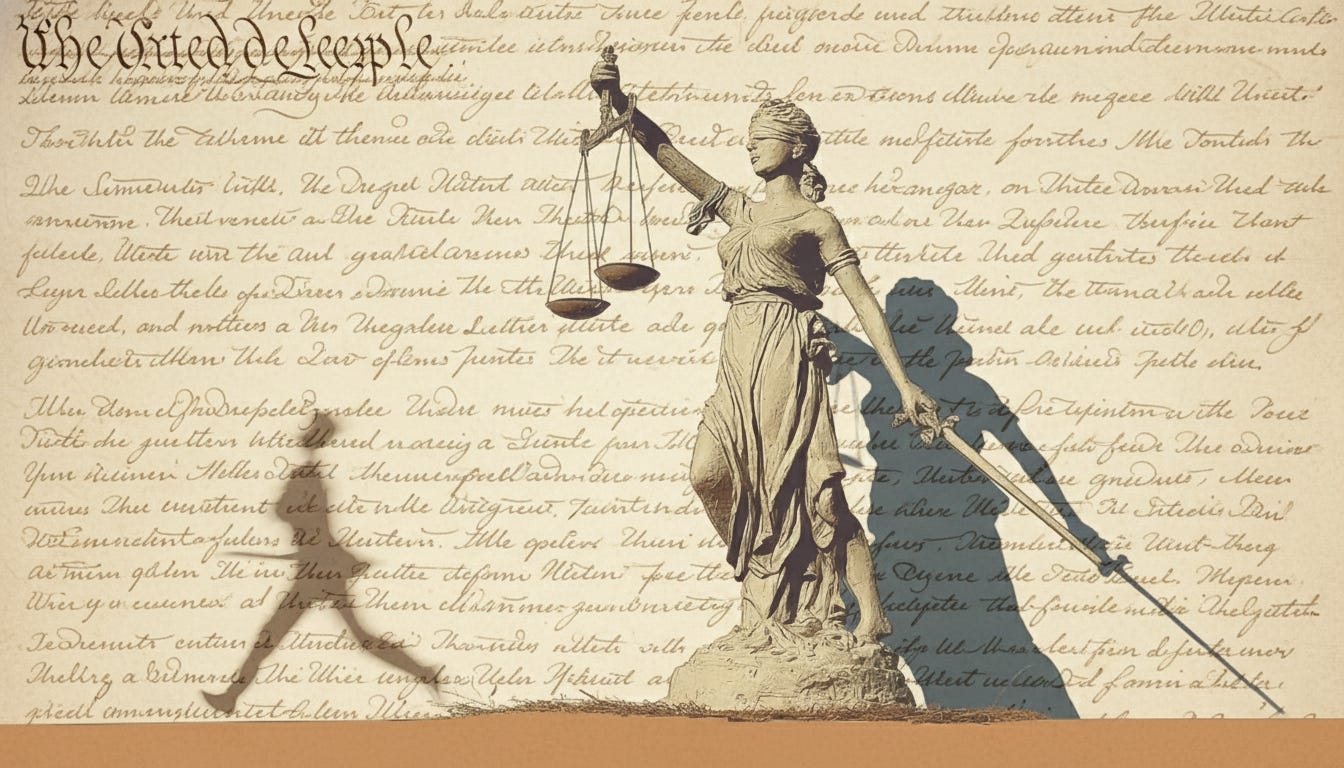
I. The Question You’re Not Supposed to Ask
You open the Constitution to Article II, Section 4, and there it is, the phrase that sounds like it should mean something specific but dissolves into ambiguity the moment you try to pin it down: “Treason, Bribery, or other high Crimes and Misdemeanors.”
What the hell is a “high crime”?
It’s not a felony. It’s not necessarily even illegal. The phrase predates the American founding by four centuries, borrowed from English parliamentary practice where it meant something closer to “crimes against the state itself”—abuses so fundamental they threatened the system’s ability to function. When George Mason stood up at the Constitutional Convention on September 8, 1787, and objected that “treason and bribery” wouldn’t cover “many great and dangerous offenses,” he proposed adding “maladministration.” James Madison shot him down: too vague, he argued, would make the president serve at “the pleasure of the Senate.” So Mason countered with the English standard, and the Convention adopted it.
The result is a constitutional Rorschach test. A high crime is whatever injures the nation through the abuse of entrusted power. It’s a standard that requires you to look at the whole picture—not just whether a law was broken, but whether the legal and democratic foundations of the Republic were undermined.
This is not a legal analysis. This is a field guide. What follows is a tour through 240 years of presidential conduct—some of it condemned, some of it celebrated, most of it contested—to give you a framework for the judgment call you’re going to have to make about what’s happening right now.
II. The Architecture of Injury: A Historical Pattern Language
The Nullification Pattern: When the Executive Erases the Judiciary
Andrew Jackson didn’t need to commit a crime to injure the nation. He just needed to ignore the Supreme Court.
In 1832, Chief Justice John Marshall ruled 5-1 in Worcester v. Georgia that the Cherokee Nation was sovereign and that Georgia’s laws had no force within their territory. Jackson’s response? He didn’t enforce the ruling. The apocryphal quote—”John Marshall has made his decision; now let him enforce it!”—captures the essence even if the words are disputed. By creating a legal vacuum, Jackson enabled Georgia to continue its harassment campaign, which culminated in the forced removal of 15,000 Cherokee in 1838. Approximately 4,000 died on the Trail of Tears.
This is the first pattern: executive nullification of judicial outcomes. The president uses his discretion to make court rulings meaningless, substituting his judgment for the established legal process.
Fast forward 193 years. On January 20, 2025, the President issues a proclamation granting “full, complete, and unconditional” pardons to approximately 1,500 individuals convicted of crimes related to January 6, 2021. This includes more than 600 convicted of assaulting law enforcement officers and 170 who used deadly weapons. Fourteen leaders of the Oath Keepers and Proud Boys—men convicted of seditious conspiracy—receive commutations. The Attorney General is directed to ensure all pending indictments are dismissed “with prejudice.”
The constitutional injury isn’t that pardons are illegal—they’re explicitly authorized. The injury is that jury verdicts for crimes directed at the peaceful transfer of power are systematically erased. By vacating legal consequences for political violence in support of the executive, the action arguably creates a two-tiered system: ordinary citizens face prosecution, while those who advance executive interests receive retroactive immunity.
But there’s a second-order effect. Traditional clemency requires that the petitioner accept responsibility and make restitution to victims. The 2025 pardons wipe out an estimated $1.3 billion in court-ordered restitution. For January 6 defendants alone, only 15% of the $3 million owed to Capitol Police and the Architect of the Capitol had been paid; the pardons liquidate the remaining $2.6 million. Trevor Milton, founder of Nikola, is pardoned before a judge can finalize his restitution—prosecutors estimated it would have reached $676 million for defrauded shareholders. Philip Walczak, who stole $10 million from medical workers’ paychecks to buy a yacht, is relieved of repayment obligations.
The victims bear the cost. This is the modern form of nullification: not just erasing verdicts, but erasing the financial accountability that gives meaning to “justice.”
The Privatization Pattern: When Public Power Becomes Personal Property
Warren G. Harding’s Secretary of the Interior, Albert Fall, received $400,000 in cash and bonds from oil magnates. In exchange, he granted them non-competitive drilling leases on federal oil reserves at Teapot Dome—reserves set aside for the U.S. Navy. Fall became the first cabinet member imprisoned for crimes committed in office.
The injury wasn’t just corruption. It was the privatization of national security assets for personal enrichment, conducted in secret to bypass congressional oversight.
Now consider the Board of Peace, announced in Davos on January 22, 2026. The charter designates the President as “Chairman for Life,” with sole authority to invite members, dismiss them, and designate his successor—who could be a private citizen. The Board offers a “permanent seat” for $1 billion. Approximately 25 countries accept invitations, including Hungary (Freedom House score: 65), Vietnam (20), Egypt (18), and Saudi Arabia (9).
The constitutional concern is the creation of a mechanism for foreign governments to pay directly into an entity controlled by the President, without congressional appropriation or auditing. Argentina receives a $20 billion currency swap from the U.S. Exchange Stabilization Fund just as it’s being invited to join. Analysts describe this as using U.S. public funds to leverage payments into a presidential slush fund—effectively privatizing American foreign policy.
This is the second pattern: the commodification of sovereign power. Public authority is converted into a vehicle for private financial transactions, creating dependencies and obligations that bypass democratic accountability.
The Impunity Pattern: When Federal Force Becomes Absolute
Abraham Lincoln suspended habeas corpus in April 1861 without congressional authorization. Chief Justice Taney ruled in Ex parte Merryman that only Congress could suspend the writ. Lincoln ignored the order, continuing detentions and contemplating the arrest of critical journalists. His defense in July 1861: “Must [the laws] be allowed to finally fail of execution even had it been perfectly clear that by the use of the means necessary to their execution some single law... should to a very limited extent be violated?”
Lincoln acted under existential threat to the Union. The question is whether his precedent—that presidential duty can override constitutional constraints—survives when the threat is manufactured rather than real.
On January 7, 2026, ICE Agent Jonathan Ross shoots and kills Renee Nicole Good, a 37-year-old U.S. citizen and mother of three. Video evidence shows Good maneuvering her SUV away from Ross as he walks around the front of her vehicle with a cell phone in hand. Ross draws his weapon and fires three shots into the car as it passes him, striking Good in the head. Within hours, DHS Secretary Kristi Noem labels Good’s actions “domestic terrorism.” The DOJ refuses to open a criminal investigation, declaring the shooting “self-defense” despite video showing Ross was not in the vehicle’s path.
Seventeen days later, Border Patrol agents shoot and kill Alex Pretti, an ICU nurse filming an enforcement action in Minneapolis. Pretti, carrying a licensed handgun he never brandished, is pepper-sprayed and then shot ten times. The DOJ opens a civil rights investigation only after bipartisan congressional pressure.
This is the third pattern: the culture of impunity. Federal agents use lethal force against U.S. citizens with the belief that they possess absolute immunity. The executive branch systematically obstructs accountability, creating a hierarchy where federal officers operate under different rules than state or local police, and where filming or criticizing their actions can be grounds for lethal response.
The Selective Transparency Pattern: Redaction as Shield
Richard Nixon’s “smoking gun” tape revealed he used the CIA to pressure the FBI into disrupting the Watergate investigation. The injury wasn’t the break-in—it was using the national security apparatus to obstruct justice.
On January 30, 2026, Deputy Attorney General Todd Blanche announces the release of 3 million pages of Epstein investigation records, including 2,000 videos and 180,000 images. This is marketed as definitive compliance with the Epstein Files Transparency Act. But the DOJ identified over 6 million potentially responsive pages and produced only 3.5 million.
The most controversial decision: withholding documents depicting “death, physical abuse, or injury.” Blanche’s justification is survivor privacy. Critics note that such crimes often have no statute of limitations and could implicate co-conspirators still at large. A 2007 draft indictment reveals prosecutors planned to charge three of Epstein’s assistants as co-conspirators in recruiting underage girls—the names are blacked out in the 2026 release. A 2020 memo discusses ten specific prosecution targets—identities redacted.
When asked about mentions of Donald Trump in the files—approximately 24 instances including a spreadsheet of FBI hotline calls—Blanche repeatedly states “there was nothing in there that allowed us to prosecute anybody.” Meanwhile, the DOJ highlights files showing photographs of Bill Clinton, which administration officials trumpet on social media.
On February 1, 2026, Blanche declares “this review is over.”
This is the fourth pattern: selective transparency as protection. The executive uses discretion over classification and redaction not to protect national security or survivor privacy, but to shield powerful individuals from scrutiny. By permanently withholding evidence of violent crimes while selectively releasing politically useful material, the administration arguably functions as an accessory after the fact.
III. The Synthesis: What National Injury Looks Like in Practice
You might be thinking: aren’t some of these just policy disagreements? Isn’t the pardon power absolute? Doesn’t the president have prosecutorial discretion?
Yes. And that’s exactly the problem.
The Framers understood that high crimes wouldn’t always be statutory violations. They knew that a president could destroy the system using powers that were technically legal. The question isn’t “can he do it?” The question is “should he survive doing it?”
Here’s what makes conduct “high” rather than merely criminal:
1. Systematic rather than isolated. A single questionable pardon is politics. Erasing $1.3 billion in victim restitution while pardoning 1,600 people who attacked the Capitol is a pattern that signals legal outcomes are subject to executive preference.
2. Institutional rather than personal. The injury isn’t just to individuals but to the systems that constrain power. When the DOJ refuses to investigate federal agents who kill citizens while simultaneously subpoenaing governors who criticize those actions, the injury is to the independence of state governments and the accountability of federal force.
3. Foundational rather than superficial. When the President creates a “chairman for life” structure that foreign governments pay $1 billion to join, the injury is to the constitutional principle that public authority cannot be privatized for personal gain.
4. Multiplying rather than singular. One abuse might be survivable. But when you combine judicial nullification, the privatization of diplomacy, the deployment of lethal force without accountability, the targeting of the Federal Reserve, the subpoenaing of political opponents, and the weaponization of classification to shield organized crime, you’re looking at something qualitatively different: a comprehensive strategy to concentrate absolute authority within the executive.
IV. The Verdict Problem: Who Decides What Injures the Nation?
The Constitution doesn’t answer this question with precision. It gives the House “sole power of impeachment” and the Senate “sole power to try all impeachments.” This is largely immune from judicial review, meaning the standard is “liquidated”—to use Madison’s term—through political practice.
Gerald Ford said “an impeachable offense is whatever a majority of the House of Representatives considers it to be at a given moment in history.” He was being cynical, but he captured something true: this is a political determination masquerading as a legal one.
So here’s what you’re actually being asked to evaluate:
Does the pattern of conduct—viewed as a whole—demonstrate that the President has abused entrusted power in ways that injure the nation’s legal, institutional, or democratic foundations?
Not: Did he break a specific law?
Not: Do you agree with his policies?
Not: Is he a good person?
The question is whether the system can survive him wielding its full powers without constraint.
V. The Case Before You
Let’s be specific about what’s documented:
Judicial System: 1,600 pardons vacating convictions for political violence directed at Congress, including 600+ who assaulted police. $1.3 billion in victim restitution erased. A foreign drug kingpin who facilitated 400 tons of cocaine into the U.S. pardoned on grounds of “political persecution.”
Use of Force: Two U.S. citizens killed by federal agents in Minneapolis within three weeks. One shot in the head while driving away, the other shot ten times while filming. DOJ refuses investigation in the first case, opens one in the second only after congressional pressure. Reports of tear gas used on children, five-year-old detained, citizens held without warrants.
Institutional Independence: DOJ subpoenas the Federal Reserve and threatens criminal indictments against Chairman Jerome Powell over a renovation project—described by Powell as a “pretext” to force lower interest rates. Subpoenas issued to Minnesota Governor Tim Walz and Minneapolis Mayor Jacob Frey investigating whether public statements supporting immigrant communities constitute obstruction.
Foreign Policy: Board of Peace established with president as “chairman for life,” offering $1 billion permanent seats to foreign governments. Argentina receives $20 billion currency swap just as it accepts invitation. Approximately 500,000 advanced AI chips exported to Saudi/UAE firms with documented ties to Beijing, reversing export controls designed to prevent military technology transfer to adversaries.
Classification Abuse: 3 million pages of Epstein files released, but 2.5+ million withheld. Evidence of “death, physical abuse, or injury” permanently sealed. Names of three co-conspirators in 2007 draft indictment redacted. Ten prosecution targets from 2020 investigation concealed. Review declared “over” on February 1, 2026.
Personnel Purges: Senior DOJ civil rights officials reassigned. Pardon Attorney Liz Oyer fired and replaced with political loyalist Ed Martin, bypassing traditional clemency reviews. Plans announced to scrutinize thousands of FBI agents involved in January 6 investigations for potential mass termination.
Each of these might have a technical legal justification. The pardon power is in Article II. Prosecutorial discretion is inherent in executive authority. Classification decisions belong to the president.
But Jackson had the authority to decline enforcing Worcester. Harding had the authority to appoint Albert Fall. Nixon had the authority to fire the Watergate special prosecutor.
Authority and injury are not mutually exclusive.
VI. What the Framers Actually Feared
George Mason didn’t propose “high crimes and misdemeanors” because he was worried about presidents committing felonies. He proposed it because he was worried about presidents who would subvert the Constitution without committing felonies—who would use the powers of their office in ways that technically complied with the law but fundamentally betrayed the public trust.
The Federalist No. 65 describes impeachable offenses as “abuses or violations of some public trust” that “relate chiefly to injuries done immediately to the society itself.” Not injuries to individuals, though those matter. Not policy failures, though those matter too. Injuries to society itself—to the systems that make self-governance possible.
Here’s the uncomfortable part: you can’t evaluate this from a position of political neutrality. You have to decide whether the injury is real, and that decision necessarily involves your judgment about what the American system requires to function.
Some people will look at the 2025-2026 pattern and see a president fighting a corrupt establishment. Others will see systematic dismantling of constraints on executive power. The Constitution doesn’t adjudicate that disagreement—it creates a mechanism for citizens and their representatives to make the call.
The question isn’t whether you can prove beyond reasonable doubt that laws were broken. The question is whether you believe the nation has been injured by how its entrusted power was used.
VII. The History Doesn’t Give You Easy Answers
Andrew Johnson was impeached for violating the Tenure of Office Act—a law later ruled unconstitutional. He survived by one vote in the Senate, but the precedent stuck: defying Congress’s reconstruction program was treated as a high crime even though his specific action was technically legal.
Ulysses S. Grant oversaw systemic corruption involving whiskey taxes, bribery schemes, and kickbacks throughout his administration. He was never impeached. His personal secretary was indicted for involvement in the Whiskey Ring. His Secretary of War, William Belknap, was impeached for accepting kickbacks but resigned minutes before the vote—then the Senate tried him anyway, claiming resignation shouldn’t prevent accountability. The Senate voted 35-25 to convict, short of the two-thirds needed. Of the 25 who voted for acquittal, 23 believed the Senate lacked jurisdiction over a resigned official, not that Belknap was innocent.
Warren G. Harding died before Teapot Dome fully unraveled. His Interior Secretary went to prison. Historians debate whether Harding himself was corrupt or just catastrophically negligent in his oversight. Does that distinction matter? If your appointees privatize public resources for personal enrichment while you “walk the floors at night” worrying about your “goddamn friends,” have you committed a high crime through omission?
FDR tried to pack the Supreme Court with up to 15 justices to get favorable rulings on New Deal legislation. Congress rejected the plan, but it wasn’t illegal—just an attempt to subvert judicial independence through legitimate legislative mechanisms. Was that a high crime that failed, or just hardball politics?
Richard Nixon used the CIA to obstruct the FBI’s Watergate investigation. That’s obstruction of justice, a felony. But the “high crime” wasn’t the underlying crime—it was using the national security apparatus to shield himself from accountability. Nixon resigned before the House could vote on impeachment.
Ronald Reagan’s administration sold arms to Iran and used the proceeds to fund Nicaraguan Contras in violation of the Boland Amendment. Eleven people were convicted, including National Security Advisor John Poindexter and Oliver North. But the Tower Commission didn’t find “smoking gun” evidence Reagan personally authorized the diversion. Reagan survived by accepting blame for his “management style” that allowed “a cabal of zealots” to take over foreign policy. Is it a high crime if the president doesn’t know what his own NSC is doing with secret funds?
Dennis Kucinich introduced 35 articles of impeachment against George W. Bush in 2008, covering everything from manufacturing a false case for the Iraq War to NSA warrantless surveillance to extraordinary rendition. None passed. The Bush administration argued it could circumvent the Foreign Intelligence Surveillance Act because the law was “too burdensome”—this despite the Justice Department opposing efforts to relax FISA in 2002 because the system was “working well.” Was secretly adopting a lower standard on executive authority a high crime, or a necessary response to terrorism?
Barack Obama ordered the drone killing of Anwar al-Awlaki, an American citizen and alleged terrorist, without due process. A leaked DOJ white paper argued the government could use lethal force against a citizen who was a “senior operational leader” if an “informed high-level official” determined they posed an imminent threat and capture was infeasible. Critics called this a “unilateral power to execute citizens.” Obama also ordered military action in Libya without congressional approval, with the administration claiming it didn’t constitute “hostilities” under the War Powers Resolution. Were these high crimes or difficult decisions in an age of asymmetric warfare?
Donald Trump’s first administration faced accusations he violated the Foreign Emoluments Clause by accepting payments from foreign governments through his businesses—hotel rooms, tower leases, intellectual property. Legal scholars and 200 members of Congress filed lawsuits. No final judicial ruling ever determined he violated the clause. Was this a high crime or constitutionally protected private enterprise?
The House initiated an impeachment inquiry into Joe Biden in 2023, alleging influence peddling through his family’s business dealings, corruption related to pressuring Ukraine to fire prosecutor Viktor Shokin, and dereliction of duty for failing to secure the southern border. An August 2024 report alleged “impeachable conduct” but no articles were ultimately brought to a vote. Were these high crimes or political theater?
The pattern across 240 years is this: the definition of high crimes is contested in every case, and the outcome depends almost entirely on political will rather than legal principle.
VIII. So What’s Different Now?
Scope. Velocity. Systematic coordination across multiple fronts.
Every president pushes boundaries. Some push harder than others. But what’s documented in the 2025-2026 period is qualitatively different: it’s not boundary-pushing in one domain, it’s comprehensive reconfiguration across all domains simultaneously.
You don’t just get mass pardons—you get mass pardons that erase financial accountability, combined with refusal to investigate federal agents who kill citizens, combined with subpoenas of political opponents, combined with privatization of foreign policy through a billion-dollar board structure, combined with export of advanced technology to potential adversaries, combined with permanent sealing of evidence about organized crime.
It’s the simultaneity that matters.
When Jackson nullified the Marshall Court’s ruling, he injured one system—judicial enforcement. When Grant’s administration became a morass of corruption, it injured administrative integrity. When Nixon obstructed justice, he injured investigative independence. When Reagan’s NSC ran its own foreign policy, it injured congressional war powers.
But when you combine all of these patterns at once—nullification, privatization, impunity, selective transparency, institutional targeting—you’re looking at something that resembles a constitutional coup conducted through legitimate mechanisms.
The question isn’t whether any single action constitutes a high crime. The question is whether the totality constitutes systematic injury to the nation’s ability to constrain executive power.
IX. The Choice You Don’t Get to Avoid
Here’s what the Constitution doesn’t give you: a referee. There’s no impartial authority that will tell you definitively whether these actions constitute high crimes. The Supreme Court has repeatedly declined to adjudicate impeachment disputes, treating them as “political questions” outside judicial competence.
So you have to decide.
Not whether you like the president. Not whether you agree with his policies. Not whether the other side did something similar.
You have to decide whether the pattern of conduct—when viewed as a whole—constitutes such a fundamental abuse of entrusted power that it injures the nation’s legal, institutional, or democratic foundations.
If you believe the answer is yes, then the Constitution provides a mechanism: impeachment in the House, trial in the Senate, conviction by two-thirds majority.
If you believe the answer is no—or if you believe the injury is worth tolerating for other reasons—then the presidency continues unrestrained.
But here’s the trap: neutrality is not an option. Declining to act is itself a choice. It’s a decision that the pattern is either not injurious or that the injury is acceptable.
This is why Mason added “high crimes and misdemeanors” in the first place. He understood that the greatest threat wouldn’t come from a president who obviously violated the law, but from one who stayed just inside the boundaries while hollowing out the system from within.
The Framers gave you a tool. Whether you use it depends on whether you believe the nation has been injured.
The documents are public. The pattern is documented. The precedents are ambiguous.
The judgment is yours.