

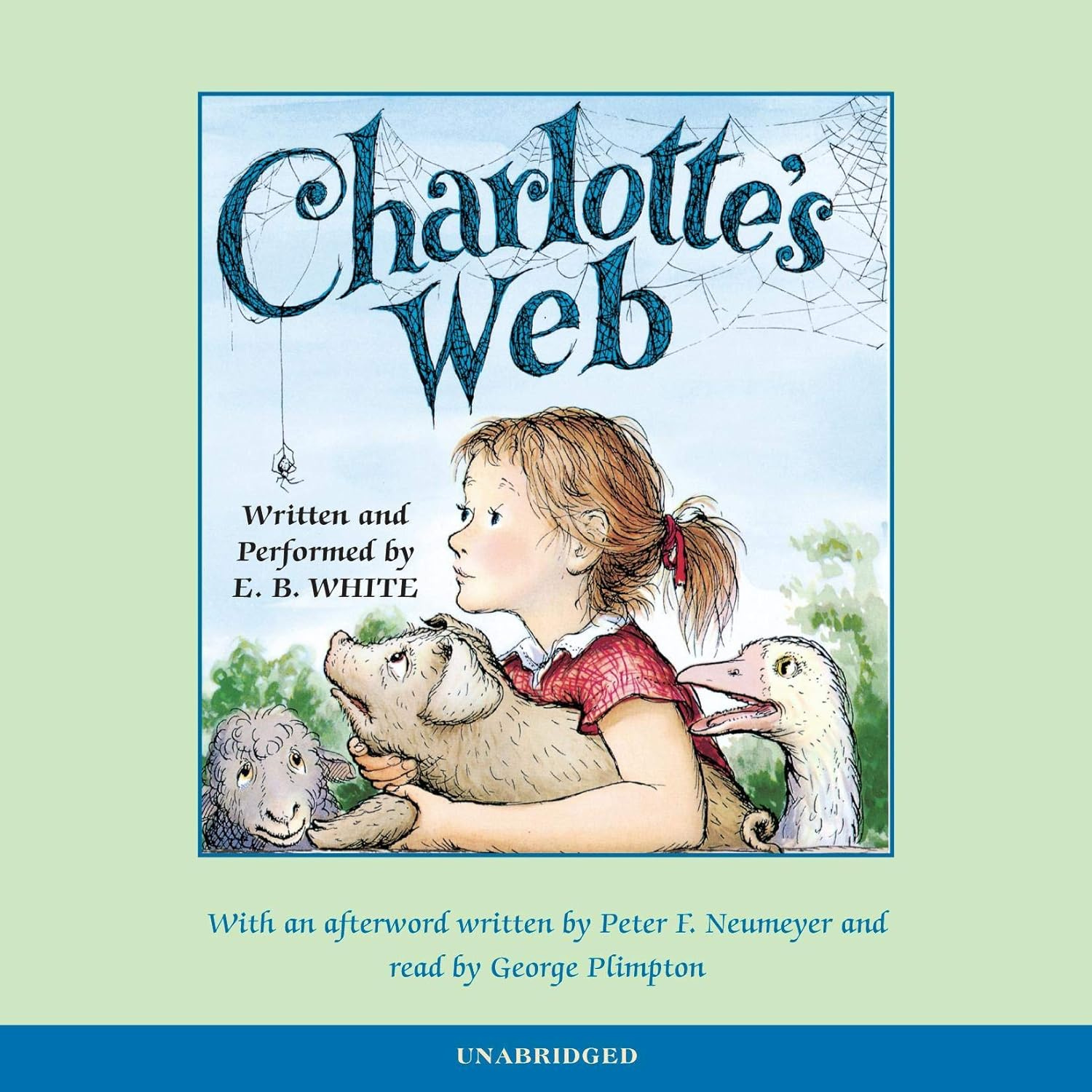
Chapter Summaries
Before Breakfast
A father walks toward the hog house with an axe. His eight-year-old daughter Fern demands to know why. The runt of the litter, he explains, must be killed—it’s too small, too weak, will never amount to anything. But Fern sees something her father has stopped seeing: the injustice of killing something just because it was born small. She wins the argument through moral clarity, not sentimentality. The pig gets a reprieve, a bottle, and a name: Wilbur. What White establishes in these opening pages is the book’s central preoccupation—not cuteness, but the stark reality that some lives are deemed expendable, and that love is the only force that can argue otherwise.
Wilbur
Fern and Wilbur become inseparable. She feeds him, walks him, tucks him into a doll carriage. He grows. The rhythm here is domestic, tender, but White never lets us forget what’s coming—Mr. Arable’s patience has limits, and pigs are farm animals, not pets. When Wilbur is five weeks old, he’s sold to Uncle Homer Zuckerman. Fern can visit, but she can’t keep him. The chapter ends with Wilbur moving from a home under an apple tree to a manure pile in a barn cellar. It’s a small death, the first of many separations the book will document. White understands that growing up means learning to let go, and he doesn’t soften it.
Escape
Wilbur is bored, lonely, and desperate for adventure. When a goose points out a loose board in his fence, he escapes—briefly. Freedom turns out to be terrifying. Everyone chases him. His friends shout contradictory advice. He’s dizzy, confused, crying. Then Mr. Zuckerman arrives with a bucket of slops, and Wilbur gives up. The comfort of captivity wins. White is doing something quietly devastating here: showing us that Wilbur isn’t built for freedom, that his world is small by necessity, and that what he’ll need to survive isn’t escape but connection. The chapter ends with Wilbur back in his pen, relieved, peaceful, sleepy—and admitting to himself that he’s too young to go out into the world alone.
Loneliness
Rain ruins Wilbur’s carefully planned day. He tries to make friends—the goose is sitting on eggs, the lamb is contemptuous, the rat is selfish. Nobody will play with him. He throws himself into the manure and sobs. Then, out of the darkness, a voice: “Do you want a friend, Wilbur? I’ll be a friend to you.” The voice promises he’ll see her in the morning. White withholds the reveal, lets the mystery sit overnight. What he’s establishing is that friendship, real friendship, doesn’t announce itself with fanfare. It arrives quietly, in the dark, when you need it most.
Charlotte
Wilbur meets Charlotte A. Cavatica, a large grey spider who lives in the doorway above his pen. She’s articulate, intelligent, and unapologetic about her diet of blood. Wilbur is horrified—she’s brutal, bloodthirsty, everything he doesn’t like. But she’s also his friend, and she’s patient with his revulsion. By the chapter’s end, Wilbur is “suffering the doubts and fears that often go with finding a new friend,” but White assures us he’ll discover he’s wrong about Charlotte. What makes this friendship radical is that it doesn’t require Charlotte to change. She’ll keep drinking blood. Wilbur will keep being squeamish. They’ll be friends anyway.
Summer Days
The rhythm of farm life: haying, bird songs, lazy afternoons. Fern sits on her stool and watches. The goose’s eggs hatch—seven goslings emerge. Templeton the rat takes the eighth egg, the dud, and stores it in his lair. White is building the world now, populating it with creatures who will each play their part in what’s coming. The chapter feels like breathing room, like the last peaceful moment before everything changes. And it ends with a detail that seems minor but isn’t: the rat has a rotten egg hidden away, a stink bomb waiting to go off.
Bad News
The old sheep tells Wilbur the truth: they’re fattening him up to kill him at Christmas. Wilbur screams. Fern nearly jumps up to save him. Then Charlotte speaks: “I am going to save you.” How? “That remains to be seen.” White refuses to resolve the tension. He lets Wilbur’s terror and Charlotte’s promise sit side by side, unreconciled. This is the chapter where the book stops being a pastoral and becomes something else—a story about death, and about what it means to promise the impossible.
A Talk at Home
Mrs. Arable is worried. Fern sits in the barn for hours, claims the animals talk to each other, repeats their conversations at home. Mrs. Arable takes her concern to Dr. Dorian, the family doctor. He’s magnificulous: “I’ve never heard one say anything, but that proves nothing.” He points out that a spider’s web is itself a miracle, that children pay better attention than adults, that Fern will grow up eventually and stop spending all her time in barns. White is threading a needle here—he needs Fern to be the bridge between animal world and human world, but he also needs the adults to be skeptical without being cruel. Dr. Dorian accomplishes this. He takes Fern seriously by refusing to dismiss what he doesn’t understand.
Wilbur’s Boast
Charlotte explains her web-spinning technique—seven sections to each leg, silk produced by spinnerets, the whole architecture of it. Wilbur, competitive and foolish, announces he can spin a web too. He can’t. He climbs the manure pile, jumps, crashes. Tries again with a string tied to his tail—crashes again. Charlotte gently explains: “You lack two things needed for spinning a web. You lack a set of spinnerets, and you lack know-how.” Then she pivots to philosophy. Humans are always rushing, always thinking there’s something better on the other side. “I’m glad I’m a sedentary spider.” Wilbur admits he’d rather be in a forest, searching for truffles, smelling, smelling, smelling. A lamb insults him—calls him smelly. Charlotte defends him: “He has a perfect right to smell, considering his surroundings.” The chapter ends with Wilbur watching Charlotte work, asking questions in the dark. It’s a study in acceptance—of limits, of differences, of the gulf between what we want and what we are.
An Explosion
Avery tries to capture Charlotte. He climbs into Wilbur’s pen, stick raised, ready to knock the spider into a candy box. Then he loses his balance, falls on Wilbur’s trough, and lands on Templeton’s rotten goose egg. The egg explodes. The smell is unbearable. Avery flees. Charlotte is saved—not by heroism or clever planning, but by a rat’s hoarding and a boy’s clumsiness. White keeps reminding us that salvation rarely looks noble. Sometimes it’s just a stink bomb going off at the right moment.
The Miracle
Charlotte works through the night, cutting away part of her web, weaving something new. In the morning, in the fog, Lurvy sees it: SOME PIG, woven in block letters across the web. He drops to his knees. Mr. Zuckerman is called. They stare. They tremble. Word spreads. The minister gives a sermon. Crowds arrive. Cars and trucks fill the driveway—Fords, Chevys, Buick Roadmasters, old Jeeps. Everyone comes to see the miraculous pig. White’s genius here is in showing us that the miracle isn’t the writing—it’s that people believe what they see in print more than they believe their own eyes. Charlotte is saving Wilbur not by changing him, but by changing how people see him. The trick works because humans are “very gullible.”
A Meeting
Charlotte calls a meeting. The animals assemble. She explains: people are getting bored with SOME PIG. She needs a new word. The gander suggests TERRIFIC. Charlotte agrees, but asks who knows how to spell it. The gander offers: “T-double-E-double-R-double-R-double-I-double-F-double-I-double-C.” Charlotte sighs—she’s not an acrobat. The old sheep suggests Templeton can help. The rat refuses until the sheep points out the obvious: Wilbur’s food is Templeton’s food. If Wilbur dies, the rat starves. Templeton agrees to bring a word from the dump. The chapter is White at his most efficient—advancing plot while deepening character. We see the whole ecosystem of the barn, everyone operating out of self-interest, everyone bound together by necessity.
Good Progress
Charlotte spins TERRIFIC into her web, narrating her own work like a coach encouraging an athlete: “Now for the R. Up we go. Attach. Descend. Pay out line. Ho for girl. Steady now.” Lurvy finds it in the morning. Another miracle. More crowds. More attention. Mr. Zuckerman orders extra feedings, clean straw, and starts building a crate—he’s taking Wilbur to the county fair. Meanwhile, Templeton searches the dump for words. He brings back CRUNCHY (no—makes Wilbur sound delicious), then PRE-SHRUNK (no—makes him sound deflated), then WITH NEW RADIANT ACTION from a soap ad. Charlotte tests Wilbur: run around, jump, do a back flip. She decides RADIANT will work. Wilbur protests—he’s not radiant. Charlotte replies: “You’re terrific as far as I’m concerned, and that’s what counts.”
Dr. Dorian
Fern tells her mother about Charlotte’s stories—about a cousin who caught a fish in her web, about another cousin who’s a balloonist, riding warm air currents on a silk thread. Mrs. Arable is alarmed. She returns to Dr. Dorian. Is it normal for a little girl to believe animals talk? He’s untroubled: “If Fern says that the animals in Zuckerman’s barn talk, I’m quite ready to believe her. Perhaps if people talked less, animals would talk more.” He predicts Fern will grow up, will stop spending all her time in barns, will eventually notice boys—specifically Henry Fussy. Mrs. Arable is relieved. White is working two plots simultaneously now—Fern growing up, Wilbur growing toward slaughter. Both involve loss. Both involve learning what can’t be kept.
The Crickets
Summer is ending. The crickets sing their sad, monotone song: “Summer is over and gone, over and gone.” Everyone hears it. Fern and Avery know school is starting. The young geese know they’ll never be goslings again. Charlotte knows she doesn’t have much time. Mrs. Zuckerman sighs in her kitchen. Lurvy digs potatoes. The sheep break through a fence, restless. A maple tree turns red with anxiety. Wilbur is now the center of attention—clean, radiant, beloved. Good food, regular hours. He’s gained weight. He’s a pig any man would be proud of. But Charlotte is working on something else now, something private. She can’t go to the fair, she tells Wilbur. It’s a bad time. She has to make an egg sac. Wilbur begs. She relents: “I’ll come if I possibly can.”
Off to the Fair
Everyone prepares. Fern wears her prettiest dress. Avery’s hair is slicked down. Mr. Arable polishes his truck. Mrs. Zuckerman gives Wilbur a buttermilk bath—he emerges pure white, pink around the ears, smooth as silk. Charlotte climbs into the crate unseen. Templeton, enticed by the old sheep’s descriptions of fair food—”popcorn fragments, frozen custard dribblings, candied apples abandoned by tired children”—hides in the straw. Wilbur is loaded. The geese cheer. They drive to the fairgrounds. Music, smells, crowds. Fern and Avery run off with pocket money. Wilbur is unloaded into his pen. Charlotte scrambles to the ceiling. In the next pen: Uncle, an enormous spring pig. Charlotte investigates, reports back: “He’s going to be a hard pig to beat.”
Uncle
Charlotte is tired. She admits she doesn’t have the energy she once had. Wilbur is worried. She begins building her web—her last web. Templeton returns from the midway with a newspaper clipping: HUMBLE. Charlotte weaves it into the web by dawn. Nobody notices in the darkness. That night, while Wilbur tries to sleep, Charlotte works in the back corner of the pen. “What are you doing up there?” Wilbur asks. “Making something,” she says. “Something for me, for a change.” In the morning, she’ll show him. But Wilbur falls asleep before she finishes the sentence. White is preparing us. Charlotte is dying, and she’s doing it quietly, without fanfare, the way most creatures die.
The Egg Sac
Morning. Wilbur looks up. Charlotte is in the corner, diminished, legs spread wide. Next to her: a peach-colored sac, beautiful, made of the toughest silk she has. Inside: 514 eggs. Wilbur is awed. Charlotte is exhausted, “languishing.” She admits she probably won’t see her children—they won’t hatch until spring, and she won’t live that long. Templeton appears, bloated from gorging at the fair, and delivers the bad news: Uncle has won a blue ribbon. Wilbur is crushed. Then the loudspeaker crackles: Mr. Zuckerman should bring his famous pig to the judges’ booth for a special award. Chaos. Joy. Avery throws straw in the air. But Charlotte stays hidden in her corner, holding her egg sac, feeling her heart beat weakly.
The Hour of Triumph
The crowd gathers. The loudspeaker booms praise: “This is some pig... terrific... radiant... humble.” Wilbur, overwhelmed, faints. Avery kneels beside him. Lurvy runs for water. Templeton, hidden in the straw, bites Wilbur’s tail—hard. Wilbur leaps up, screaming. The crowd cheers. The judge awards Mr. Zuckerman twenty-five dollars and a bronze medal. A photographer takes Wilbur’s picture. It’s the greatest moment in Mr. Zuckerman’s life. Lurvy, arriving late with water, accidentally drenches Mr. Zuckerman and Avery instead of the pig. Avery starts clowning, pretending to take a shower. The crowd loves it. Up in the shadows, Charlotte watches, unseen, holding her egg sac. Her heart beats weakly. But she’s satisfied. She’s saved Wilbur’s life. She feels peaceful.
Last Day
The fair is ending. Fern has gone off with Henry Fussy. Charlotte and Wilbur are alone. Wilbur is resting, medal around his neck. Charlotte is dying. She tells him: “I will not be going back to the barn.” Wilbur panics. She explains she’s too weak to climb down, too weak to spin a dragline to the ground. Wilbur sobs, throws himself on the ground. Charlotte tells him to stop making a scene. He begs to stay with her. She says no—he’ll be put in the crate, driven home, and that’s that. Then Wilbur has an idea: the egg sac. If Charlotte can’t come home, her children must. He calls for Templeton. The rat refuses until Wilbur makes a promise: from now on, Templeton eats first. The rat climbs up, gnaws through the threads, carries the egg sac down. Wilbur takes it in his mouth, holds it on his tongue. As he’s loaded into the crate, he looks up at Charlotte and winks. She waves one leg. She never moves again. Next day, as the fair is dismantled, as the crowds leave, Charlotte dies. Nobody notices. “No one was with her when she died.”
A Warm Wind
Winter comes. Wilbur grows large, sleek, beloved. He knows now that Mr. Zuckerman won’t kill him—he’s too famous, too valuable. He keeps Charlotte’s egg sac in a safe corner of his pen, guards it, warms it with his breath on cold nights. The seasons turn. Spring arrives. One morning, the first spider emerges—tiny, grey, with a black stripe, looking exactly like Charlotte. Then more. Dozens. Hundreds. They explore, then climb to the top of the fence and balloon away, one by one, riding the warm wind. Wilbur is devastated—he’s losing them all. But three stay. They introduce themselves: Joy, Aranea, Nellie. They build webs in the doorway. Wilbur gives them a speech: “I was devoted to your mother. I owe my very life to her. She was brilliant, beautiful, and loyal to the end.” Life continues. Fern grows up, stops visiting the barn, starts noticing boys. But Charlotte’s children and grandchildren, year after year, live in the doorway. Some balloon away. Two or three always stay. Wilbur lives a long life, surrounded by friends, but he never forgets Charlotte. “It is not often that someone comes along who is a true friend and a good writer. Charlotte was both.”
Bridge
What emerges from these chapters isn’t a story about a miraculous pig or a clever spider—it’s a story about what we owe each other when we love. Charlotte doesn’t save Wilbur because he’s special. She saves him because he’s her friend, and friendship, in White’s universe, is the only force that justifies existence. “After all, what’s a life, anyway?” she asks. “We’re born, we live a little while, we die. A spider’s life can’t help being something of a mess, with all this trapping and eating flies. By helping you, perhaps I was trying to lift up my life a trifle.”
The book you’re about to read more deeply is often taught to children as a gentle story about barnyard animals. It is not gentle. It is honest. White knew what he was doing when he let Charlotte die alone, when he let Templeton be selfish, when he showed us that most of Charlotte’s children abandon Wilbur without a second thought. He knew that children don’t need protection from death—they need to see that death can be met with dignity, that love doesn’t prevent loss, and that the work we do for each other is what makes a life meaningful.
This is a book about a pig who wants to live and a spider who knows she won’t. Everything that happens between them—the promises, the weaving, the final goodbye—happens in the shadow of that knowledge. And yet it’s not a sad book. It’s a book about how much you can do with the time you have, how much difference one life can make in another, how the small mercies we extend to each other—a web, a word, a friendship—are the only things that save us.
The Literary Review Essay
Where’s Papa going with that axe?
Fern Arable is eight years old, and she’s just asked the question that opens Charlotte’s Web, E.B. White’s 1952 children’s book about a pig, a spider, and the weight of a single life. Her father is walking to the hog house with an axe because a runt was born last night—too small, too weak, never going to amount to anything—and runts get killed. This is farm logic. This is how things work. But Fern sees it differently. She sees injustice. She runs after her father, sobbing, demanding to know why size determines who gets to live. If she’d been small at birth, would he have killed her too?
Mr. Arable pauses. He looks at his daughter. Something shifts. He lets her raise the pig on a bottle.
The pig’s name is Wilbur. Fern loves him completely, desperately, the way children love things—with no sense that love might not be enough. She feeds him, walks him, sleeps with him curled in a doll carriage. But Wilbur grows. At five weeks he’s sold to her uncle, moved from a home under an apple tree to a manure pile in a barn cellar. Fern can visit, but she can’t keep him. And in that barn, Wilbur discovers something worse than being sold: he discovers loneliness. He tries to make friends. The goose is busy with eggs. The lamb is contemptuous. Templeton the rat is selfish. Wilbur throws himself into the manure and sobs.
Then a voice speaks from the darkness: “Do you want a friend, Wilbur? I’ll be a friend to you.”
The voice belongs to Charlotte A. Cavatica, a large grey spider who lives in the doorway of the barn. She’s articulate, intelligent, and unapologetic about drinking the blood of flies. Wilbur is horrified—she’s everything he doesn’t like. But she’s also patient, and she’s his friend. And when the old sheep delivers the news that Wilbur is being fattened for Christmas slaughter, Charlotte makes a promise: “I am going to save you.”
How? She doesn’t know yet. But she’s working on it.
What Charlotte does—what makes Charlotte’s Web more than a barnyard fable—is this: she spins words into her web. SOME PIG. Then TERRIFIC. Then RADIANT. Then HUMBLE. The words appear in the fog, in block letters, woven with such precision that people can’t look away. Crowds gather. The minister preaches. Reporters arrive. Wilbur becomes famous—not because he changes, but because Charlotte changes how people see him. She tricks them into believing the pig is miraculous when really the miracle is her web, her devotion, the fact that she’s willing to spend her nights weaving salvation for a friend.
But Charlotte is dying. Spiders don’t live long, and she’s used up her energy spinning webs and laying eggs. At the county fair, where Wilbur wins a special prize, Charlotte makes one final effort—an egg sac containing 514 children. Then she tells Wilbur she can’t go home. She’s too weak. He’ll have to take the egg sac without her.
Wilbur panics. He refuses to leave. But Charlotte is firm: “You can’t stay here.” So Wilbur begs Templeton the rat to climb up and cut down the egg sac. Templeton complies, grudgingly, motivated not by friendship but by appetite—Wilbur promises to let him eat first from the trough from now on. Wilbur carries the egg sac home in his mouth. Charlotte waves one leg in goodbye. She never moves again.
She dies alone at the fairgrounds while the rides are being dismantled. “No one was with her when she died.”
Let’s talk about what White refuses to do here.
He refuses to save Charlotte. He refuses to make her death symbolic or distant or anything other than what it is: the end. She doesn’t get a grand farewell. She doesn’t deliver a final speech. She just stops moving. And when her children hatch in the spring, most of them balloon away on the warm wind, abandoning Wilbur without a thought. Only three stay—Joy, Aranea, Nellie—to build webs in the doorway and carry on some version of what their mother began.
White also refuses to make Wilbur heroic. Wilbur is vain, anxious, prone to fainting. He cries when he’s lonely. He brags that he can spin a web (he can’t). He eats slops and sleeps in manure and spends most of the book terrified of his own death. He’s not noble. He’s just alive, and he wants to stay that way, and there’s no shame in that wanting.
What White does instead is this: he makes friendship the mechanism of grace. Charlotte doesn’t save Wilbur because he deserves saving—there’s no moral calculus here, no earned redemption. She saves him because she likes him. “You have been my friend,” she tells him. “That in itself is a tremendous thing.” And when Wilbur asks why she did all this for him, when he insists he’s done nothing for her, she explains: “By helping you, perhaps I was trying to lift up my life a trifle. Heaven knows anyone’s life can stand a little of that.”
This is the book’s radical proposition: that love doesn’t require merit, that kindness is its own justification, that the work we do for each other—unearned, unreciprocated—is what gives a life meaning. Charlotte’s web isn’t a metaphor. It’s a literal thing she makes with her body, night after night, to keep a friend alive. And when she dies, the web remains for a while—torn, empty, a few strands catching the light—and then it’s gone. That’s all we get. That’s all we ever get.
The question I kept asking while reading Charlotte’s Web is this: why does it work? Why does a book about a pig and a spider, written for children, manage to say something true about death that most adult literature avoids?
Part of the answer is White’s ruthless clarity. He doesn’t hide the stakes. From the opening scene—Mr. Arable walking with an axe, Fern running after him—we know that survival is not guaranteed, that some lives are deemed expendable, that love is the only argument against efficiency. When the old sheep tells Wilbur he’s being fattened for slaughter (”They’re going to kill you. Turn you into smoked bacon and ham”), Fern grows rigid on her stool, but she doesn’t intervene. She’s a child. She has no power here. Charlotte has to act.
But White also understands something about how we talk to children about death. He doesn’t make it comforting. He doesn’t promise reunion or transformation or any kind of afterlife. Charlotte dies, and she’s gone. What remains is her work—the words in the web, the egg sac, the three daughters who stay to spin webs in the doorway. That’s the inheritance: not immortality, but continuation. Not Charlotte herself, but what she made possible.
The book’s final line is this: “It is not often that someone comes along who is a true friend and a good writer. Charlotte was both.”
Notice what White doesn’t say. He doesn’t say Wilbur was happy forever. He doesn’t say Charlotte’s death was peaceful or beautiful or part of some larger plan. He says she was a true friend and a good writer. That’s the testimony. That’s the sum of it.
There’s a subplot in Charlotte’s Web that’s easy to miss: Fern growing up. When the book opens, she spends every afternoon in the barn, sitting on a milking stool, watching animals, listening to their conversations. Her mother worries—it’s not normal for a little girl to be so interested in animals, to claim they talk. Mrs. Arable takes her concerns to Dr. Dorian, the family doctor, who offers this: “I’ve never heard one say anything, but that proves nothing. It is quite possible that an animal has spoken civilly to me, and that I didn’t catch the remark because I wasn’t paying attention. Children pay better attention than grown-ups.”
As the book progresses, Fern starts noticing Henry Fussy. She rides the Ferris wheel with him. She daydreams about it. By the end, she’s stopped visiting the barn regularly. “She was growing up, and was careful to avoid childish things, like sitting on a milkstool near a pig pen.”
White is showing us the same process from two angles: Wilbur losing Charlotte, Fern losing the barn. Both are about what we leave behind as we grow, what we stop being able to see. Fern doesn’t stop loving Wilbur—she just stops being able to hear him. The world closes in. Adulthood means losing access to certain kinds of attention, certain kinds of listening.
But White doesn’t moralize about this. He doesn’t say Fern should have stayed in the barn forever, refusing boys and Ferris wheels and growing up. He just notes it. This is what happens. You change. You lose things. You move on. And the barn continues without you, with new spiders hatching every spring, building webs in the same doorway, doing the same work.
The book’s central tension is between Wilbur’s terror and Charlotte’s calm. Wilbur is always panicking—about loneliness, about death, about being left behind. Charlotte is always thinking. When Wilbur asks how she’s going to save him, she says, “I don’t really know, but I’m working on a plan.” And she is. She hangs upside down at the top of her web, blood rushing to her head, figuring it out.
What she figures out is this: people are gullible. They believe what they see in print. So she’ll write something about Wilbur, something that makes him seem special, and Zuckerman won’t want to kill a famous pig. It’s not magic. It’s advertising. It’s understanding that perception creates value, that a pig called SOME PIG is worth more than a pig called nothing.
But here’s the thing: Charlotte is right about people, and she’s also lying. Wilbur isn’t some pig. He’s not terrific. He’s not radiant. He’s humble, maybe, in the sense that he’s ordinary, close to the ground, unexceptional. What Charlotte does is make the lie true by making people believe it. And once they believe it, Wilbur becomes valuable. He becomes worth saving.
This is the trick at the heart of the book: love is a kind of con. You convince someone that this particular life matters—not because it’s objectively more valuable than any other life, but because you’ve decided it matters to you. And if you’re persuasive enough, if you spin your web carefully enough, you can convince other people too. You can create a world in which one pig’s life is worth more than bacon and ham.
Charlotte knows this. She knows she’s manufacturing a miracle. But she also knows that all value is manufactured, that every life is worth saving if someone loves it enough to argue. So she spends her nights weaving words into silk, turning affection into architecture, making the case that Wilbur deserves to live.
And it works. Until it doesn’t. Until Charlotte dies and Wilbur survives and the question becomes: what do we owe the dead? What do we owe the ones who saved us?
White worked on Charlotte’s Web for years. He’d start, put it aside, come back to it. In early drafts he couldn’t decide where to begin—with the spider, with the pig, with the barn itself. He tried starting with Charlotte: “Charlotte was a big grey spider who lived in a beautiful web doorway.” Then with Wilbur: “He was what farmers call a spring pig.” Then with the barn: “A barn can have a horse in it, and a barn can have a cow in it... but if a barn hasn’t got a pig in it, it is hardly worth talking about.”
What he finally landed on was the axe. “Where’s Papa going with that axe?” It’s a question about violence, about who gets to decide which lives are expendable. And it’s the question that drives the entire book.
White also struggled with Charlotte’s words. He kept lists: “worthmore,” “high grade,” “delicious,” “nutritious,” “crunchy.” He needed words that would convince people Wilbur was special without making them think about eating him. “Crunchy” was out for obvious reasons—too close to “crispy bacon.” “Pre-shrunk” didn’t work either—made Wilbur sound deflated. What he settled on—SOME PIG, TERRIFIC, RADIANT, HUMBLE—are words that create awe without appetite. They make Wilbur seem miraculous, not delicious.
And then there’s the ending. White originally titled the penultimate chapter “The Death of Charlotte.” His editor, Ursula Nordstrom, suggested he change it. The point, she said, wasn’t Charlotte’s death—it was the new life bursting from her egg sac, the baby spiders setting forth on the warm wind. White took the advice. He retitled the chapter “Last Day” and gave the final chapter the title “A Warm Wind.”
But he didn’t soften the death itself. Charlotte dies offstage, alone, at a deserted fairground. Nobody notices. Nobody mourns. The book doesn’t linger. It moves on, the way life moves on, to spring and baby spiders and Wilbur growing old and fat and beloved. Charlotte is gone. Her children remain. That’s the inheritance.
Here’s what I think Charlotte’s Web understands: death doesn’t have to be meaningful to be bearable. Charlotte doesn’t die for a reason. She doesn’t sacrifice herself. She just dies, the way spiders die, at the end of their natural span. What makes her death bearable—for Wilbur, for us—is that she lived well. She made a web. She wrote words. She saved a friend. She laid eggs. She did the work she came to do.
And Wilbur? Wilbur gets to live because someone loved him. Not because he was special, not because he earned it, but because Charlotte decided his life was worth saving. That’s grace. That’s the only grace the book offers.
Near the end, Charlotte tells Wilbur: “You have been my friend. That in itself is a tremendous thing.” She means it. Friendship is tremendous. It’s the whole point. Not because it prevents death—it doesn’t—but because it makes life, while we have it, less lonely. Less terrifying. Less unbearable.
White knew this. He’d spent his life raising animals on his farm in Maine—pigs, sheep, chickens, geese. He’d watched them live and watched them die. In 1948, two years before he started Charlotte’s Web, he published an essay called “Death of a Pig” in The Atlantic Monthly. It’s about nursing a sick pig for several days, sitting up with it at night, trying to save it, failing. The pig dies. White buries it. The essay ends like this: “I have written this account in penitence and in grief, as a man who failed to raise his pig, and to explain my deviation from the classic course of so many raised pigs. The grave in the woods is unmarked, but Fred can direct the mourner to it unerringly and with immense good will, and I know he and I shall often revisit it, singly and together, in seasons of reflection and despair, on flagless memorial days of our own choosing.”
That’s the same voice—clear, unsentimental, honest—that runs through Charlotte’s Web. White doesn’t lie about death. He doesn’t make it easier than it is. He just shows us that the work we do for each other—the webs we spin, the words we write, the promises we keep—matter because they make the time we have less lonely.
Charlotte’s children hatch in spring. Most of them balloon away. Three stay. They build webs in the doorway. They’re not Charlotte, and Wilbur knows it. But they’re her daughters, and they’re his friends, and that’s enough. Life continues. Fern grows up. Wilbur grows old. The barn endures. The work goes on.
That’s the book. That’s the testimony. Not that love conquers death—it doesn’t—but that love makes the argument, night after night, that this life, this particular life, is worth the effort of saving. And sometimes, if you’re lucky, if you spin your web carefully enough, the argument works.
Charlotte was a true friend and a good writer. That’s what Wilbur remembers. That’s what we remember. Not that she lived forever, but that she lived well. That she used her gifts—her spinnerets, her patience, her way with words—to save someone she loved.
It’s not a small thing. It’s everything.
The fact that White's first instinct was to title it 'The Death of Charlotte' says everything about his honesty as a writer. His editor nudged him toward hope, and the book is richer for it, but you can feel White resisting comfort the whole way through. That last line about her being a true friend and a good writer is the only eulogy that matters because it doesn't reach for more than what was real.