

A Note on What You’re Reading
What follows is not the review.
That matters. A reader encountering these pages without warning might mistake them for a finished argument — might read the chapter-by-chapter dissections, the bridge sections, the final meditation on Strange Loops and the inviolate level, and conclude that this is the essay. It is not. It is the engine that will power the essay. It is the work that happens before the work, the receipts run before the verdict is rendered.
Let me explain what these notes actually are.
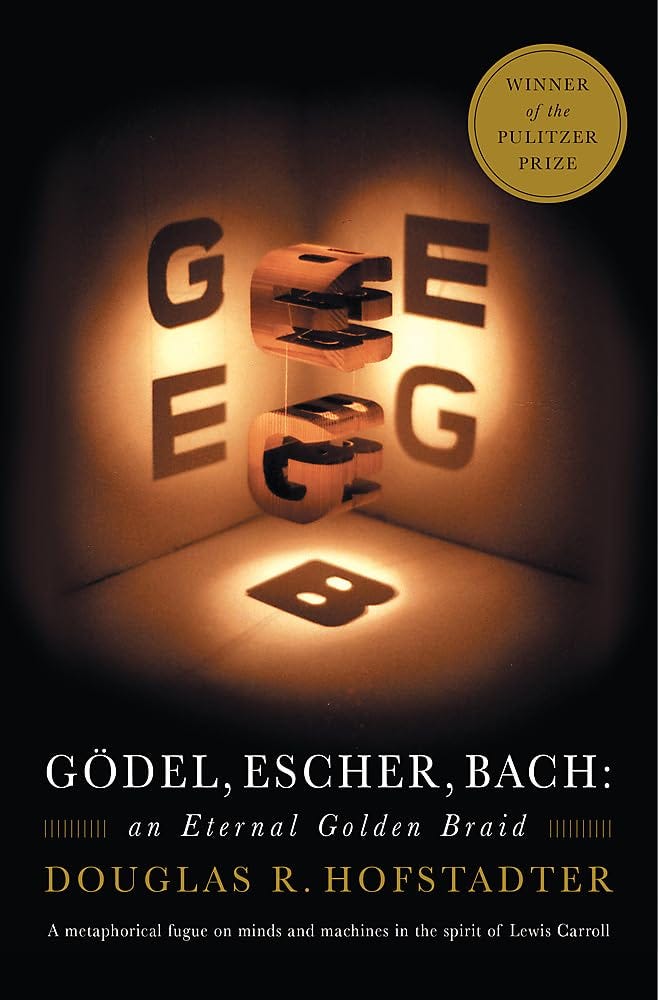
Gödel, Escher, Bach: An Eternal Golden Braid is 777 pages long. Douglas Hofstadter published it in 1979, won the Pulitzer Prize for it in 1980, and spent the following two decades watching readers miss the point. His 1999 Preface to the twentieth-anniversary edition opens with barely concealed frustration: the book is not about math, art, and music. It is about consciousness. It is about how animate beings emerge from inanimate matter. It is about Strange Loops. He said this clearly in 1979. He is still saying it in 1999. The misreadings persist.
This tells you something important about the book — and about why notes like these are necessary before writing about it.
GEB is a seduction. That is not a criticism. It is a structural description. The book works by distributing its argumentative burden across 700 pages of formal systems, visual art analysis, musical counterpoint, Zen koans, dialogues between a tortoise and Achilles, and a formal system Hofstadter invents from scratch called Typogenetics. No single chapter carries too much weight. The analogies accumulate. The parallels multiply. By the time Hofstadter makes his central claim — that consciousness emerges from Strange Loops in sufficiently complex symbol-processing systems — the reader has been so thoroughly prepared, so richly surrounded by structural evidence, that the claim feels proven.
It is not proven. It is argued by analogy, beautifully and at length.
These notes exist to track that distinction — between what the book demonstrates and what it asserts, between where Hofstadter proves and where he analogizes and then proceeds as though the analogy had done the work of the proof. Each chapter summary here contains three elements: what the chapter claims, what evidence it marshals, and where the logical gaps live. The bridge sections — the “More Random Notes” that interrupt the chapter summaries — synthesize the accumulated debt, the unproven claims carrying forward from chapter to chapter, gathering weight through repetition rather than through demonstration.
This is not hostile criticism. Hofstadter is almost always honest about when he is speculating. The words “suggests,” “reminds us of,” “metaphorical and not intended to be taken literally” appear throughout the final chapters. The intellectual honesty is genuine. But honesty about speculation does not prevent the speculation from being treated, in the chapters that follow, as established ground. The book knows its limits. It does not always observe them.
What the notes also track — because it would be dishonest not to — is what the book genuinely achieves. The formal exposition of Gödel’s Incompleteness Theorem is correct, clear, and pedagogically remarkable. The Bongard problem framework for analyzing pattern recognition is a real analytical contribution, specific enough to be falsifiable. The Central Dogmap — the structural parallel between DNA replication and Gödel numbering — is not merely decorative; it identifies a genuine isomorphism between domains that had no obvious connection. And the book’s deepest achievement is formal rather than argumentative: GEB demonstrates its central thesis by being a demonstration of its central thesis. A book about self-referential systems that is itself self-referential. A Strange Loop about Strange Loops.
That is worth taking seriously. That is worth the 777 pages.
The essay that follows these notes will make an argument about all of this — about what Hofstadter built, what he proved, what he believed he proved, and why the gap between those two things is not a failure but a condition. The condition of any sufficiently ambitious system. The condition Gödel named.
These notes are the map. The essay is the territory.
Or perhaps it is the other way around. Hofstadter would say so.
Tags: Gödel Escher Bach preface, analytical reading notes methodology, Strange Loops consciousness argument, literary essay scaffolding, Hofstadter intellectual honesty
PREFACE TO THE TWENTIETH-ANNIVERSARY EDITION
Core Claim: GEB is not about math, art, and music per se, but about how animate beings emerge from inanimate matter — specifically, how “strange loops” (self-referential hierarchical systems) give rise to selves and consciousness.
Supporting Evidence:
Hofstadter recounts his own intellectual biography to establish that the thesis emerged organically from encounters with Gödel, Escher, and Bach as a teenager
The analogy: meaningless symbols → self-aware systems mirrors inanimate matter → conscious beings
Gödel’s incompleteness proof is cited as the first formal instantiation of a strange loop
Logical Method: Retrospective clarification — Hofstadter corrects two decades of misreadings by restating the central thesis directly: “GEB is a very personal attempt to say how it is that animate beings can come out of inanimate matter.”
Logical Gaps:
The claim that “meaning cannot be kept out of formal systems when sufficiently complex isomorphisms arise” is asserted rather than proved. This is the thesis’s most ambitious move, and the Preface acknowledges it is taken up repeatedly in the text — but its treatment remains illustrative rather than deductive throughout the book.
Hofstadter concedes that “small-souled” formal systems (like Principia Mathematica) have only skeletal selves — but the mechanism by which richer self-reference becomes genuine consciousness is never precisely specified. The analogy between Gödel-numbering and brain-self-modeling is suggestive, not demonstrative.
The admission that subsequent consciousness researchers “almost never mention” the strange-loop thesis despite reading GEB is noted without resolution.
Methodological Soundness: The Preface functions as a thesis statement correcting misreadings. It is honest about what the book argues and what it does not prove. The personal memoir framing appropriately signals that this is a philosophical argument by analogy rather than formal proof.
INTRODUCTION: A MUSICO-LOGICAL OFFERING
Core Claim: Bach’s Musical Offering, Escher’s impossible figures, and Gödel’s Incompleteness Theorem are three shadows of one central object: strange loops, which arise whenever a hierarchical system loops back on itself.
Supporting Evidence:
Bach’s “Endlessly Rising Canon” (Canon per Tonos): modulates through six keys and returns to the starting key an octave higher — a finite representation of an infinite process
Escher’s Waterfall and Ascending and Descending: physically impossible loops where descending is ascending
Gödel’s Theorem: a statement of number theory that says of itself “I am not provable inside PM” — a mathematical Epimenides paradox
Logical Method: Structural analogy across three domains. The Introduction does not prove that these three phenomena share a common logical structure; it demonstrates family resemblance and asserts common origin.
Logical Gaps:
The Introduction conflates two senses of “strange loop”: (a) a visual or auditory paradox (Escher, Bach’s canon) and (b) a formal logical self-referential construction (Gödel). These are related but not identical. The visual loops are phenomenological; the Gödelian loop is syntactic. The conflation is productive but not rigorous.
The history of mathematical logic is condensed to the point of inaccuracy in places. Hilbert’s Program is presented as simply “demolished” by Gödel, which is a strong reading.
Bloom’s 2-sigma problem is not yet introduced (that’s AutoTutor) — but the analogous move here is presenting an aspirational target (explaining consciousness) without establishing that strange loops are sufficient.
Methodological Soundness: This section is explicitly framing and motivating. It works as intellectual seduction — establishing that three disparate domains share structure worth investigating. It should not be read as proof.
CHAPTER I: THE MU-PUZZLE
Core Claim: Formal systems consist of meaningless symbols manipulated by mechanical rules; the key distinction is between working within a system (M-mode) and reasoning about a system (I-mode). Decision procedures — tests that terminate in finite time — are crucial for assessing systems.
Supporting Evidence:
The MIU-system is constructed with four explicit rules. The reader is invited to try to derive MU from MI.
The proof that U cannot be produced (first letter must be M) is a simple demonstration of outside-system reasoning applied to constrain inside-system possibilities.
The impossibility of deriving MU can be shown by parity argument (I-count modulo 3 is invariant), though this is deferred.
Logical Method: Worked example + proof sketch. The chapter teaches by doing.
Logical Gaps:
The chapter defers the actual proof that MU cannot be derived. This is pedagogically defensible but leaves the central claimed result unestablished at first presentation.
The claim that “it is impossible for a human to act unobservant” is stated without qualification. This is demonstrably too strong — humans routinely fail to notice obvious patterns.
Methodological Soundness: Strong as pedagogy. The conceptual framework (formal system, theorem, axiom, derivation, decision procedure) is established with precision that the rest of the book depends on.
CHAPTER II: MEANING AND FORM IN MATHEMATICS
Core Claim: Meaning in formal systems arises when an isomorphism exists between symbol-patterns and the real world. This isomorphism is discovered, not imposed; it makes meaning passive (cannot extend the formal system) rather than active (as in natural language).
Supporting Evidence:
The pq-system: theorems of the form xpyqz, where the isomorphism “p means plus, q means equals, – means 1” makes every theorem a true addition
Multiple valid interpretations exist for the same formal system (p = equals, q = taken from, yields subtraction) — demonstrating that symbols have meanings in context, not intrinsically
The modified pq-system (with Axiom Schema II added) appears inconsistent under the original interpretation but becomes consistent under a new interpretation
Logical Method: Constructive demonstration of isomorphism, followed by analysis of what isomorphism does and does not establish.
Logical Gaps:
The passive/active distinction between formal-system meaning and natural-language meaning is crucial for the book’s argument but is asserted rather than argued. The claim that “we then make new statements based on the meaning of the word” (active meaning) vs. theorems being “predefined by the rules” (passive meaning) obscures that natural language also has grammar constraints, and that formal systems can be extended.
The double-interpretation result (pq as addition or subtraction) is presented as somewhat trivial — but it prefigures the deep problem of Gödel’s proof, where a single string has two levels of meaning simultaneously. The significance is understated here.
Methodological Soundness: The chapter builds its logical scaffold correctly. The isomorphism framework is the book’s most important technical concept, and it is established here with appropriate care.
CHAPTER III: FIGURE AND GROUND
Core Claim: There exist formal systems whose negative space (set of non-theorems) cannot be characterized as the positive space of any formal system. Equivalently: not all recursively enumerable sets are recursive. This means decision procedures do not exist for all formal systems.
Supporting Evidence:
The C-system and tq-system: composite numbers can be generated positively; primes can only be characterized negatively (as the complement of composites)
The prime-generating system (using the divisor-free approach) shows that primes can be represented positively — but by exploiting monotonicity (no backtracking) rather than negation
Escher’s recursive figure/ground drawings (birds, the FIGURE-FIGURE figure by Scott Kim) illustrate that not all figures have grounds that are also figures
Logical Method: The formal result (∃ r.e. sets that are not recursive) is stated but not proved; the chapter provides conceptual scaffolding and motivating examples.
Logical Gaps:
The claim “There exist recursively enumerable sets which are not recursive” is one of the most significant claims in the book and is here accepted on faith, explicitly: “This result, it turns out, is of depth equal to Gödel’s Theorem — so it is not surprising that my intuition was upset.” This is appropriate acknowledgment but means the logical spine of the chapter rests on an unproved assertion.
The analogy between artistic figure/ground and formal r.e./recursive sets is illuminating but imprecise. In art, “recognizability” is subjective; in mathematics, it is formally defined.
Methodological Soundness: Chapter functions as conceptual preparation for the deeper result. The honest acknowledgment that the key claim is taken on faith is methodologically appropriate.
CHAPTER IV: CONSISTENCY, COMPLETENESS, AND GEOMETRY
Core Claim: Consistency and completeness are not intrinsic properties of formal systems but depend on interpretations chosen for their symbols. Non-Euclidean geometry demonstrates that the same formal skeleton can have multiple valid interpretations, undermining the assumption that geometric axioms describe a unique reality.
Supporting Evidence:
Saccheri, Lambert, Bolyai, Lobachevsky: centuries of failed attempts to prove the parallel postulate, ultimately succeeded by accepting that denial of the postulate yields a valid (non-Euclidean) geometry
The modified pq-system: adding Axiom Schema II creates apparent inconsistency under the original interpretation; re-interpreting q restores consistency — showing inconsistency is interpretation-dependent
Consistency: all theorems come out true under some interpretation. Completeness: all truths expressible in the system are theorems. These are defined precisely and shown to be distinct.
Logical Method: Historical case study (geometry) + formal analysis of the pq-system.
Logical Gaps:
The claim “Is number theory the same in all conceivable worlds?” receives an answer that is historically contingent: “it is now well established — as a consequence of Gödel’s Theorem — that number theory is a bifurcated theory, with standard and nonstandard versions.” This is presented as established fact but is not demonstrated here.
The treatment of “imaginable worlds” as the domain for internal consistency is philosophically informal. The slide from logical consistency to mathematical consistency is made quickly.
Methodological Soundness: The chapter successfully establishes that both consistency and completeness require interpretation, and that the same formal system can be consistent under one interpretation and not another. This is critical for understanding Gödel’s result.
CHAPTER V: RECURSIVE STRUCTURES AND PROCESSES
Core Claim: Recursion — processes defined partly in terms of themselves — appears at every level of nature, from language grammar to quantum field theory. The key distinction is between bounded recursion (always bottoms out) and free loops (potentially infinite). RTNs (Recursive Transition Networks) model recursive processes.
Supporting Evidence:
Fibonacci sequence: recursive definition that bottoms out at F(1) = F(2) = 1
Diagram G: a tree generated by G(n) = n − G(G(n−1)); the right-hand edge is the Fibonacci sequence
Gplot: a recursive graph from solid-state physics showing electron energy bands in a magnetic field — “a picture of God” in one agnostic’s description
Feynman diagrams: renormalized particles involve infinite nesting of virtual particle clouds
Language RTNs: FANCY NOUN calls itself recursively; indirect recursion between CLAUSE and FANCY NOUN
Logical Method: Illustrative catalog of recursion across domains. The chapter is not building a single argument but demonstrating universality of the concept.
Logical Gaps:
The Q-sequence example (Q(n) = Q(n − Q(n−1)) + Q(n − Q(n−2))) is introduced as producing “chaos” without proof that the chaos is genuine or irreducible. This is left as an open problem.
The analogy between linguistic RTN recursion and Gödelian self-reference is suggested but not developed. This connection will matter later.
Hofstadter’s Law (”It always takes longer than you expect, even when you take into account Hofstadter’s Law”) is a joke — but also a genuine example of a self-referential structure. Its placement here is not accidental.
Methodological Soundness: Chapter functions as a conceptual repository rather than a developing argument. The range of examples is the point.
CHAPTER VI: THE LOCATION OF MEANING
Core Claim: Meaning is located in messages to the extent that it acts upon intelligence in a predictable way. This is an anti-”jukebox” thesis: some messages have enough inner logic that their meaning could be recognized by any sufficiently powerful intelligence, independent of cultural context.
Supporting Evidence:
Three levels of any message: frame message (I am a message), outer message (how to decode me), inner message (the content)
DNA as genotype/phenotype: the phenotype cannot be extracted from genotype without chemical context — but a long enough genotype could trigger the right decoding mechanism in a sufficiently powerful intelligence
The Fibonacci plaque thought experiment: sending (1,3) without context is a trigger; sending nine rows of dots provides enough outer message for the recursive rule to be inferred
Bach vs. Cage: Bach has compelling inner logic that could survive extraction from cultural context; Cage’s aleatoric music requires cultural context to be meaningful
Logical Method: Thought experiments + analogical argument.
Logical Gaps:
The claim that intelligence is a “universal phenomenon” that arises in “diverse contexts” is foundational to the argument that meaning can be intrinsic — but it is asserted, not argued. The entire section on “Earth Chauvinism” acknowledges this circularity without resolving it.
The Bach vs. Cage comparison assumes that Bach’s patterns are “universally appealing” to intelligence, but Hofstadter himself concedes “we do not know enough about the nature of intelligence, emotions, or music to say whether the inner logic of a piece by Bach is so universally compelling.” This is an honest acknowledgment that the key positive claim is speculative.
The three-level framework (frame/outer/inner) is useful but underspecified. The outer message being “necessarily a set of triggers rather than a message which can be revealed by a known decoder” is claimed but not proved to be necessarily so.
Methodological Soundness: The chapter is philosophically sophisticated but its central positive claim (some messages have intrinsic meaning) depends on the unproved assumption that intelligence is a universal natural phenomenon of a specific type.
DIALOGUES: LOGICAL FUNCTION
The dialogues function as pre-formal demonstrations of concepts that the subsequent chapters formalize. Their logical role is to create concrete phenomenological experience of the idea before abstract treatment.
Three-Part Invention: Introduces Achilles and Tortoise; demonstrates Zeno’s paradox as the first “strange loop” (infinite regress in a finite process)
Two-Part Invention (Lewis Carroll): Self-reference in reasoning — you can never finish justifying an inference using only more inferences; rules require rules require rules. This is the logical cousin of Gödel’s construction.
Sonata for Unaccompanied Achilles: Figure/ground in conversation; Achilles’ lines imply the Tortoise’s absent lines
Contracrostipunctus: The central dialogue. Explicitly maps the record-player paradox onto Gödel’s Theorem. The Tortoise’s own trap-method backfires (level-two strange loop). The Bach goblet, destroyed by its own melody, enacts the Gödelian self-reference.
Little Harmonic Labyrinth: Nested stories enact push/pop stack operations. Bach’s “wrong key” ending is a formal example of a system that appears to resolve but doesn’t — prefiguring incompleteness.
Canon by Intervallic Augmentation: The single record plays different songs depending on the record player — different interpretations of one formal structure. BACH transforms to CAGE by intervallic multiplication.
Methodological Note on Dialogues: The dialogues are not logical arguments. They are phenomenological scaffolding — they create the felt experience of a concept (self-reference, strange loops, multiple levels of meaning) before the concept is formalized. This is a legitimate pedagogical strategy, but readers who expect the dialogues to carry argumentative weight will be confused.
BRIDGE: SOME RANDOM NOTES
The book’s argumentative spine has three interlocking claims:
Structural Claim: Gödel’s incompleteness, Escher’s impossible figures, and Bach’s strange-loop canons all instantiate the same formal phenomenon: hierarchical systems that fold back on themselves, generating self-reference.
Ontological Claim: Consciousness and selfhood are instances of this same phenomenon — strange loops arising in sufficiently complex symbol-processing systems (brains, or possibly formal systems).
Epistemological Claim: Meaning is not purely contextual (the anti-jukebox thesis) — some messages have enough inner logic that their meaning is intrinsic, recognizable by any sufficiently powerful intelligence.
The strength of each claim varies radically:
The structural claim is well-supported. The formal parallels between the Epimenides paradox, Russell’s paradox, Gödel’s construction, and Escher’s visual loops are real and precisely characterized. This is the book’s most rigorous contribution.
The ontological claim is the book’s central thesis and its most speculative. The move from “Gödel’s proof involves self-reference” to “consciousness involves self-reference” to “Gödel’s proof therefore illuminates consciousness” is an analogy, not a deduction. The Preface is honest about this: Hofstadter calls it “a long proposal of strange loops as a metaphor.” The word “metaphor” is doing significant work here. As of the 1999 edition, Hofstadter notes with evident frustration that consciousness researchers have not adopted his framework. This may indicate the analogy is illuminating but not mechanistically predictive.
The epistemological claim is the least developed. The argument that some meanings are intrinsic — because intelligence is a universal natural phenomenon that processes certain messages predictably — is circular (we define “intelligence” partly as “gets the same meaning out of messages as we do”) and empirically unverifiable.
Three tensions run through the entire work:
Tension 1: Formal rigor vs. analogical reasoning. The book shifts constantly between rigorous formal systems exposition (MIU-system, pq-system, TNT, Gödel’s proof) and large analogical claims about consciousness and meaning. The formal sections can bear scrutiny; the analogical sections cannot without additional argument.
Tension 2: The strange loop as explanation vs. description. Hofstadter claims strange loops generate consciousness, but he also says that not all strange loops do (Principia Mathematica has a Gödelian strange loop but is not conscious). The distinguishing condition — sufficient complexity and richness of self-reference — is never precisely specified. “More self-referentially rich” loops generate “more consciousness” is proposed, but the relevant metric for richness is unspecified.
Tension 3: Anti-reductionism within a reductionist framework. The book is simultaneously committed to the view that “the key is not the stuff out of which brains are made, but the patterns” (strongly anti-substrate-reductionist) and to the view that these patterns are instantiated in physical systems governed by physical law. The relationship between pattern-level explanation and physical-level explanation is never resolved.
The book’s most proven claims:
Gödel’s proof involves self-reference and yields genuine incompleteness for sufficiently powerful formal systems (taken on faith but accurately characterized)
Recursive definitions, when they bottom out, are not circular
Multiple interpretations of the same formal system are possible; meaning is interpretation-dependent
Not all recursively enumerable sets are recursive (stated; not proved)
The book’s most significant unproven claims:
Consciousness is a strange loop
Strange loops are sufficient (with sufficient complexity) for consciousness
Some messages have intrinsic meaning independent of cultural context
The book’s most significant acknowledged gaps:
What distinguishes a consciousness-generating strange loop from a non-consciousness-generating one
Whether the brain’s self-modeling actually resembles Gödelian self-reference in any mechanistic sense
Why subsequent consciousness researchers have not found the strange-loop framework useful
CHAPTER VII: THE PROPOSITIONAL CALCULUS
Core Claim: Logical connectives (’and’, ‘or’, ‘not’, ‘if-then’) can be captured in a formal system whose rules are explicitly typographical, producing only universally true statements while bypassing all questions of meaning.
Supporting Evidence:
The Propositional Calculus is defined with eight rules (Joining, Separation, Double-Tilde, Fantasy, Carry-Over, Detachment, Contrapositive, De Morgan, Switcheroo) and no axioms — theorems are generated entirely by the Fantasy Rule
A full derivation of Q from the Ganto’s Ax premise (P→Q ∧ ¬P→Q) is worked out in 24 steps
The consistency question is debated between “Prudence” and “Imprudence” — neither definitively wins
Logical Method: Formal system construction + Socratic dialogue on limits of proof.
Logical Gaps:
The chapter’s most important logical result — that from a contradiction anything follows (ex contradictione quodlibet) — is demonstrated and immediately described as “not like human thought.” The honest acknowledgment that the formal system mismodels how we actually handle contradictions (we isolate and revise, not propagate) is not resolved. The proposed remedy (”relevant implication”) is mentioned but not implemented. This gap between formal contradiction-handling and cognitive contradiction-handling will matter for the book’s later claims about formalizing thought.
The Fantasy Rule’s recursive structure (fantasies within fantasies) is introduced as analogous to nested stories and push-down stacks — but the analogy is not yet connected to Gödel’s construction, where a system can “imagine” strings about itself. The connection is being set up, but not stated.
The system has a decision procedure (truth tables), which is mentioned but not demonstrated. This contrasts usefully with TNT, which does not. The contrast is not drawn explicitly here.
Methodological Soundness: The Propositional Calculus is correctly and completely specified. The chapter’s philosophical discussion of consistency (Prudence vs. Imprudence) is honest about the circularity of proving a reasoning system correct using that same reasoning system — this connects directly to Carroll’s Two-Part Invention and will connect to Gödel’s Second Incompleteness Theorem.
CHROMATIC FANTASY, AND FEUD (Dialogue)
Logical Function: The Tortoise refuses to accept that two separately uttered sentences constitute a contradiction, then accepts the compound sentence only if the word “and” behaves correctly — but demands to know why “and” should behave that way. Achilles cannot defend the rule without using rules to defend rules (regress).
What this establishes: The gap between formal ‘∧’ (which obeys explicit rules) and natural-language “and” (which our minds use without explicit rules) is the core problem Chapter VII addresses formally. The dialogue also demonstrates that the Tortoise’s behavior is entirely consistent with a formal system in which “and” is not the standard conjunction — he has simply chosen a different interpretation. This is exactly the lesson of the modified pq-system: apparent inconsistency disappears under reinterpretation.
CHAPTER VIII: TYPOGRAPHICAL NUMBER THEORY
Core Claim: Number theory can be completely formalized in a single system (TNT) with five axioms and a finite set of rules. This system is of sufficient power that all known number-theoretical reasoning can be conducted within it — and, as a consequence of Gödel’s construction (foreshadowed here), statements about formal systems can be expressed as statements of number theory via Gödel-numbering.
Supporting Evidence:
Complete vocabulary of TNT is specified: numerals (0, S0, SS0...), variables (a, b, c...), terms, atoms (s=t), formulas, quantifiers (∀, ∃), propositional connectives imported from Chapter VII
Six sample number-theoretical sentences (primeness, squareness, FLT, Goldbach-type, infinitude of primes, evenness) are translated into TNT notation — demonstrating expressiveness
Five Peano axioms are presented and incorporated
Rules of specification, generalization, interchange, existence, equality, and successorship are fully stated
A 56-line derivation of commutativity of addition is worked through in full
The MIU-system is Gödel-numbered, and the equivalence between typographical rules and arithmetical operations is demonstrated via the Central Proposition
TNT is Gödel-numbered using a codon system; the derivation is shown in both notations
The concept of TNT-numbers (producible numbers in arithmetized TNT) is introduced, along with the predicate “a is a TNT-number” as a TNT-expressible property
Logical Method: Constructive formalization + worked examples + Gödel-numbering demonstration.
Logical Gaps:
The chapter defers the full Gödel construction to Chapters XIII and XIV. At this stage, the reader has been shown that TNT can express statements about the MIU-system (MUMON) and about itself (strings of the form “x is a TNT-number”), but has not yet seen the self-referential string G constructed. The incompleteness result is foreshadowed but not established.
The notion of ω-incompleteness and ω-inconsistency is introduced carefully and correctly: a pyramidal family of theorems can all be derivable while the universally quantified summary is not. This is pedagogically important but its full significance — that even extensions of TNT via new axioms will face similar problems, infinitely — is not developed here.
The “non-Euclidean TNT” discussion (adding ¬∀a:(0+a)=a as a sixth axiom) correctly establishes that TNT underdetermines its models, allowing “supernatural numbers.” The implication — that any consistent extension of TNT has non-standard models — is the content of the Löwenheim-Skolem theorem, which Hofstadter does not name but correctly gestures toward.
The 56-line derivation of commutativity is described as having “tension and resolution” like music. This is the chapter’s most explicit statement of the book’s meta-thesis that formal structure and emotional experience share underlying patterns. The analogy is suggestive but the structural parallel (both involve resolution of accumulated tension via a return to home state) is not formalized.
Methodological Soundness: This is the book’s most technically dense chapter and its most rigorous. The formalization of TNT is correct. The Gödel-numbering demonstration is simplified but accurate. The distinction between TNT (the formal system) and N (informal number theory) is maintained carefully throughout.
A MU OFFERING (Dialogue)
Logical Function: A sustained extended analogy between the MIU-system and molecular biology (DNA), between Zen koans and formal system strings, and between Gödel-numbering and the “Geometric Code” that maps koans to folded strings.
The dialogue’s structure mirrors the Central Dogma of Mathematical Logic:
koan → transcription → messenger → translation → folded string
corresponds to:
N-statement → Gödel-numbering → TNT-string → arithmetization → TNT-number
The key insight, delivered obliquely: the Tortoise creates a string that (when “read”) yields a koan about the origin of the Art of Zen Strings — a self-referential koan, generated without following the rules, that turns out to be the same string the Tortoise originally produced. This is a parable of Gödel’s G: a string that talks about its own generation.
Methodological Note: The dialogue does not prove anything. It creates phenomenological familiarity with two ideas that will be used in the formal proof: (1) that a system can contain strings which, at the first level, describe number-theoretical properties, and at a second level, describe the system’s own strings; and (2) that such strings can be generated from within the system without explicit “intent.”
CHAPTER IX: MUMON AND GÖDEL
Core Claim: (1) The MU-puzzle can be solved by embedding it in number theory via I-count parity modulo 3; (2) Gödel-numbering allows all formal systems to be embedded in number theory; (3) TNT, by Gödel-numbering itself, contains strings capable of expressing statements about TNT; (4) The string G — whose first-level meaning is a number-theoretical claim and whose second-level meaning is “G is not a theorem of TNT” — can in principle be constructed, and its existence implies TNT’s incompleteness.
Supporting Evidence:
The MU-puzzle is solved rigorously: I-count begins at 1, rules II and III preserve the property “I-count is not divisible by 3,” therefore I-count can never reach 0, therefore MU is not a theorem
The Central Proposition is stated: typographical rules manipulating decimal numerals are equivalent to arithmetical operations, so any formal system can be “arithmetized”
The MIU-system is arithmetized; derivations are shown in both typographical and numerical notation
MUMON is introduced: a TNT-string expressing “30 is a MIU-number” which simultaneously expresses “MU is a theorem of the MIU-system”
TNT is Gödel-numbered; TNT-numbers are defined
The existence of a string G is asserted (not yet constructed) whose second-level meaning is “G is not a theorem of TNT”
The incompleteness argument is given as a conditional: IF G were a theorem, THEN it would say something false (that it is not a theorem), violating TNT’s soundness; THEREFORE G is not a theorem; THEREFORE G expresses something true that TNT cannot prove
Logical Method: Proof sketch + analogical scaffolding (Zen, record players, goblets).
Logical Gaps:
The construction of G is deferred to Chapters XIII and XIV. At this point, Hofstadter is arguing by foreshadowing: he asserts that G can be constructed and that the construction is analogous to previous self-referential examples. The argument from foreshadowing is not a proof.
The soundness assumption — “TNT never has falsities for theorems” — is assumed throughout but is not proved. Indeed, Gödel’s Second Incompleteness Theorem shows that this assumption cannot be proved within TNT itself, which is a significant fact Hofstadter notes later but does not foreground here.
The final paragraph’s summary (”A string of TNT... expresses a true statement... yet fails to be a theorem”) is accurate but condenses several precise distinctions: the claim that G is true depends on the standard interpretation of TNT’s symbols, which is the intended but not the only model. In non-standard models, G might be false. The standard-model dependency is not explained here.
Mumon’s poem (”If you say yes or no, you lose your own Buddha-nature”) is offered as the last word on undecidability. This is the book’s most elegant moment of cross-domain analogy — but it is explicitly a metaphor, not a proof. Buddha-nature is not a formal concept.
Methodological Soundness: The MU-puzzle solution is rigorous. The incompleteness argument is correctly structured but incompletely executed. The Zen framing creates the risk of readers concluding that Gödel’s Theorem is somehow “mystical” — a risk the book does not fully forestall.
PRELUDE... (Dialogue)
Logical Function: The Tortoise presents a “proof and counterexample” for Fermat’s Last Theorem — a deliberately absurd result that establishes the dialogue’s playful register. The “proof” was enabled by acoustico-retrieval of Bach’s harpsichord playing from atmospheric molecule trajectories, via a Diophantine equation arising from the same theory.
The logical content: the dialogue is primarily an extended setup for the Ant Fugue, establishing the characters (Crab, Anteater, Tortoise, Achilles) and their interrelationships before the chapter on levels of description. The Fermat joke (Tortoise’s “counterexample” to a theorem he has also proved) is a version of the strange-loop structure — something that is simultaneously affirmed and denied on different levels — transposed into mathematics.
CHAPTER X: LEVELS OF DESCRIPTION, AND COMPUTER SYSTEMS
Core Claim: Complex systems (brains, ant colonies, computer programs, gases) can be described at multiple levels, each valid; high-level descriptions use vocabulary unavailable at lower levels; intelligent behavior appears to require chunked high-level descriptions that “seal off” lower-level detail.
Supporting Evidence:
Chess masters chunk board positions into patterns; they look no further ahead than novices but examine fewer moves; their perception filters out bad moves implicitly rather than explicitly
Computer hierarchy: machine language → assembly language → compiler languages → operating systems; each level is “sealed off” from levels below
The PARRY/operating system confusion: a user who treats a program as a unified entity fails to recognize that different levels respond to different inputs
Epiphenomena: the critical-user-threshold (35 users) of an operating system is not stored anywhere; it emerges from overall system organization
Gas molecules: high-level law (pV=cT) uses vocabulary (temperature, pressure) with no low-level counterparts; derived from low-level laws but independent of them
Cooper pairs in superconductivity: renormalized electrons form composite entities whose mathematical description “knows nothing” of the individual electrons within
Logical Method: Extended example-based argument for the reality and utility of high-level descriptions. No single formal proof; the chapter makes a cumulative case.
Logical Gaps:
The chapter’s central implicit claim — that consciousness is an emergent high-level property that cannot be “read off” from lower levels — is not stated as such. It is implied by the epiphenomenon discussion and by the question “Could it be that the weather phenomena which we perceive on our scale are just intermediate-level phenomena?” The book’s central thesis is here approached sideways.
The “sealing off” metaphor is evocative but overstated as applied to brains. The claim that “there is almost no leakage from one level to a distant level” in science is empirically questionable: molecular biology regularly violates this claim (protein misfolding disorders, for instance, connect quantum chemistry to neurological disease across many levels). The sealing-off thesis is an idealization, not a law.
The chapter ends by asking whether consciousness is an epiphenomenon, whether mind can be “skimmed” from brain, and whether thinking requires understanding nerve cells. These questions are posed without answers. This is appropriate intellectual honesty, but it also means the chapter functions primarily as question-asker rather than answer-provider.
Methodological Soundness: The computational hierarchy is accurately described for its era (1979) and remains a useful pedagogical framework. The chess chunking examples are based on real research (de Groot’s experiments). The physics examples (renormalization, Cooper pairs) are correctly characterized. The analogical move from computer levels to brain levels is explicitly flagged as a move — not a proof.
... ANT FUGUE (Dialogue)
Logical Function: The most complex dialogue in the text. Four voices debate holism vs. reductionism, with the Anteater describing ant colony structure in terms that explicitly parallel both neural brain organization and formal system structure.
The structural argument:
Ants (lowest level) → signals (coherent temporary teams) → symbols (higher-level teams whose activity carries meaning) → full colony (Aunt Hillary)
Neurons → neural firing patterns → active symbols → brain/mind
The dialogue argues that meaning and purposefulness are visible at the symbol level and above, but dissolve when viewed from lower levels (where ants are “just running around”) or from the vast evolutionary perspective (where everything is statistical mechanics and adaptation).
Logical content of the dialogue:
The Anteater’s key argument: “Natural mapping” exists between symbols and the world; no natural mapping exists between signals (or ants) and the world. This is the same argument as the pq-system: the meaningful interpretation works at one level and not at another. The novel move is that here the “symbols” are active — they do things — rather than passive marks on paper.
Achilles’ key realization: Consciousness is reading your own brain directly at the symbol level. You have no access to lower levels. You are the high-level description of yourself.
Logical Gaps:
The “natural mapping” argument for why symbol-level (rather than signal-level or ant-level) is the “right” level of description is not formally established. Hofstadter asserts it, and the intuition is compelling — but why certain levels of abstraction support meaningful interpretations while others don’t is the hard problem his book is trying to solve, not a solved problem being applied.
The claim that Aunt Hillary is a conscious entity who “thinks” and “converses” is accepted uncritically within the dialogue. The Anteater’s analogy (ant:colony::neuron:brain) is the book’s central structural claim. But whether the analogy holds depends on whether the mechanisms are sufficiently similar — and the dialogue never specifies what would make the mechanisms similar enough. “Both involve multiple levels” is not sufficient for the analogy to carry argumentative weight.
The MU-picture reading (each character sees a different level: “MU” / “HOLISM” / “REDUCTIONISM” / then all four see “MU” at the lowest level) enacts the hierarchy-of-levels thesis in a visual format. The final twist — the lowest level also says “MU” — suggests that the book’s own answer to the holism/reductionism debate is itself a “MU”: the question is wrongly posed. But this is a rhetorical move, not an argument.
Methodological Soundness: The dialogue is the book’s most ambitious attempt to make the abstract argument about levels of description intuitive. It succeeds as phenomenological scaffolding. As formal argument, it requires the reader to accept several analogies as if they were proofs.
MORE RANDOM NOTES
At the ten-chapter mark, the book’s argumentative structure has clarified considerably. Three distinct moves have been made:
Move 1: Formal systems can embed formal systems (Chapters I–IX). The MIU-system, pq-system, and TNT collectively demonstrate that formal systems can be Gödel-numbered and that their behavior can be studied as number theory. This enables the existence of strings with dual interpretations — typographical patterns that are simultaneously arithmetic statements and meta-statements about the system they belong to.
Move 2: Complex systems admit multiple levels of description (Chapter X, Ant Fugue). The computer hierarchy, ant colony, and brain examples establish that high-level descriptions using vocabulary unavailable at lower levels can be both valid and explanatorily essential. The “sealing off” principle suggests that intelligent behavior is a high-level phenomenon not reducible to (though dependent on) lower levels.
Move 3: These two moves are intended to converge. The Gödelian strange loop (a formal system that can talk about itself) and the layered-description thesis (high-level patterns emergent from low-level activity) are positioned as two perspectives on the same phenomenon: consciousness as a strange loop in a sufficiently complex symbol-processing system.
What remains unproved: The convergence of moves 1 and 2 is asserted but not demonstrated. Gödel’s proof establishes self-reference in formal systems; it does not establish that brains are formal systems, that their self-modeling is structurally analogous to Gödelian self-reference, or that this structural analogy (if it exists) is what causes consciousness rather than being a mere description of it.
The book’s central logical gap — present from the Preface forward and not yet filled — is: Why should the abstract property of having a strange loop be sufficient (or necessary) for consciousness? Move 1 shows strange loops exist in formal systems. Move 2 shows complex systems have levels. The gap is the bridge between them.
CHAPTER XI: BRAINS AND THOUGHTS
Core Claim: Brains support “symbols” — active neural complexes that represent concepts and trigger other symbols. Thought is the trafficking of symbol activations. Meaning in a brain arises from the same isomorphism principle as meaning in formal systems, but here instantiated in active, not passive, structures.
Supporting Evidence:
Neurons: ~10 billion, threshold-based firing; up to 200,000 inputs per neuron; ms recovery time
Visual cortex hierarchy: retinal neurons → lateral geniculate → simple cells → complex cells → hypercomplex cells, progressively responding to more abstract features (edges, orientation, movement direction)
Lashley’s experiments: cortex removal damaged rat maze performance proportionally to area removed, not by removing specific knowledge — suggesting distributed storage
Penfield’s experiments: local electrode stimulation produced specific memories — suggesting local coding
These are genuinely contradictory results; Hofstadter acknowledges both
Logical Method: Review of empirical literature + constructive hypothesis about neural symbols.
Logical Gaps:
The contradiction between Lashley and Penfield is not resolved — it is acknowledged and two possible reconciliations offered (multiple copies, or dynamic reconstruction from distributed patterns). Neither is confirmed by evidence presented.
The “grandmother cell” hypothesis is raised and dismissed as unlikely — but the alternative (a network of neurons collectively activated) is asserted without evidence that such networks have been located. The dismissal of the grandmother cell does not constitute support for any alternative.
The chapter’s key inferential move — from “complex and hypercomplex cells exist” to “symbols (higher-level neural complexes) must exist” — is a reasonable hypothesis but is not demonstrated. The funneling argument (”Escher’s crystallization” of neural activity into a recognized object) is analogical, not empirical.
The claim that symbols are “software realizations of concepts” — potentially realizable in any substrate — is introduced as a hope, not an established fact. It is flagged explicitly as “the key assumption at the basis of all present research into Artificial Intelligence.”
Methodological Soundness: The empirical review is accurate for its era. The hypothesis-building is clearly marked as speculative. The chapter’s contribution is framing, not proof.
The Class/Instance Distinction: The chapter’s most substantive philosophical contribution is the detailed treatment of how class symbols spawn instance symbols, which gradually become autonomous — the “splitting-off” model. This is the book’s best attempt to explain how concepts are not static objects but dynamic processes. The Palindromi football player example is pedagogically effective and structurally sound.
ENGLISH FRENCH GERMAN SUITE (Dialogue)
Logical Function: A worked example in multiple levels of description. “Jabberwocky” and its French and German translations are placed side by side to demonstrate that translation is not a one-to-one symbol mapping but an attempt to preserve isomorphism at a chosen level of abstraction. The choice of level (phonological, lexical, cultural, emotional) determines what gets preserved and what is lost.
This prepares Chapter XII’s question: at what level do two brains share the same “map”?
CHAPTER XII: MINDS AND THOUGHTS
Core Claim: Human brains share a “core” symbol network (analogous to major US cities appearing in everyone’s personalized ASU map) while diverging in peripheral details. Perfect isomorphism between brains is impossible; approximate, level-dependent isomorphism exists. Translation between brains (or between natural languages) is a problem of finding the right level of abstraction at which to assert correspondence.
Supporting Evidence:
The ASU (Alternative Structure of the Union) thought experiment: everyone fills in a blank US map from memory; major cities coincide, rural areas diverge
Jabberwocky translations as empirical evidence that local word-level equivalences fail while global emotional texture can be preserved
Crime and Punishment translation examples: three translators making radically different choices at the first sentence (S. Lane / S. Place / Stoliarny Place / Carpenter’s Lane)
Lucas’s passage on consciousness (introduced but not yet rebutted)
Logical Method: Extended analogy (ASU) + worked examples of translation problems.
Logical Gaps:
The ASU analogy is structurally elegant but has a fatal limitation Hofstadter does not address directly: in the ASU, there is a fact of the matter (the actual USA) against which all maps can be checked. For brains, there is no “actual symbol network” to compare against — the isomorphism is constructed by the comparing minds themselves, which creates circularity. Two people “agree” on concepts because they successfully communicate, but communication success is the criterion for agreement, not independent verification of shared symbols.
The chapter’s most original claim — that “consciousness is the brain reading itself at the symbol level” — is stated clearly: “What else are you doing but reading your own brain directly at the symbol level?” This is a genuine philosophical position. But it has a gap: reading implies a reader distinct from what is read. The chapter gestures at this with “subsystems,” but does not resolve the homunculus problem it thereby inherits.
The self-symbol discussion is the chapter’s deepest section and its weakest argumentatively. The claim that the self-symbol is necessary because all stimuli arrive at one location (the organism) is functionally plausible but does not explain qualia, phenomenal experience, or why symbol-trafficking should feel like anything at all. The chapter’s final sentence — “Awareness here is a direct effect of the complex hardware and software we have described” — asserts rather than demonstrates.
Lucas’s passage is quoted at chapter’s end without rebuttal. The rebuttal is deferred. This is fair, but means the chapter ends with the strongest challenge to Hofstadter’s view unaddressed.
Methodological Soundness: The ASU analogy is the chapter’s strongest contribution — a genuinely useful way to think about partial cognitive isomorphism. The self-symbol hypothesis is clearly speculative. Lucas’s challenge is accurately represented.
ARIA WITH DIVERSE VARIATIONS (Dialogue)
Logical Function: Establishes the distinction between predictably terminating searches (Goldbach property: finite search space) and potentially endless searches (Tortoise property: no a priori bound on prime size). This is the conceptual preparation for Chapter XIII’s BlooP/FlooP distinction.
Additional content: the Goldbach Conjecture’s history; Vinogradov’s partial result (every sufficiently large odd number = sum of ≤3 primes); wondrousness (the 3n+1 Collatz problem); the fictional Copper, Silver, Gold book’s “padding” analogy (a narrative whose true ending is detectable by an assiduous reader but not immediately obvious — another form of the “sufficient search terminates but unpredictably” idea).
The Cantor-diagonal hint in the gold box: the diagonal of mathematician names (De Morgan, Abel, Boole, Brouwer, Sierpinski, Weierstrass) yields “Cantor” when the bold letters are read. The instruction “subtract 1 from the diagonal to find Bach in Leipzig” refers to Cantor’s diagonal method subtracting 1 from each diagonal digit — and “Bach” as a Gödel-numbered musical sequence. This is the book’s most compressed formal joke.
CHAPTER XIII: BLOOP AND FLOOP AND GLOOP
Core Claim: (1) Primitive recursive functions (BlooP-computable) are exactly those whose computation length is predictable in advance. (2) Non-primitive-recursive functions exist, demonstrated by Cantor’s diagonal method applied to the catalogue of all Blue Programs. (3) FlooP (free loops, Turing-complete) captures all computable functions, but no FlooP program can reliably distinguish terminating from nonterminating FlooP programs (Turing’s halting problem analog). (4) GlooP is a myth — the Church-Turing Thesis asserts there is no more powerful computational model.
Supporting Evidence:
BlooP defined precisely: bounded loops, automatic chunking via procedure calls, tests (YES/NO output)
Four full BlooP procedures: TWO-TO-THE-THREE-TO-THE, MINUS, PRIME?, GOLDBACH?
Cantor diagonal argument for reals (the original geometric version) explained precisely
Diagonal argument applied to Blue Programs: Bluediag[N] = 1 + Blueprogram{#N}[N] is well-defined but not in the BlooP catalogue
FlooP’s MU-LOOP extension allows open-ended search; termination tester cannot exist because Red Program diagonal leads to contradiction under the shaky assumption of a termination tester’s existence
Church-Turing Thesis stated in three versions
Logical Method: Formal construction + diagonalization.
Logical Gaps:
The Turing argument against a termination tester is described but not executed: “We shall not give it here — suffice it to say that the idea is to feed the termination tester its own Gödel number.” This is an acknowledged deferral, but the alternative argument (via Red Programs) is given, so the gap is not critical.
The Church-Turing Thesis is stated as a “hypothesis” and “widely believed” — the book correctly refrains from claiming it is proved, since it is not a mathematical theorem but a claim about the relationship between formal computation and informal human computation.
The list of BlooP/FlooP exercises at chapter’s end (TORTOISE?, MIU-THEOREM?, TNT-THEOREM?, FALSE?) is pedagogically excellent. TNT-THEOREM? and FALSE? are set up as exercises the reader should recognize as not BlooP-programmable — the argument for this follows in Chapters XIV and XV.
Methodological Soundness: This is the book’s most technically rigorous chapter outside of the TNT formalization. The BlooP/FlooP framework is a genuine pedagogical innovation. The diagonal arguments are correctly executed and clearly explained.
AIR ON G’S STRING (Dialogue)
Logical Function: Introduces quining — the operation of preceding a predicate by its own quotation — as the linguistic analog of Gödel’s arithmoquining. The dialogue works through several quined sentences, culminating in the self-referential sentence:
“YIELDS FALSEHOOD WHEN PRECEDED BY ITS QUOTATION” YIELDS FALSEHOOD WHEN PRECEDED BY ITS QUOTATION.
This is the Epimenides paradox constructed via Quine’s method. Its parallel in TNT is G, constructed via arithmoquining. The dialogue maps the parallel explicitly in a table at chapter’s end.
The dialogue also introduces the use-mention distinction formally (using vs. mentioning a word), which is the linguistic analog of the object-language/metalanguage distinction in formal systems.
What this establishes formally: The “uncle” of G is the TNT analog of the predicate “yields falsehood when preceded by its quotation.” Arithmoquining the uncle — substituting the uncle’s own Gödel number into itself — is the TNT analog of quining that predicate. The resulting sentence G is the TNT analog of the quined Epimenides sentence.
CHAPTER XIV: ON FORMALLY UNDECIDABLE PROPOSITIONS OF TNT AND RELATED SYSTEMS
Core Claim: Gödel’s Incompleteness Theorem is proved. TNT contains a sentence G such that: (1) G is true (under standard interpretation); (2) G is not a theorem of TNT; (3) ¬G is also not a theorem of TNT. Furthermore, TNT is ω-incomplete. Adding either G or ¬G as an axiom yields a consistent extension, but the ¬G extension requires “supernatural numbers” — non-standard models. Gödel’s Second Theorem: if TNT is consistent, it cannot prove its own consistency.
Supporting Evidence:
Two Fundamental Facts: (1) Being a proof-pair is primitive recursive; (2) It is therefore represented in TNT
The substitution relation (SUB{a,a’,a”}) is primitive recursive and represented in TNT
Arithmoquining is the special case SUB{a”,a”,a’}
G is constructed in full: arithmoquine the uncle, where the uncle explicitly mentions both TNT-PROOF-PAIR and ARITHMOQUINE
The incompleteness argument is stated precisely: if G were a theorem, it would assert a falsity; if ¬G were a theorem, the infinite pyramidal family would be contradicted — showing ω-inconsistency
Supernatural numbers are introduced as the model-theoretic consequence of adding ¬G
Non-standard analysis (Abraham Robinson) is mentioned as a productive application of supernatural-type thinking
Gödel’s Second Theorem is stated and motivated
Logical Method: Formal construction + model-theoretic analysis.
Logical Gaps:
The proof of G’s truth (under standard interpretation) depends on the assumption that TNT is consistent (i.e., that it never proves false statements). This assumption — while entirely reasonable — is not itself a theorem of TNT (that is Gödel’s Second Theorem). Hofstadter is clear about this but the circularity deserves more emphasis: we know G is true only given the consistency assumption, which is itself unprovable within the system.
The treatment of supernatural numbers is accurate but the claim that “supernatural schoolchildren cannot know both their plus-tables and times-tables simultaneously” (the Heisenberg-like result) is stated without proof and the cited result is not standard. This appears to be a creative extrapolation that may not be rigorously established.
The Diophantine equation connection (Hilbert’s Tenth Problem / MRDP theorem) is mentioned at chapter’s end as a “simplification” of G into a self-referential Diophantine equation. This is accurate — it is one of the most remarkable results in 20th-century logic — but the presentation is too brief to convey its significance.
Methodological Soundness: This is the book’s formal climax. The construction of G is correctly executed. The incompleteness argument is valid. The Second Theorem is accurately characterized. The model-theoretic discussion of supernatural numbers is appropriate and well-executed.
BIRTHDAY CANTATATATA... (Dialogue)
Logical Function: Enacts ω-incompleteness. Achilles keeps providing more and more comprehensive “Answer Schemas” (corresponding to stronger and stronger metatheories) — from individual answers, to ω, to 2ω, to ω², to ω^ω, to Ε₀ — yet the Tortoise always requires one more step. The progression of ordinals parallels the progression of extensions of TNT: each one can be Gödelized, requiring yet another extension.
The dialogue establishes that no finite description captures “all the Gödel sentences” — the Church-Kleene theorem about constructive ordinals (stated in Chapter XV) is here enacted informally.
CHAPTER XV: JUMPING OUT OF THE SYSTEM
Core Claim: (1) Adding G to TNT produces TNT+G, which has its own Gödel sentence G’; adding G’ produces a system with G’‘; and so on. (2) Adding an axiom schema Gω that captures all G, G’, G’‘, ... is not sufficient — TNT+Gω still has its own Gödel sentence. (3) This is essential incompleteness: any consistent, sufficiently powerful formal system is incomplete, and the incompleteness cannot be eliminated by any extension that remains well-defined. (4) Lucas’s argument that humans can “Godelize” where computers cannot is false, because humans also reach limits of Godelization for sufficiently complex systems.
Supporting Evidence:
G’ is constructed for TNT+G in explicit parallel to G for TNT
The multifurcation diagram (Fig. 75): every extension branches into two further extensions
Essential incompleteness: the three conditions for Gödel’s method to apply are stated (expressiveness, representation of general recursive predicates, decidable axiomhood)
Lucas quoted at length; rebutted via Church-Kleene theorem on constructive ordinals
Goffman’s Frame Analysis on advertising and “jumping out of the system” as a cultural universal
The Escher Dragon image: a creature that tries to be three-dimensional while remaining irreducibly flat
Logical Method: Extension argument + refutation of Lucas via Church-Kleene.
Logical Gaps:
The rebuttal of Lucas via Church-Kleene is the chapter’s strongest formal argument but it proves less than claimed. The Church-Kleene theorem shows there is no recursive notation system covering all constructive ordinals. This means humans cannot algorithmically Godelize all systems. But Lucas does not claim humans Godelize algorithmically — he claims they do so insightfully, using non-algorithmic reasoning. Hofstadter’s rebuttal addresses a weaker version of Lucas’s claim than the one Lucas actually makes. The book’s other rebuttal (via the woman-Loocus analogy) is more rhetorically pointed but less formally decisive.
The “jumping out of the system” theme is stated as a “pervasive drive” in art, music, and human endeavors. This is a large claim based primarily on Goffman’s advertising example and Zen. The connection between Gödelian incompleteness and artistic self-transcendence is the book’s most suggestive meta-level analogy — and the least rigorously established.
The chapter ends with the claim that “self-transcendence” is a “modern myth” — that no system can genuinely escape itself. This is correct for formal systems. Whether it applies to consciousness is the central unresolved question of the book.
Methodological Soundness: The formal argument (essential incompleteness, multifurcation) is correct. The Lucas rebuttal is partially effective. The cultural-philosophical claims are argumentatively thin.
EDIFYING THOUGHTS OF A TOBACCO SMOKER (Dialogue)
Logical Function: Transitions from the mathematical core (Chapters XIII–XV) to the biological themes of Chapter XVI. The Crab’s new phonograph — a style-recognizing filter that identifies “alien” records — is an analog of a self-recognizing formal system: it can check if inputs match its own “signature.” The Tortoise claims he can still slip a record past the filter (analogous to constructing a string that mimics the system’s own style while being extrinsic to it).
The dialogue also introduces:
Self-assembly in biological systems (Tobacco Mosaic Virus, ribosomes) — active structures that spontaneously reconstitute from parts, without a higher-level director
Self-engulfing TV screens — a visual strange loop introduced by pointing the camera at its own output (Fig. 81)
Magritte’s paintings as visual explorations of the same frame-breaking themes as Escher’s impossible figures
The self-engulfing TV camera is one of the book’s most concrete instances of a strange loop: a system that takes itself as input. It is a physical analog of the Gödelian construction, made visible.
CHAPTER XVI: Self-Ref and Self-Rep
Core Claim: Self-reference and self-reproduction share a common logical mechanism—both require a string, program, or molecule to function simultaneously as data and as instructions for operating on that data. This dual-use structure is not merely analogical but structurally isomorphic across domains: sentences in English, programs in BlooP-like languages, and molecules of DNA all achieve self-reference/self-reproduction by the same underlying trick.
Supporting Evidence:
Quine sentences in English, the ENIUQ program in BlooP, and DNA replication are all analyzed as instances of a single structural pattern: a template + instructions acting on the template
The 5-step typogenetic system (strands, enzymes, ribosomes, translation, the Typogenetic Code) is developed as a formal model capturing the Central Dogma of Molecular Biology
The Central Dogmap explicitly pairs: DNA↔TNT strings, mRNA↔statements of N, proteins↔statements of meta-TNT, transcription↔interpretation, translation↔arithmetization, Crick↔Gödel
Logical Method: Structural analogy developed into formal isomorphism. Hofstadter builds the Typogenetics system from scratch, runs worked examples through it, and only then draws the parallels to real genetics—making the analogy grounded rather than decorative.
Logical Gaps:
The Central Dogmap is explicitly acknowledged as not “a rigorous proof of identity” but rather a display of “profound kinship.” This is honest, but it leaves the central claim—that self-ref and self-rep are “in essence only one phenomenon”—as a suggestive hypothesis rather than a demonstrated theorem. The isomorphism is real; its implications are not fully cashed out.
Typogenetics deliberately omits “purely chemical aspects” and “all aspects of classical genetics.” The simplifications are pedagogically justified, but some readers may find the leap from the clean formal model to real molecular biology underexamined. The chapter does not fully account for how much the real system’s chemical complexity could disrupt the isomorphism.
The “sufficient support system” requirement—that a self-rep needs pre-existing ribosomes and RNA polymerase to function—is stated but philosophically underdeveloped. This is the bootstrap problem of life’s origin, and Hofstadter gestures at it (”which came first, the ribosome or the protein?”) without pursuing it. The question matters for the self-rep claim: a DNA strand is not a self-rep in isolation, only in the context of a cell. This limits what “self-reproduction” means.
Methodological Soundness: Strong. The chapter’s unusual pedagogy—building a complete formal system before drawing analogies—is intellectually honest. The isomorphism between Typogenetics and real genetics is real where it holds; the acknowledged simplifications are appropriate.
CHAPTER XVI Dialogues: “Edifying Thoughts of a Tobacco Smoker” and “Self-Ref and Self-Rep”
Core Claim (Dialogue): The tobacco smoker dialogue dramatizes the problem of “total self-engulfment”—the impossibility of any system fully containing a description of itself, including all the machinery required for its operation. The TV camera/screen recursion demonstrates that partial self-reference is achievable; total self-reference always leaves something out (the back of the mirror, the electric cord, the inside of the television).
Logical Gaps:
The dialogue’s Magritte reference (”Ceci n’est pas une pipe”) is used to gesture at the distinction between an object and its representation—but this point is made obliquely through Achilles’ vertigo rather than stated. The philosophical content is embedded in comedy rather than argument, which is Hofstadter’s stylistic choice but delays the logical payoff.
Methodological Soundness: The dialogues function as thought experiments, not proofs. Taken as such, they are well-constructed.
CHAPTER XVII: Church, Turing, Tarski, and Others
Core Claim: No mechanical procedure can reliably distinguish (a) theorems from non-theorems of TNT, or (b) true from false statements of number theory. These are Church’s Theorem and the Tarski-Church-Turing Theorem respectively. Both follow from the same self-referential construction that produced Gödel’s G—applied now to the hypothetical existence of decision procedures rather than to provability. The Church-Turing Thesis, in its various strengths, then extends these formal results to claims about the limits and structure of human and machine intelligence.
Supporting Evidence:
Church’s Theorem: if TNT-theoremhood were representable (not merely expressible), G becomes as vicious as the Epimenides paradox, generating actual contradiction rather than mere undecidability—forcing abandonment of the representability assumption
Tarski’s Theorem: if TRUE{a} existed in TNT, arithmoquination of its uncle produces T, a TNT formula that is simultaneously true and false as a statement about natural numbers—which is impermissible, unlike the English-language Epimenides which can be shrugged off
Ramanujan and calculating prodigies are cited as potential counterexamples to strong versions of the CT-Thesis, examined and found insufficient
The Magnificrab dialogue is a sustained thought experiment about whether a mechanism could exist that reliably distinguishes mathematical beauty from ugliness—and hence, by correspondence, truth from falsity
Logical Method: Proof by contradiction extended from Gödel’s diagonal construction. The proof structure is: assume decision procedure exists → by CT-Thesis it must be implementable as a FlooP program → such a program represents the property in TNT → self-referential construction generates paradox → therefore the assumption is false.
Logical Gaps:
The chain from “TNT-representable property” to “paradox” is technically correct but moves fast. Readers unfamiliar with the difference between expressibility and representability (introduced earlier in GEB) may lose the thread. The chapter assumes this distinction is secure when it is one of the book’s harder conceptual moves.
The treatment of Ramanujan conflates two different questions: (a) whether Ramanujan’s methods were computationally equivalent to general recursive functions (a question about mechanism), and (b) whether his results were correct (a question about output). Hardy’s testimony is used to address (a), but the anecdotes mostly bear on (b). A Ramanujan who gets wrong answers occasionally is no more threatening to the CT-Thesis than any other fallible human.
The “Soulists’ Version” of the CT-Thesis is presented somewhat caricaturishly, grouping together philosophers with genuinely different views (Dreyfus’s phenomenological critique of AI is not the same as Eccles’s dualism). This allows Hofstadter to dismiss the package rather than engage the strongest version of the anti-computationalist argument.
The distinction between “syntactic” and “semantic” properties of form—proposed at the chapter’s close—is intuitively compelling but underdeveloped as formal machinery. Hofstadter defines syntactic properties as those testable by terminating BlooP programs and semantic properties as those requiring open-ended tests. This is a real distinction. Whether it maps cleanly onto the phenomenology of aesthetic perception (his application case) is asserted rather than demonstrated.
Methodological Soundness: The formal results (Church, Tarski) are genuine theorems correctly explained. The extension from formal results to claims about human cognition and machine intelligence is philosophically motivated but involves moves the chapter does not fully justify—the AI Version of the CT-Thesis is presented as one option among several rather than established fact, which is appropriate epistemic humility.
CHAPTER XVII Dialogue: “The Magnificrab, Indeed”
Core Claim (Dialogue): The Crab’s ability to distinguish musical beauty corresponds—unbeknownst to him—to an ability to distinguish mathematical truth. Since no such decision procedure can exist (Tarski-Church-Turing), the Crab’s performance is impossible in principle, not merely improbable in practice.
Logical Gaps:
The dialogue relies on the reader having already accepted that Achilles’ “compositions” (which are TNT formulas) are beautiful or ugly based solely on their mathematical properties (true/false, provable/unprovable). This mapping is asserted through the fiction rather than argued. If the Crab’s musical aesthetic tracks something other than truth—say, syntactic elegance, or some property that correlates imperfectly with truth—the argument loses its bite.
The final unprovable formula, which the Crab declines to evaluate (claiming it would be rude to play music in the teahouse), is the dialogue’s sharpest moment—but its dramatic power depends on the reader catching the implication that the Crab knows he cannot evaluate it. This is buried in theatrical evasion. Hofstadter trusts the reader considerably here.
Methodological Soundness: As a thought experiment, the Magnificrab is well-constructed. As an argument, it requires accepting several steps embedded in dramatic structure rather than stated as premises.
CHAPTER XVIII: Artificial Intelligence: Retrospects
Core Claim: The development of AI has repeatedly revealed that what was assumed to be the “essential ingredient” of intelligence turned out to be the next thing that hadn’t yet been programmed (Tesler’s Theorem). The central problem of AI is not any specific task but the choice of internal representation—the mental metric by which a system judges proximity to a goal. Programs that excel at single tasks are not intelligent; genuine intelligence requires brain-like symbols: internal structures with meaning, flexibility, and self-perspective, as well as the ability to operate in both the M-mode (rule-following within a fixed framework) and the I-mode (stepping outside frameworks to reorient).
Supporting Evidence:
Mechanical translation failed because translation requires a world model, not dictionary lookup
Computer chess revealed that human skill depends on chunked pattern recognition, not look-ahead alone—twenty-five years of work had not produced grandmaster-level play
Samuel’s checker program achieved world-class play through iterative “flattening” of dynamic evaluation into static evaluation—presented as a genuine AI achievement
Lenat’s program rediscovered prime numbers, counting, and Goldbach’s Conjecture from the concept of sets—then stalled because it could not improve its own notion of “interesting”
SHRDLU demonstrates sophisticated natural language understanding by deeply interweaving parsing, semantics, and world-knowledge in a single procedural representation, with the limitation being precisely the constraint of its domain
The ELIZA effect demonstrates that humans readily attribute understanding to systems that lack it
The dog-and-bone analogy demonstrates that moving away from the goal in physical space can constitute progress in abstract problem space
Logical Gaps:
The claim that “genuine AI” requires structures “similar to the symbols in our brains” is the chapter’s central normative assertion but is never argued—it is assumed as a standard and applied to judge existing programs. What specifically would make a symbol “similar to” a brain symbol is never specified, making the claim unfalsifiable: any program could be dismissed by asserting it lacked the right internal structure.
Tesler’s Theorem is used in two distinct ways: (a) as a sociological observation about shifting goalposts, and (b) as evidence that intelligence is genuinely elusive. The first is certainly true; the second does not follow from it.
The distinction between “excelling at a single task” (Sphex wasp) and “genuine intelligence” (humans) is asserted but never operationalized. SHRDLU itself repeats behavior regardless of context if asked repeatedly. The distinction is one of degree, not kind, and the chapter does not resolve this.
The conclusion that Samuel’s technique would be “one million times as difficult” in chess relies on the 1961 committee’s estimate—essentially an intuition, not a derivation—and is presented as closing the book on that approach.
The question “who composes computer music?” is resolved by appealing to the absence of “brain-like symbols” in the composing program. But this presupposes exactly what the chapter is trying to establish.
Lenat’s program running “out of steam” is a single observation about one architecture, not evidence of a principled barrier.
SHRDLU’s integrated architecture is presented as superior to modular decomposition, but the chapter does not weigh this against SHRDLU’s severe limitations: it cannot handle hazy language, cannot notice repetition, has no overview of what it is doing.
Methodological Soundness: The historical survey is accurate and largely sound. The normative claims about what genuine intelligence requires are philosophically motivated but empirically underspecified. The Samuel program section is the chapter’s most technically rigorous contribution.
CHAPTER XIX: Artificial Intelligence: Prospects
Core Claim: Counterfactual and “almost”-situations are among the richest sources of insight into human cognition. The ability to manufacture subjunctive worlds—to slip parameters while holding others fixed—is fundamental to intelligence and constitutes a kind of mental metric. AI’s challenge is to formalize this slippage through frames, nested contexts, concept networks, and flexible description schemes. The Bongard problems constitute a clean test domain for this capacity.
Supporting Evidence:
Bongard problems require all the mechanisms of intelligent pattern recognition: tentative descriptions, sameness detection (Sams), meta-descriptions, concept networks, focusing, filtering, and slippage between closely related terms
The Crab Canon’s development is a detailed case study of how conceptual mapping works through recombination, forced matching, and successive analogy-following across media (music → dialogue → DNA → meiosis)
Steiner’s analysis grounds the claim that counterfactual ability is fundamental to language and perhaps to human survival
Frames (Minsky) and message-passing actors (Hewitt) are presented as partial implementations of the “symbol” construct the book requires; their synthesis is labeled a “symbol” and acknowledged as still incomplete
Logical Gaps:
The claim that any AI program “would seem alien” because its body would differ from ours is presented as a logical consequence of different substrate, but the argument is not made—it is asserted.
Several speculations in the “Questions and Speculations” section (no chess programs that can beat everyone; no tunable AI parameters; emotions as emergent rather than programmable) have been partially disconfirmed by subsequent developments. They are presented as near-certainties when they are empirical questions.
The Bongard problem-solver described is a proposed architecture, not an implemented system. The chapter describes what such a program would do without establishing that the proposed mechanisms are sufficient or that they carve cognitive reality at its joints.
The fission/fusion framework for symbol combination is compelling but underspecified. What determines when two symbols fuse rather than remaining separate? The genetic recombination analogy identifies the question without answering it.
Methodological Soundness: This chapter is explicitly prospective and speculative, which Hofstadter signals clearly. The Bongard analysis is the chapter’s most analytically grounded contribution—it anchors speculative mechanisms to a well-defined problem domain with verifiable structure. The specific architectural proposals are sketches, not validated models.
CHAPTER XX: Strange Loops, Or Tangled Hierarchies
Core Claim: In any complex system—formal, biological, political, artistic, mental—there is always a level that governs the rest from outside the system’s own Tangled Hierarchy. This inviolate level is what makes Strange Loops possible without making the system paradoxical. Consciousness, free will, and the “I” emerge from exactly this structure: a self-symbol that reflects on the symbol-tangle below it while remaining constituted by it.
Supporting Evidence:
Samuel’s argument against machine will is shown to be analogous to Carroll’s argument against mechanical reasoning—both prove too much, since they would also eliminate human will and reasoning by requiring an infinite regress of self-programming
Drawing Hands, Print Gallery, and the Endlessly Rising Canon are presented as visual/musical illustrations of the Strange Loop structure, each with explicit diagrams showing the inviolate level (Escher’s hand, Escher’s signature, the tonal substrate) governing the loop from outside
The self-modifying chess analogy demonstrates that any Tangled Hierarchy retains an inviolate substrate—the interpretation conventions—that cannot be changed by the rules operating within the system
The free will analysis proceeds through increasing levels of system complexity (marble → calculator → chess program → T-maze robot with self-symbol) to identify the distinguishing feature of choice: a Tangled Hierarchy of symbols the system cannot fully monitor, producing the balance between self-knowledge and self-ignorance that generates the sensation of freedom
Gödel’s proof is recruited to suggest that consciousness might be an intrinsically high-level fact—like G’s non-theoremhood—explainable at the high level but having no explanation at the level of neurons
Logical Gaps:
The “inviolate level” argument is structurally correct but does not resolve the problem it addresses. Samuel argues machine will is impossible because no machine programs itself from zero. Hofstadter responds that humans don’t program themselves either. True—but this deflects rather than answers the question of whether substrate origin determines freedom. The deeper claim—that will emerges from the Strange Loop regardless of substrate origin—is stated but not demonstrated.
If “brains are software running on physics,” the inviolate level is physics itself, shared between humans and any physical machine. This should collapse the human/machine distinction the chapter wants to preserve. The chapter does not confront this directly.
The Gödel-consciousness analogy at the chapter’s close is genuinely suggestive, but “suggests” is doing considerable work. No mechanism is specified. The analogy licenses speculation; it does not constitute evidence.
The Central Pipemap maps Magritte’s self-defeating pipe paintings onto Gödel’s G. The mapping is charming but loose: G is precisely formulated within a formal calculus; the painting’s self-reference is phenomenological. Treating them as equivalent structures obscures important disanalogies.
Methodological Soundness: This is the book’s philosophical payoff and is appropriately speculative. The structural observations—inviolate levels, Strange Loops, level-crossing—are correct and illuminating. The specific claims about consciousness and free will are hypotheses that require substantial further specification before they can be evaluated.
“Six-Part Ricercar” (Closing Dialogue)
Core Claim: The Dialogue dramatizes the book’s central loop: Hofstadter the Author enters his own book, his characters recognize their nature as characters, and the question of whether being authored is compatible with authentic will is explored through the Babbage/Turing pair—who each claim to have programmed the other.
Logical Gaps:
The Author’s entry resolves nothing about the free will question. Achilles protests that knowing he is a character doesn’t diminish his sense of will. This is the right response, but it is stated as an assertion and enacted as a performance rather than demonstrated as a conclusion. The Dialogue is proof of concept without proof of claim.
The Babbage/Turing exchange—each claiming to have programmed the other—is the book’s most sophisticated illustration of Strange Loop epistemology. The Turing test that follows ends without a verdict, which is appropriate but also avoids the question the book has been building toward: can the test be passed?
Methodological Soundness: The Dialogue is a performative argument rather than a propositional one—it demonstrates the Strange Loop structure rather than proving claims about it. This is Hofstadter’s most sophisticated formal device, and here it is deployed at maximum effect.
BRIDGE: The Logical Architecture of the Full Work
The book’s argumentative spine:
The book establishes, through three parallel tracks—formal systems (Gödel), visual art (Escher), and music (Bach)—that Strange Loops are not paradoxical accidents but constitutive features of any sufficiently complex system capable of self-reference. The positive claim: consciousness, meaning, and will emerge from this structure. The negative claim: no system can fully model itself—there will always be a residue that escapes, a Gödel sentence, a blank center in Print Gallery, a scale that never arrives at the octave it started from.
Four major tensions running through the complete work:
Tension 1: The AI paradox. The book argues both for AI (minds are formal systems, formal systems can be implemented in hardware, therefore AI is possible in principle) and against it (as soon as any mental task is mechanized it ceases to seem like intelligence; genuine intelligence requires the full symbol-level architecture no current program possesses). These commitments never fully resolve. Tesler’s Theorem is the most honest formulation of the tension, but it implies the goal may be permanently receding.
Tension 2: The isomorphism claim. The book’s central intellectual pleasure is the demonstration of deep structural parallels—between DNA and formal systems, between the Crab Canon and molecular palindromes, between Gödel numbering and the Genetic Code. The tension is between claiming these are genuine isomorphisms (justifying inference across domains) and acknowledging they are illuminating analogies (which cannot license formal conclusions). The book consistently uses “suggests” and “reminds us of” while treating the parallels as structurally deep.
Tension 3: Reductionism vs. emergence. The book is explicitly reductionist (consciousness reduces to neural activity, neural activity reduces to physics) while arguing that emergent levels have explanatory power that lower levels lack in principle. The resolution—reductionism is true but incomprehensible at the particle level, so high-level descriptions are necessary even though technically reducible—is philosophically coherent but creates the practical problem of knowing when a high-level description has real ontological weight versus being a convenient summary.
Tension 4: Mechanism vs. meaning. The book argues all mental processes are mechanical at the lowest level, while also arguing that meaning is a real property of certain systems—that Gödel’s G genuinely means something, that music genuinely expresses emotions. If mechanism is complete, meaning is an epiphenomenon; if meaning is real, mechanism is incomplete. The Strange Loop framework is Hofstadter’s attempt to hold both simultaneously, but the attempt remains a sketch, not a resolution.
The book’s most proven claims:
Strange Loops—systems in which moving through a hierarchy of levels returns you to the starting point—are genuine structural phenomena appearing in formal systems, visual art, music, and cellular biology
Any formal system powerful enough to express basic arithmetic contains true but unprovable statements (Gödel’s Theorem, correctly established)
The mechanisms of DNA replication and Gödel numbering share a structural parallel involving the dual use of a string as both program and data
Human intelligence involves chunking—the compression of lower-level operations into higher-level units—and this process is not fully introspectable
The book’s most significant unproven claims:
That consciousness emerges from Strange Loops in the specific way described (correctly identified as a hypothesis, but repeatedly treated as more)
That “genuine” AI requires brain-like symbols (the book’s central normative standard for AI, never operationalized)
That the emotional content of music is universal in a way that grounds cross-cultural claims about musical meaning (asserted through examples, not demonstrated)
The book’s most significant open question: Whether the mechanisms proposed for intelligence—frames, concept networks, sameness detectors, tentative descriptions—are sufficient to produce genuine understanding, or whether they are themselves simply a more sophisticated level at which Tesler’s Theorem applies again.
MORE RANDOM NOTES
The Inviolate Level
Douglas Hofstadter’s Gödel, Escher, Bach ends with a dialogue in which the Author—explicitly labeled as such, carrying the manuscript—enters his own book and meets his characters. The characters recognize that they are characters. Achilles protests. The Crab points out that there might be levels above the Author too. The Author deflects: “And their brain, too, may be software in a yet higher brain.”
This is either the book’s most honest moment or its most evasive. Forty-five years later, it is still impossible to be certain which.
The question the book has been building toward for 740 pages is whether the Strange Loop—the self-referential structure in which a system reaches back and touches its own substrate—can generate something genuinely new, or whether it is always merely the same structure repeated at higher resolution. Gödel’s proof shows that formal systems can talk about themselves. The Central Dogmap shows that DNA encodes the enzymes that copy it. Drawing Hands shows that the drawn hand draws the drawing hand. The Crab Canon reverses and meets itself in the middle. Each demonstrates that self-reference is structurally possible; none proves that self-reference produces consciousness, meaning, or will.
Hofstadter knows this. He says it repeatedly, in the careful hedges that run through the final chapters: “suggests—though by no means proves,” “metaphorical and not intended to be taken literally,” “this should not be taken as an antireductionist position.” The book’s intellectual honesty is genuine. But there is a residue of the unproven that the book does not fully acknowledge, and it sits precisely at the point where Strange Loops become claims about minds.
The book’s structural argument runs as follows. Gödel’s Incompleteness Theorem proves that any formal system powerful enough to express arithmetic contains statements that are true but unprovable within that system. The proof works by constructing a statement that says, in effect, “I am not provable in this system”—and showing that if the system is consistent, the statement must be true and must be unprovable. The mechanism is self-reference: the system talks about itself, via Gödel numbering, and in doing so exposes its own limits.
This formal result Hofstadter establishes correctly and with considerable pedagogical skill. The parallel he draws to consciousness runs: brains are systems that can represent themselves; self-representation creates a Strange Loop; the Strange Loop produces the sensation of “I.” Therefore, consciousness is to brains what Gödel’s G is to formal systems—an intrinsically high-level fact that cannot be explained in terms of the substrate below it.
The problem is that Gödel’s proof is a proof about a specific formal relationship between strings and their Gödel numbers. It does not establish that all self-referential systems produce emergent high-level facts that cannot be reduced to their substrates. The leap from “Gödel numbering in TNT produces an undecidable statement” to “self-representation in brains produces irreducible consciousness” is not a logical inference. It is an analogy.
This matters because Hofstadter is aware of it and says so, and then proceeds to treat the analogy as though it were stronger than an analogy. The book’s final chapter opens: “My belief is that the explanations of ‘emergent’ phenomena in our brains—for instance, ideas, hopes, images, analogies, and finally consciousness and free will—are based on a kind of Strange Loop.” Belief, not proof. But the chapter then develops as though the belief were established.
The book’s richest contribution is not the consciousness claim but something more tractable: the detailed phenomenology of thought-as-slippage that runs through the AI chapters.
The Bongard problem framework is a genuine analytical achievement. Hofstadter identifies—with precision unusual in this literature—that pattern recognition requires not just detecting features but tentative, revisable, layered description: the ability to start with a template, notice that it fails, restructure it at a higher level of abstraction, use the concept network to find nearby concepts, slip from “pointy” to “acute” when the first label misses, store old descriptions rather than discarding them, recognize when diversity in the boxes signals that the answer lies at a higher abstraction level than any description so far reached.
This is not hand-waving. It is a specific proposal about the cognitive operations underlying a well-defined class of problems. Whether the proposal is correct—whether the mechanisms Hofstadter identifies are the ones human brains actually use—is an empirical question. But the proposal is at least falsifiable, and the Bongard problems are a genuine test case. The chapter on AI Prospects is more analytically grounded than it might appear, precisely because it anchors its speculations to a concrete problem domain.
The same is true of the counterfactual analysis. The observation that humans generate subjunctive worlds by slipping some parameters while holding others constant, and that different parameters have different slippability—football rules less slippable than weather; three-dimensionality essentially non-slippable; the sex of Leonardo essentially non-slippable in a way that the particular stroke of a brush is not—is a real observation about how minds work. The Contrafactus dialogue enacts it; Chapter XIX provides conceptual structure. The framework of nested contexts, defaults, and frames gives phenomenological grounding to ideas that Minsky had sketched more abstractly.
The tragedy of these chapters, historically, is that they were written at a moment when the AI community was beginning to move away from the symbolic, frame-based approaches Hofstadter describes and toward statistical and connectionist approaches that would eventually produce systems like the one composing this sentence. The Bongard framework, the concept network, the sameness detector—these are architectures that were not built, at least not in the form Hofstadter imagined. Whether they capture something real about cognition that statistical approaches miss is still not settled.
The book’s most genuinely original contribution is neither the formal exposition of Gödel nor the AI framework, but the persistent demonstration that the same structural pattern—a system that generates, via self-reference, a level of description unavailable from below—appears in domains that have no obvious connection. The Crab Canon encodes its own retrograde motion. Drawing Hands encodes its own authorship. DNA encodes its own replication machinery. Gödel numbering encodes metamathematics inside arithmetic. Print Gallery encodes the gallery inside the picture.
These are not merely decorative parallels. They demonstrate that self-referential closure is a structural possibility in any sufficiently rich formal system—musical, visual, biological, logical—and that when it appears, it always creates a level that seems to float free of its substrate while remaining constituted by it. Drawing Hands looks like it draws itself; Escher’s signature is invisible in the blank center. G looks like it asserts something about numbers; it is actually a statement about provability. The ribosome looks like it interprets the Genetic Code; the Code is itself encoded in DNA.
What Hofstadter establishes with clarity is that this structure is robust, portable, and recognizable across wildly different media. What he does not establish is that this structure is sufficient to produce consciousness. The inviolate level—physics, Escher’s hand, the substrate of the universe—is always there, always outside the loop. Strange Loops do not eliminate substrate; they create the appearance of floating above it.
This appearance is precisely what Hofstadter identifies as the source of the feeling of “I.” And he may be right. But “may be” is where the argument ends, however beautiful the argument is.
The book closes with Hofstadter at the piano, about to play continuo while Achilles, Tortoise, Crab, Babbage, and Turing perform the six-part ricercar. The Crab’s Theme—C-Eb-G-Ab-B-B-A-B, spelling out the book’s program (”Compose Ever Greater Artificial Brains By And By”)—has been sung. The recursion is complete. The Crab’s Theme is a theme about composing themes; the six-part ricercar is a ricercar about ricercars; the book is a book about books that are loops that are minds.
It is, by any measure, a remarkable book. It achieves in form what it argues in content: that the same pattern can be instantiated in multiple media simultaneously, that structure can carry meaning beyond what any particular instantiation contains, that self-reference generates levels of description unavailable from below. The book demonstrates its thesis by being a demonstration of its thesis.
Whether the thesis is true—whether Strange Loops in brains produce consciousness in the way the book claims—remains, forty-five years later, an open question. The book knew this. Hofstadter wrote it as though it were provisional. His characters are still sitting at the piano, about to start playing.
The question is still open.
Tags: Gödel Escher Bach complete analysis, Strange Loops consciousness emergence, Bongard problems pattern recognition AI, counterfactuals subjunctive cognition, self-reference formal systems mind