

You think you know what protest means. You’ve seen the marches, held the signs, maybe even risked arrest. But here’s what your high school history teacher probably didn’t tell you: the very word “Protestant”—the religious identity claimed by roughly 42% of Americans—doesn’t describe a theology at all. It describes an act of political resistance.
April 19, 1529. The Diet of Speyer. Not a weight-loss plan, but an imperial assembly in the Holy Roman Empire where Emperor Charles V, through his brother Ferdinand I, tried to pull off what authoritarians have always tried: taking back freedom once it’s been tasted. Three years earlier, the 1526 Diet had granted princes the right to manage religious affairs in their territories however they could “justify before God and his Imperial Majesty.” It was a compromise, a pressure valve. It let the Lutheran movement breathe.
By 1529, the emperor wanted that air back.
Six princes and representatives from 14 Imperial Free Cities did something revolutionary. They wrote a formal document—a Protestation—asserting that in matters of faith and conscience, the majority has no power to bind the minority. They argued that secular authority and a person’s relationship to God must remain separate. They refused to let the government ban certain teachings or enforce specific sacraments.
They were called Protestants. Not because they protested the Catholic Church—though they did that too—but because they protested the state’s attempt to control conscience through religious mandate.
The irony is exquisite. And fatal.
Because 497 years later, in a Southern Baptist church in St. Paul, Minnesota, that principle was turned inside out.
THE NINETY-FIVE GRIEVANCES
But to understand why those princes and cities risked everything at Speyer, you need to go back twelve years earlier.
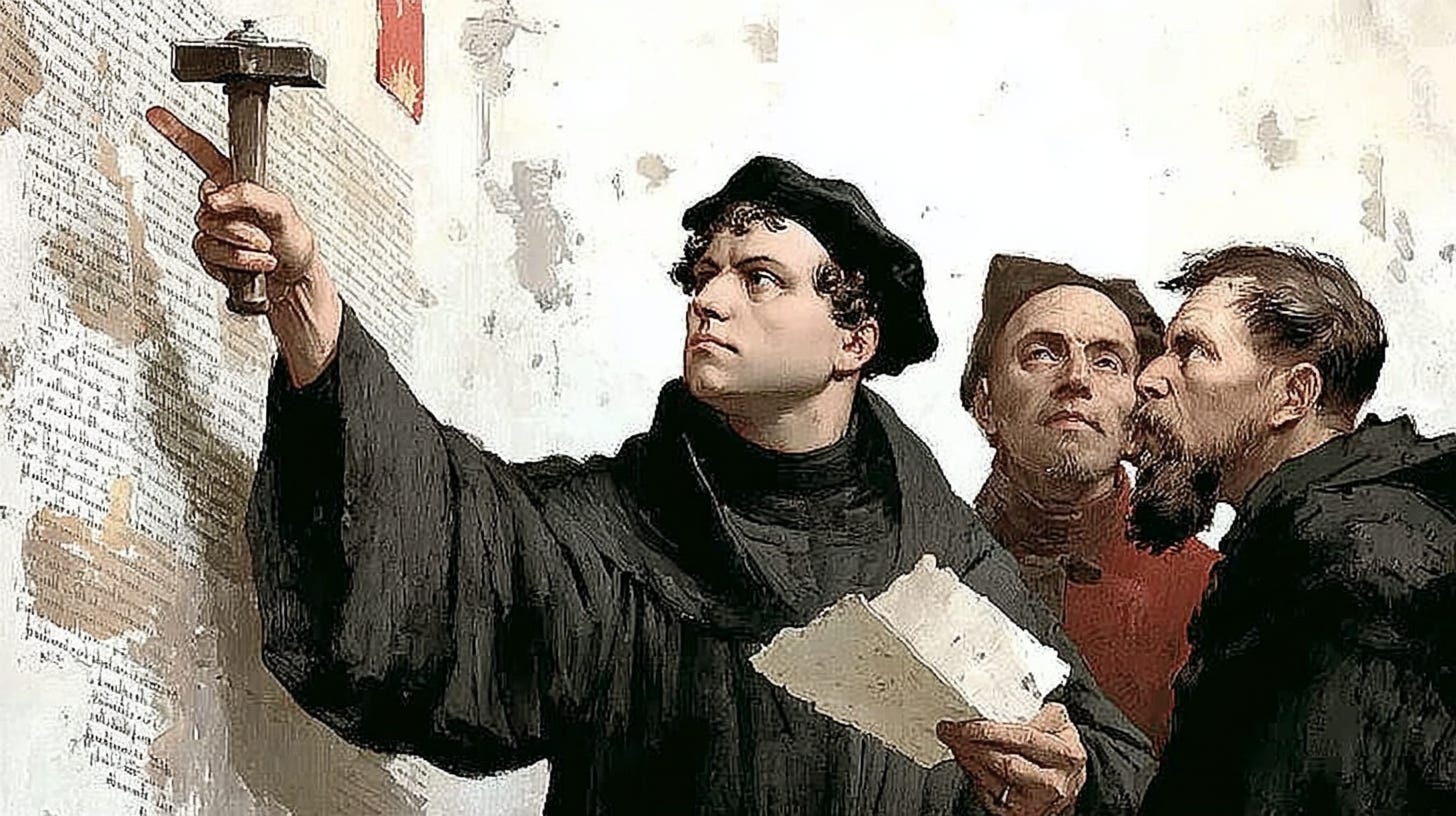
October 31, 1517. Wittenberg, Germany. A 34-year-old Augustinian monk and theology professor named Martin Luther walked up to the Castle Church door—which functioned as the community bulletin board—and nailed up a document. Ninety-five theses. Ninety-five grievances against the Roman Catholic Church.
The immediate trigger? The sale of indulgences. The Church was literally selling forgiveness—pay money, reduce your time in purgatory, get your dead relatives out faster. Pope Leo X needed funds to build St. Peter’s Basilica in Rome. A monk named Johann Tetzel was touring Germany with a sales pitch that would make a used car dealer blush: “As soon as the coin in the coffer rings, the soul from purgatory springs.”
Luther’s 95 Theses weren’t just theological complaints. They were accusations of corruption at the fusion point of religious authority and monetary power. The Church was using the machinery of salvation—the thing people feared and loved most—to extract wealth. Thesis 86 asked a simple question: “Why does the pope, whose wealth today is greater than the wealth of the richest Crassus, build the basilica of St. Peter with the money of poor believers rather than with his own money?”
It was a protest against instrumentalized faith. Against using people’s relationship with God as a mechanism of control and extraction.
The document spread across Europe in weeks, thanks to the printing press. The Catholic Church demanded Luther recant. He refused. In 1521, the Edict of Worms declared him a heretic and an outlaw. Anyone could kill him without legal consequence.
But Luther had sparked something that couldn’t be extinguished: the idea that religious authority could be questioned, that the state’s endorsement of a church didn’t make that church right, and that conscience could—must—stand against institutional power.
By 1526, enough German princes had broken with Rome that Emperor Charles V had to grant them temporary autonomy. That’s what the 1529 Diet of Speyer tried to rescind. Luther’s hammer strikes on that cathedral door echoed for twelve years until they became a formal Protestation—the birth of Protestant identity.
The principle was simple: You cannot use religious authority to suppress dissent. You cannot make faith into a tool of political control.
Remember that. We’ll need it.
THE DUAL-ROLE PARADOX
Picture this: You’re an ICE agent. No, scratch that—you’re the Acting Field Director for ICE Enforcement and Removal Operations across Minnesota and surrounding states. Your name is David Easterwood. During the week, you oversee operations that, in the first months of 2026, involved deploying more than 2,000 armed and masked Department of Homeland Security agents to the Twin Cities. That’s nearly five times the size of the entire Minneapolis Police Department. Your teams made over 3,400 arrests.
On Sunday, you preach the gospel.
You shepherd a Southern Baptist congregation at Cities Church in St. Paul, teaching about mercy, redemption, the least of these. You hold a Bible in the same hands that sign operational directives.
Does this make you a hypocrite? A man of contradictions? Or does it make you untouchable?
THE DEATHS THAT CHANGED THE CALCULUS
Here’s what your congregation might not have known, unless they watched the news: Renée Good, 37 years old, mother of three, was shot and killed in her car by an ICE agent during Operation Metro Surge. The official story? Self-defense. She tried to ram him with her vehicle.
But eight in ten U.S. voters saw the video. ABC News analysts confirmed what the footage showed: seconds before the agent fired, Good was steering her wheel to the right, away from him.
Then there was Alex Pretti. Thirty-seven years old. Intensive care nurse. He joined protests after Renée Good’s death. BBC News obtained footage showing Pretti filming agents as he stood between an officer and a woman who’d been pushed to the ground. Agents pepper-sprayed him. Wrestled him down. Less than a second later, they fired ten shots.
The White House called him a “would-be assassin.” Minnesota Governor Tim Walz and Attorney General Keith Ellison called the federal actions unconstitutional retaliation.
So when Nekima Levy Armstrong—a civil rights attorney and activist—led protesters into Cities Church on January 18, 2026, they had a simple message: A man who oversees “militarized raids” and “terroristic violence” during the week cannot authentically preach the gospel on Sunday. They chanted “ICE out” and “Justice for Renee Good.”
They wanted the congregants to know who was teaching them.
It was Luther’s question, updated: Why does the pastor, whose operational authority during the week oversees raids that killed a mother of three, preach mercy on Sunday rather than resigning his position?
THE FACE ACT: A SHIELD BECOMES A SWORD
The Department of Justice’s response was unprecedented. For the first time in the law’s 32-year history, they used the Freedom of Access to Clinic Entrances Act—the FACE Act—to prosecute political protesters who entered a place of worship.
Let that sink in. The FACE Act was passed in 1994 to stop a nationwide campaign of violence and blockades against abortion clinics. Anti-abortion extremists were firebombing facilities, stalking doctors, physically blocking patients. Congress acted. Republicans insisted on a clause protecting “places of religious worship” to ensure religious freedom got the same protection.
In 2026, Attorney General Pam Bondi and Assistant Attorney General Harmeet Dhillon pardoned 23 people convicted of violating the FACE Act at abortion clinics. They dismissed pending cases. Meanwhile, between 2023 and 2024, there were 777 reported incidents of clinic obstruction. The DOJ de-prioritized those investigations.
But they prosecuted the St. Paul church protesters. Dhillon called the action “un-American and outrageous,” declaring that a “house of worship is not a public forum for your protest.”
The Center for Reproductive Rights is suing, calling it selective enforcement. Critics call it an ideological weapon: protect the groups you like, criminalize dissent against the agents you employ.
It’s the indulgence sale in reverse. Instead of the Church extracting money using religious authority, the state extracts obedience using religious protection.
THE KKK ACT: TURNED AGAINST THE PROTESTERS
Then it got worse.
The DOJ charged protesters—and two journalists—under 18 U.S.C. § 241, commonly known as the “Conspiracy Against Rights” statute. You might know it better as the KKK Act. Passed during Reconstruction to protect newly freed Black citizens from white supremacist terror, it makes it a federal crime to conspire to deprive someone of their constitutional rights.
Don Lemon and Georgia Fort, independent journalists, were indicted. The charge? They conspired to deprive Cities Church congregants of their First Amendment right to worship. How? By filming the protest. By traveling to the church with protesters. By livestreaming.
Legal experts point to Holder v. Humanitarian Law Project (2010), where the Supreme Court ruled that expressing ideas or reporting cannot constitute “material support” for a conspiracy. But the DOJ labeled Lemon and Fort “agitators” and “insurrectionists.”
Professor Jane Kirtley at the University of Minnesota called the charges “overkill,” noting that while state trespass laws cover disruption, these federal conspiracy charges are “far more severe and difficult to square with Supreme Court precedent regarding journalistic activities.”
The message is clear: Film us at your own risk.
THE ESTABLISHMENT CLAUSE INVERSION
Here’s the constitutional nightmare: David Easterwood operates as a federal official who can trigger federal criminal penalties against anyone who criticizes him—but only if that criticism occurs in his church.
During the week, he’s a public servant subject to public accountability. On Sunday, he’s shielded by the First Amendment’s Free Exercise Clause. Churches are “sensitive locations” under DHS policy where immigration enforcement doesn’t occur—to respect religious freedom.
But what happens when the ICE director is the pastor? The community can’t bring their grievances to him at work (he’s too high-ranking, too protected). They can’t confront him at his church (it’s a federal crime under the FACE Act). They can’t even document the confrontation (that’s conspiracy under the KKK Act).
The Supreme Court ruled in Larkin v. Grendel’s Den (1982) that government cannot delegate its power to religious institutions because it allows that power to be used for “explicitly religious goals.” The Court struck down a Massachusetts law letting churches veto liquor licenses within 500 feet.
The “Easterwood Paradox” is the inverse: A government official uses his religious role to shield himself from accountability for his secular actions. The government prosecutes his critics. The religious institution becomes a fortress for state power.
Attorney General Bondi was explicit: “Attacks against law enforcement and the intimidation of Christians are being met with the full force of federal law.”
Notice what she did there. She fused law enforcement with Christian identity. The Establishment Clause—meant to prevent exactly this fusion—became the weapon.
Luther nailed his theses to a church door to protest the fusion of religious authority with monetary extraction. Five centuries later, protesters can’t even enter a church door to protest the fusion of religious authority with state violence.
BACK TO 1529
Those six princes and 14 Imperial Free Cities at the Diet of Speyer understood something crucial: When the state controls religion, it controls dissent. When it can declare certain beliefs illegal, it can declare believers criminals.
They argued that faith is a “personal fight that must be respected.” They said the government lacks jurisdiction to suppress religious dissent through secular mandates.
The 2026 protesters in St. Paul were making the mirror-image argument: The government can’t use religious protection as a shield for its secular agents. It can’t transform a sanctuary into a safe house for state violence.
Nekima Levy Armstrong didn’t want to stop people from worshipping. She wanted them to know who was leading the worship.
THE SECOND-ORDER COLLAPSE
Consider what this precedent authorizes. Any government official can take a position at a church, mosque, synagogue, or temple. Once installed as a religious leader, they become functionally immune from political protest at their primary place of public appearance. The “sensitive location” policy becomes a moat. The FACE Act becomes the drawbridge. The KKK Act becomes the archers on the ramparts.
This is the sacralization of state actors—making them holy, untouchable, beyond the reach of “We the People.”
The KKK Act was written to stop the Klan from using violence to prevent Black Americans from voting, speaking, assembling. Now it’s being used to stop Americans from using speech to challenge state violence.
Reconstruction-era civil rights law, turned into a counterinsurgency tool.
YOU, RIGHT NOW
So what are you supposed to do? You, the voter who saw that video of Renée Good’s car. You, who read about Alex Pretti’s last moments. You, who believe government officials should be accountable to the public they serve.
If you march to the ICE office, you’re trespassing on federal property. If you go to the official’s church, you’re violating the FACE Act. If you film it, you’re part of a conspiracy. If you stream it, you’re an agitator.
The Constitution promises you “the right of the people peaceably to assemble, and to petition the Government for a redress of grievances.”
But if the government stations its agents inside sanctuaries, and then prosecutes dissent as sacrilege, where exactly are you allowed to assemble? Where are you permitted to petition?
Martin Luther walked up to a church door in 1517 and nailed his complaints to it. That act of protest sparked the Reformation. The Diet of Speyer protesters were called Protestants because they rejected the state’s power to mandate conscience through religious law. They said: You cannot make my faith into your tool of control.
The St. Paul protesters are facing federal prison for making the inverse argument: You cannot make your authority into a shield of faith.
Both groups understood the same principle: When secular power and religious exercise fuse, tyranny calls itself holy.
Five hundred and nine years separate Luther’s hammer from the chants in Cities Church. The door has become harder to reach. The stakes have become federal crimes. But the question remains exactly the same:
Who gets to decide when power wrapped in piety has become corrupt?
And you thought “Protestant” was just about theology.