

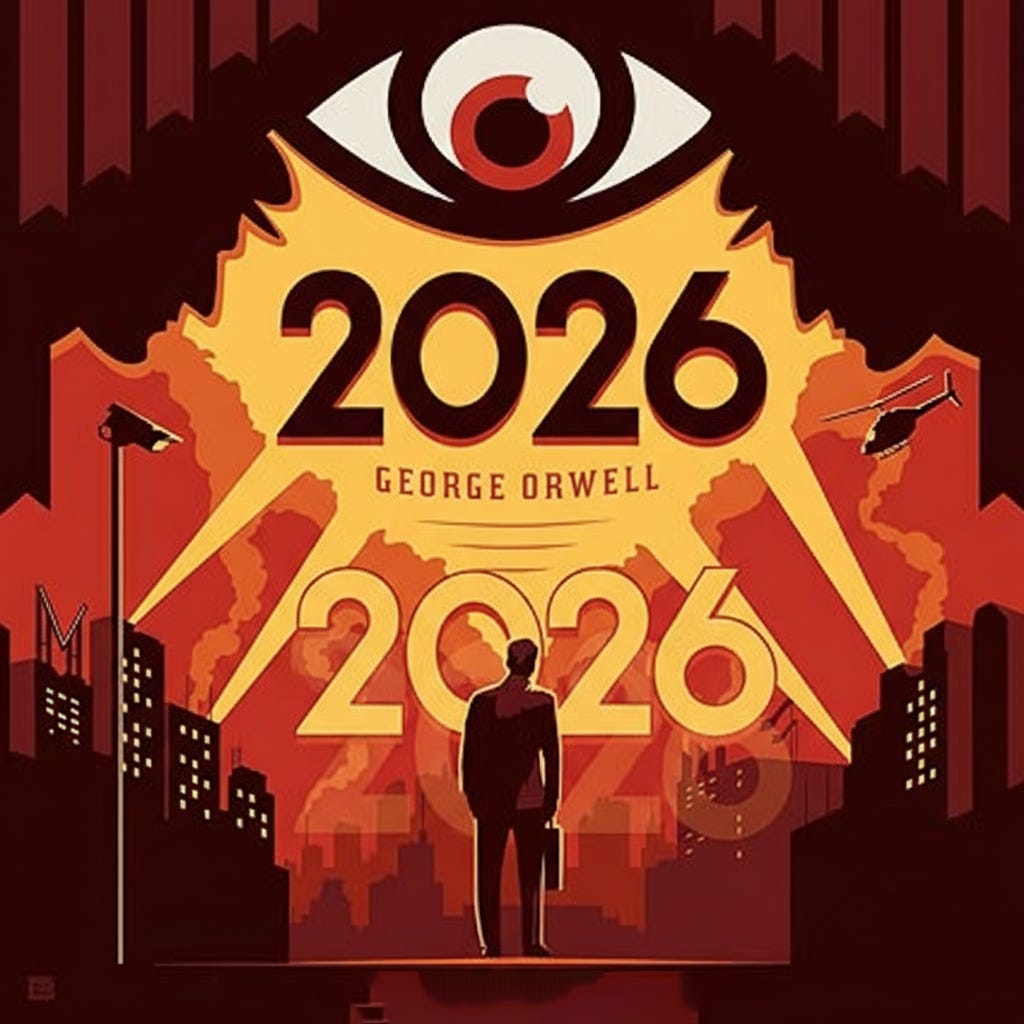
There’s a particular kind of exhaustion that comes from reading George Orwell’s Nineteen Eighty-Four in 2025. Not the exhaustion of encountering something alien and disturbing, but the fatigue of recognition. The telescreen that watches Winston Smith through his alcove, the Ministry of Truth that rewrites history overnight, the Newspeak dictionary that shrinks vocabulary until dissent becomes literally unthinkable—these aren’t warnings anymore. They’re Wednesday.
But here’s what makes the comparison more complicated than the usual “Orwell predicted everything” takes: we didn’t build Oceania. We built something stranger. The surveillance is voluntary. The censorship is algorithmic. The historical revision happens not through deliberate malice but through link rot and server shutdowns. And the Ministry of Truth? It’s running on autopilot, optimized for engagement rather than ideology, serving no master except the quarterly earnings report.
The document under examination—a rigorous chapter-by-chapter mapping of 1984 onto contemporary digital society—makes a bold claim: that the “underlying logic” of Orwell’s dystopia has achieved “structural equivalence” with modern technological systems. The analysis is systematic, spanning all eight chapters of Book One, correlating each of the Party’s mechanisms with present-day parallels. Surveillance becomes smartphones and IoT devices. The Junior Spies become parental monitoring apps. The memory hole becomes algorithmic deletion. Newspeak becomes Algospeak.
The parallels are real. The question is whether they’re as total as the document claims.
What the Numbers Actually Show
The strongest empirical evidence appears in the discussion of algorithmic polarization. During the 2024 U.S. presidential campaign, researchers manipulated the ranking of political content on X (formerly Twitter) and measured the results. The effect was quantifiable: a 2-point shift in affective polarization on a 100-point scale. This isn’t analogy—it’s proof that feed design measurably alters political attitudes without users’ knowledge.
This matters because it moves the argument from “this resembles Orwell” to “this functions like Orwell.” The Party controlled thought by controlling information flow. Modern platforms achieve similar effects through opacity: the ranking algorithm is proprietary, the training data is undisclosed, the moderation rules are vague. Citizens cannot audit or contest what they cannot see. The mechanism is invisible, the effect is measurable, and the accountability is nonexistent.
But contrast this with the document’s other examples, where the evidence thins considerably. The claim that 51% of Gen Z youth are tracked by parental monitoring apps is cited without source verification. Which study? What sample size? What demographic distribution? The correlation between monitoring and “problematic internet use” could run in either direction: do the apps cause problematic behavior, or do concerned parents deploy apps because their children are already struggling? The document doesn’t say.
More importantly, it notes that 60% of tracked adolescents admit to evasion tactics—disabling location services, creating fake accounts, clearing their browsing history. This is a majority. In Oceania, resistance was architecturally impossible. The telescreen could not be turned off. Deviation resulted in arrest. The Party’s power was its inevitability. But if modern surveillance can be evaded by a majority of those subjected to it, then the system is fundamentally different. It’s not that resistance is futile. It’s that resistance is inconvenient.
This reveals the central tension in the analysis: individuals are portrayed simultaneously as passive victims and active agents. The document cannot decide whether we are imprisoned by surveillance capitalism or merely habituated to it. Both may be true, but they require different responses. You don’t overthrow a habit. You break it.
The Problem Nobody Architected
The Party’s mechanisms were designed. Someone built the telescreen, wrote the Newspeak dictionary, staffed the Ministry of Truth. Every tool of control served a coherent ideology: Ingsoc. Power was consolidated, intentional, architectural.
Modern digital systems, by contrast, are optimized for profit. Surveillance capitalism extracts behavioral data because that data improves ad targeting. Algorithms prioritize engagement because engagement increases revenue. Deepfakes proliferate because verification is expensive and falsehood is cheap. The control effects are side effects, not primary goals.
This distinction isn’t pedantic—it changes everything about how we respond. If the problem is totalitarian conspiracy, resistance requires revolution. If the problem is market failure in the absence of regulatory constraints, regulation suffices. The document acknowledges this in passing, noting that surveillance is “commercially mediated” rather than state-imposed. But it doesn’t follow the logic to its conclusion.
Consider the “memory hole” analysis. The document argues that digital deletion functions like the Ministry of Truth’s deliberate destruction of inconvenient records. But when a website vanishes because its server shuts down, this isn’t ideological censorship—it’s technical decay or economic abandonment. When link rot erases a decade of cultural evolution, this isn’t malice. It’s negligence. The result may be the same—loss of historical record—but the cause is different. And if the cause is different, so is the solution.
The Ministry of Truth required burning. Digital archives require funding. These are not equivalent political problems.
When the Fringe Meets the Systemic
The document treats phenomena of vastly different scales as equivalent manifestations of control. Incel culture is presented as the modern equivalent of the Party’s libidinal manipulation—the Two Minutes Hate redirected into misogyny. The psychological mechanism may be similar: both channel sexual frustration into outgroup hostility. But the Party’s mechanism mobilized an entire population daily. Incel radicalization affects thousands of individuals in online forums.
For the Orwellian analogy to hold, modern mechanisms must operate at comparable scale. The document provides no evidence that incel ideology has scaled beyond its subculture. No polling data on public support for misogynistic violence. No legislative adoption of incel rhetoric. No mainstream political movements organized around their worldview. What we have instead is a marginal online phenomenon that generates periodic acts of individual violence.
Individual violence is not the same as systemic control. The Party’s mechanisms were functional—they sustained the regime. Incel violence destabilizes society. It doesn’t consolidate power. It creates chaos. And chaos, however destructive, is not totalitarianism. It’s the opposite.
The same problem emerges with “digital detox” as resistance. The document frames unplugging from digital systems as the modern equivalent of Winston’s alcove—a space where the body becomes a site of rebellion. But if only a small percentage of the population practices digital detox, this isn’t resistance. It’s privileged withdrawal. The wealthy can afford analog retreats. The working class cannot disconnect when employment, education, and social services require smartphones.
Scale determines whether a phenomenon is systemic or marginal. The Party’s mechanisms structured all of social life. Modern equivalents must meet the same threshold to validate the comparison. Most don’t.
The One That Actually Works
The strongest parallel—and the most troubling—is the relationship between Newspeak and what the document calls “Algospeak.” The mechanics are nearly identical. Orwell’s Newspeak eliminated vocabulary to narrow the range of thought. If you can’t say “freedom,” you can’t think freedom. The Party was explicit about this goal: make thoughtcrime literally impossible because the words to express it will cease to exist.
Algospeak emerged from the opposite direction. Platforms didn’t mandate euphemisms—users invented them to circumvent automated content moderation. “Unalived” for killed. “Seggs” for sex. “Corn” for pornography. The watermelon emoji for Palestine. These substitutions allow users to discuss flagged topics without triggering algorithmic censorship.
But here’s what the document gets right: the effect may be the same regardless of intent. When serious topics get coded in “dreadfully unserious language”—using the grape emoji for sexual assault, for instance—the emotional weight shifts. The intensity diminishes. The viewer becomes desensitized not through deliberate propaganda but through linguistic workarounds that treat violence as a game of Mad Libs.
The mechanism is different. The Party imposed Newspeak from above. Algospeak emerges from below as users adapt to platform rules. But both systems produce a censored lexicon that simplifies thought and discourages critique. The Party narrowed vocabulary deliberately. Platforms narrow vocabulary accidentally, as an externality of profit-maximizing content moderation. The result—simplified language, constrained thought—converges.
This is the document’s most sophisticated insight: that you can achieve Orwellian outcomes through non-Orwellian means. You don’t need a Ministry of Truth if you have an engagement algorithm. You don’t need Thought Police if you have shadow banning. You don’t need Big Brother if you have predictive analytics.
What Orwell Couldn’t Have Imagined
Winston Smith knew he was being watched. The telescreen announced its presence. The Thought Police operated openly. The Party’s power was visible, acknowledged, inescapable. Resistance was impossible precisely because the mechanisms of control were architectural—embedded in the physical infrastructure of daily life.
Modern surveillance is invisible. The algorithm doesn’t announce itself. The ranking system doesn’t explain its decisions. The deepfake looks exactly like the genuine article. And this opacity may constitute a more severe form of control than Orwell imagined, because it forecloses the possibility of conscious resistance. You cannot fight what you cannot see.
The X feed-reranking study proves this. A 2-point shift in political attitudes from algorithmic manipulation that users couldn’t detect. The mechanism was invisible. The effect was real. This is the nightmare scenario: that we’re being shaped without knowing it, by systems optimized for metrics we don’t understand, serving interests we never consented to.
But here’s where the document’s analysis needs greater precision. The invisibility cuts both ways. If platforms depend on voluntary participation—and they do—then the system is weaker than it appears. The Party’s power was inevitable. You could not opt out of the telescreen. Modern surveillance requires that you keep using the app, keep carrying the phone, keep clicking through. The moment critical mass shifts to alternative platforms or analog alternatives, the power structure fractures.
The document notes that 60% of tracked adolescents evade surveillance. That algorithms can be circumvented with VPNs and encryption. That users invent workarounds like Algospeak to resist content moderation. These aren’t footnotes—they’re evidence that the system is contested terrain, not total control. The comparison to Oceania overstates the enemy’s strength and understates the fragility of voluntary compliance.
The Diagnosis and the Disease
The value of this document lies in its systematic identification of mechanisms that threaten autonomy, truth, and democracy. Surveillance capitalism. Algorithmic polarization. Epistemic fragmentation. These are real problems with measurable consequences. The weakness lies in its assumption that these mechanisms constitute a unified system comparable to the Party’s totalitarian apparatus.
They don’t. They’re emergent, contested, and contingent. They arise from decentralized actors—corporations, platforms, advertisers—pursuing profit in the absence of regulatory constraints. This is not Ingsoc. This is neoliberalism. And the distinction matters because it determines what we do next.
If we’re building a totalitarian surveillance state, resistance requires revolution. Tear down the system. Overthrow the regime. But if we’re experiencing market failure—externalities that corporations impose on society because they’re profitable and unregulated—then regulation suffices. Mandate algorithmic transparency. Impose fiduciary duties on platforms to prioritize user welfare over engagement. Fund public digital infrastructure that operates without profit motives.
These interventions are achievable. They require political will, not revolution. They address the root cause—market dynamics optimizing for the wrong metrics—rather than fighting a phantom totalitarian enemy.
The document’s rhetorical strategy—framing contemporary issues in Orwellian terms—has power. It makes the stakes visceral. But it risks overestimating coordination and underestimating the viability of reform. We are not (yet) living in Oceania. But we are building systems that could become Oceania if left unchecked.
The question isn’t “How do we escape the totalitarian state?” It’s “How do we prevent its emergence?” And the answer lies in the details the document identifies but doesn’t emphasize: regulatory oversight, public investment, mandatory transparency. These aren’t the tools of resistance. They’re the tools of governance. And governance, however imperfect, is the barrier between the present and the dystopia Orwell imagined.
The telescreen hasn’t disappeared. It’s in your pocket. The difference is you can still turn it off. The question is whether you will—and whether we’ll build systems that make turning it off a viable choice rather than an act of professional and social suicide.
That’s the gap between analogy and architecture. Orwell gave us the language to name what we’re seeing. Now we need the precision to understand what we’re actually building—and the courage to build something else.
Tags: Nineteen Eighty-Four contemporary analysis, surveillance capitalism critique, algorithmic manipulation evidence, Orwell market failure distinction, digital epistemology regulation
The thing that stuck with me is that the fix here is boring on purpose. Not revolution, not resistance, just regulation. Most pieces like this end at the dystopia warning and dip. This one actually says okay cool now what, and the answer is just... make the rules catch up to the tech.