

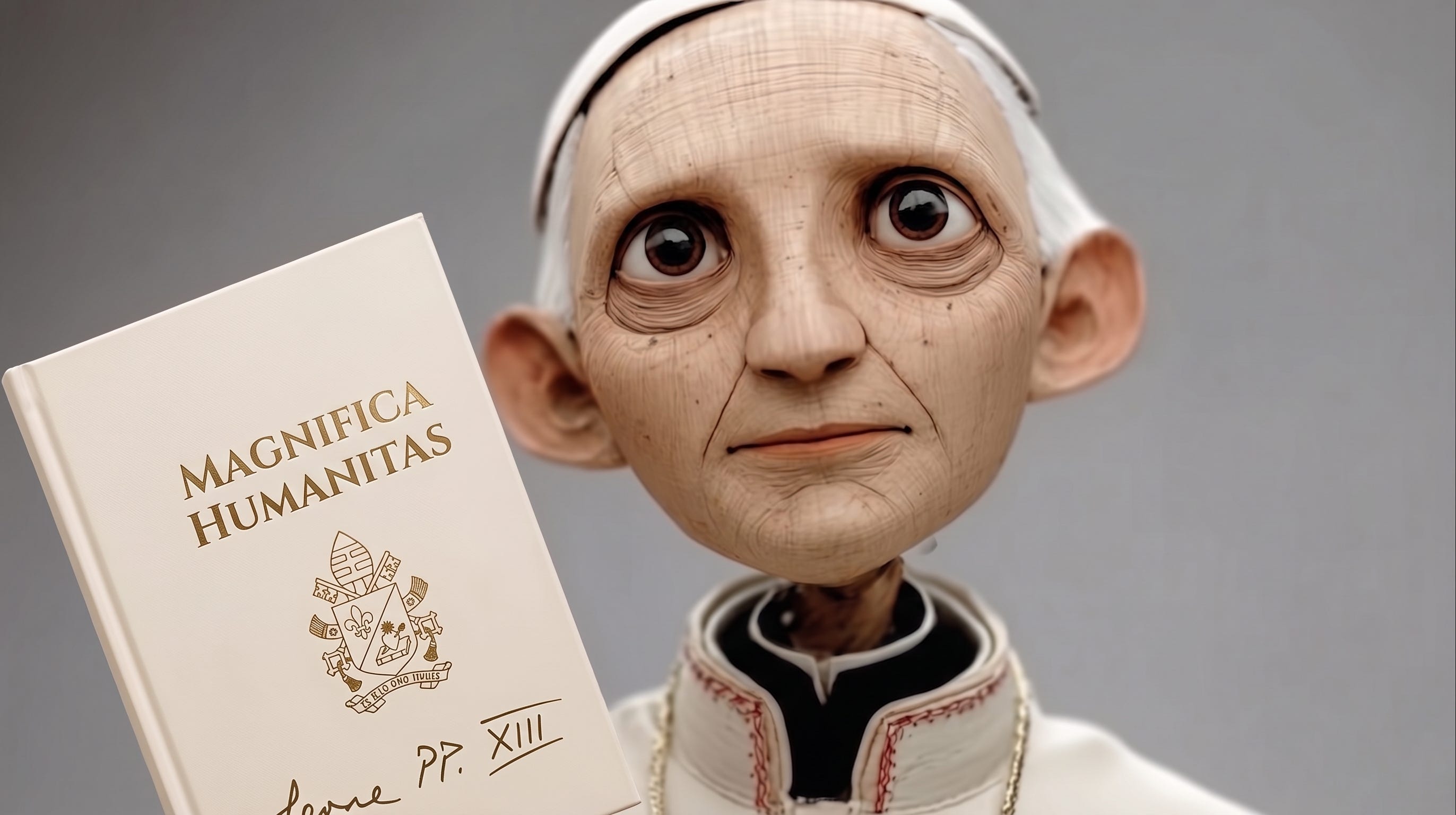
On the Anthropological Contradiction at the Heart of Magnifica Humanitas
The full text of the encyclical is available directly from the Vatican: Magnifica Humanitas
When I wrote Magnifica Humanitas: The Operational Guide, I treated Leo XIV’s encyclical as a witness — one of three independent sources that arrived, by completely different roads, at the same structural conclusion about AI governance: that authority belongs with the person closest to the problem, that the knowledge required for good decisions is held locally and cannot be moved upward without being destroyed, and that redistributing power toward those persons is not a pious hope but an institutional design requirement. I derived the same conclusion from Judea Pearl’s causal ladder and from Hayek’s dispersed-knowledge theorem, and I used the encyclical as a third confirmation — the unexpected door in the room that nobody thought had a door. I called it a witness, not a judge. Its value was precisely its independence.
Writing that book required me to read Magnifica Humanitas carefully enough to know which of its arguments were doing real work and which were decorative. And reading it that carefully revealed a tension the document does not resolve — one that I passed over in the operational text because it did not affect the prescriptions I was drawing from it, but that deserves a fuller reckoning on its own terms. The encyclical opens with a claim and closes with a prayer, and between them runs a contradiction it never fully examines.
The claim is this: human dignity is ontological, inalienable, grounded in God’s love rather than in human capacity or social recognition, impervious to any act or condition that might appear to diminish it. “Every human person possesses an infinite dignity, inalienably grounded in his or her very being, which prevails in and beyond every circumstance, state, or situation the person may ever encounter” — the encyclical quotes Dignitas Infinita approvingly, italicizing the universality (para. 62). No sin, failure, humiliation, or exclusion can touch it. The prayer — the Magnificat — envisions God scattering the proud and lifting the lowly, which implies that the lowly are genuinely low, that real damage has been done to real people, that something of genuine moral weight has been threatened and requires divine reversal.
Between the claim and the prayer, a question: if dignity truly prevails in and beyond every circumstance, what exactly does AI threaten? What is at stake in dehumanization if the human cannot, in the relevant sense, be dehumanized?
My secular argument sharpens that question in a way the encyclical cannot see about itself. When I demonstrated that the subsidiarity prescriptions, the trust-gap diagnosis, and even the Magnificat’s redistributive logic all stand independently on cognitive-science and information-economics grounds, I inadvertently established something damaging about the encyclical’s theological foundation: the prescriptions are well-grounded whether or not the ontological dignity claim is coherent. They would be right even if the foundation failed. A utilitarian could accept every governance prescription in Magnifica Humanitas — mandatory transparency, meaningful human control, data as a common good — on purely consequentialist grounds, because supporting local judgment produces better aggregate outcomes than replacing it. The inalienable dignity of the person is not doing the derivational work. It is accompanying an argument that stands without it.
This is the pressure this essay examines. The document offers an answer to the question of what AI threatens that it does not fully examine: that what is threatened is not the ontological fact of dignity but its recognition and enactment in social relations and institutional arrangements. A person subjected to algorithmic discrimination retains inalienable worth; what is damaged is the social acknowledgment of that worth, the concrete conditions in which it can be lived. The question is whether that distinction holds under the encyclical’s own pressure — whether Magnifica Humanitas maintains a stable separation between dignity as metaphysical status and dignity as lived condition, or whether its strongest applied claims quietly convert the former into the latter, making dignity dependent on the very social conditions it was invoked to transcend. Because if the prescriptions are independently grounded, then the theological foundation is doing less work than the document believes — and the anthropological architecture is more exposed, and more consequential in its exposure, than the confident tone suggests.
The architectural function of ontological dignity in Magnifica Humanitas is clear and important. It provides the foundation that resists the utilitarian erosion the encyclical is most worried about. Para. 51 identifies the insidious ideology that “every person must earn or justify his or her own worth, to the point of attributing greater value to those who are more efficient or effective” — precisely the logic that AI systems optimizing for productivity metrics tend to embed and amplify. Against this, the encyclical insists that dignity “does not depend on a person’s abilities, wealth or position in life, nor on the right or wrong choices made; instead, it is a gift that precedes and transcends each person” (para. 50). The strategy is to locate dignity outside the register in which AI operates — outside capacity, performance, and measurable output — so that no technical system can reach it. What AI calculates, the argument runs, is not what persons are worth.
This is the right move against a genuine danger. Capacity-based accounts of human worth are philosophically precarious precisely because capacities vary, diminish, and can be exceeded by machines. An account of dignity immune to capacity comparisons is better equipped to survive the age of AI than one that grounds human worth in cognitive performance or economic productivity. The encyclical is not wrong to want this foundation.
The problem begins when the document shifts from establishing the foundation to deploying it in applied analysis. Para. 99’s account of what AI lacks — the passage most often cited as the encyclical’s philosophically strongest — argues that AI systems “do not undergo experiences, do not possess a body, do not feel joy or pain, do not mature through relationships.” The implicit argument is that these capacities are what make human beings the kind of thing whose dignity matters. But this argument structure is in tension with the foundational claim: if dignity is truly prior to and independent of capacities, then the absence of those capacities in AI tells us nothing about the presence of dignity in humans. The capacity inventory in para. 99 only does the work the document needs it to do if dignity is grounded in those capacities — which is precisely what the ontological account denies.
The document is running two different arguments about human dignity simultaneously. One argument grounds dignity in being, independently of capacity; the other distinguishes humans from AI by appeal to capacities. These arguments serve different purposes in the document, but they cannot both be correct as foundations. Either dignity is capacity-independent (in which case the capacity inventory in para. 99 is beside the point as a dignity argument) or dignity is capacity-grounded (in which case the inalienability claim is weaker than advertised). The encyclical needs both and examines neither.
The sharper version of this problem became clear to me when I worked through the same passage from Pearl’s direction. In my operational text, I derive the identical distinctions Leo draws in para. 99 — embodiment, conscience, relational maturity, the difference between statistical adaptation and inner growth — from the three-rung causal ladder and Polanyi’s account of tacit knowledge. The physician reasoning counterfactually about a patient who does not yet exist under a decision not yet made is doing something an AI pattern-matcher constitutively cannot do, I argued, not because the physician has inalienable ontological dignity but because she has stakes, a body, and consequences: she is on Pearl’s third rung, running counterfactuals, while the system is on the first, associating. That is a mechanistic claim about cognitive architecture, grounded in the phenomenology of cognition rather than the ontology of dignity. Para. 99’s genuine philosophical content — its careful, correct account of the gap between fluency and judgment, between statistical pattern and situated understanding — holds on those secular grounds with no theological support whatsoever. The encyclical is right for reasons it does not know it has. And when a document is right for reasons it does not know it has, the reasons it thinks it has are doing less work than it believes.
The metaphysical/lived distinction enters most clearly in para. 52, where the document explicitly distinguishes four registers of dignity: moral (how a person directs choices and actions), social (living conditions and concrete respect received), existential (subjective sense of worth and value), and ontological (dignity belonging to every human being simply by virtue of existing, willed and loved by God). The first three “can be enhanced or diminished”; the fourth cannot. This is a careful philosophical move, and it offers a potential resolution of the contradiction: what AI threatens is the social and existential registers; the ontological register remains intact.
The resolution is coherent as a taxonomy. The question is whether the document uses it consistently when making its strongest claims about what is at stake. Consider para. 103, one of the encyclical’s most rhetorically charged passages: “entrusting an algorithm in practice with the power to select who is worthy or not, without anyone bearing responsibility for that judgment, is to hand over the task of redefining the boundaries of human possibilities.” The language of “redefining the boundaries of human possibilities” is not language about social or existential dignity — it is language about what persons fundamentally are and can become. Similarly, para. 112 warns that the technocratic paradigm threatens to “normalize an anti-human vision” in which “the fullness of life is equated with having more, reducing weakness, eliminating uncertainty and exerting total control.” The threat named here is not to social conditions but to the self-understanding of what a human being is — a threat to humanity’s grasp of its own nature, which is a different and more serious claim than a threat to social recognition.
These passages are making an ontological-register claim dressed in social-register language. They are arguing that AI threatens not merely how people are treated but what kind of beings people understand themselves to be, which is a claim that strikes at the ontological foundation itself. The document cannot simultaneously hold that ontological dignity is impervious to any circumstance and that there exists a technological configuration capable of normalizing an “anti-human vision” that reaches the ontological self-understanding of persons. If the latter is possible, the former is overstated.
The pressure becomes most visible in Chapter Three’s treatment of transhumanism and posthumanism (paras. 115–117). The encyclical argues that these ideological currents, even when “largely speculative,” gain relevance “by altering the collective imagination” and thereby “influence social, economic and political choices.” The threat is not to individual persons in specific transactions but to the cultural substrate within which persons understand themselves and are understood by others. Para. 117 makes this explicit: “If the human being is treated as something to be perfected or surpassed, it becomes easier to accept that some lives are less useful, less desirable or less worthy.”
This is a claim about moral epistemology at the civilizational level: that certain technological and ideological environments degrade humanity’s capacity to recognize dignity in one another. It is a serious and important claim. But notice what it implies about the ontological account. If dignity is truly inalienable and grounded in God’s love independently of social recognition, then the degradation of humanity’s capacity to recognize dignity is a tragedy — but it is a tragedy about epistemology, not about the dignity itself. The person declared “less worthy” by an algorithm, or imagined as a substrate for enhancement, retains inalienable ontological dignity regardless of how they are classified. Their dignity is not diminished by the misclassification; only the recognition of it is.
But the encyclical does not treat this as a merely epistemological problem. It treats it as a threat to human dignity as such — as something that must be resisted not because false recognition is epistemically unfortunate but because something of genuine worth is actually at stake. Para. 126 concludes: “humanity — in all its grandeur and woundedness — must never be replaced or surpassed.” The phrase “must never be replaced” is not about recognition; it is about the thing itself. The encyclical is not saying that humans must never be misrecognized as replaceable; it is saying that replacement would be a genuine loss, that something real would be destroyed. This is a claim that the ontological dignity framework, strictly interpreted, cannot support — because what cannot be diminished cannot be lost, and what cannot be lost cannot be destroyed by replacement.
There is a move available to the encyclical that would resolve this tension, and the document occasionally approaches it without making it explicit. The move is to distinguish between dignity as a metaphysical fact about persons and dignity as a normative claim about how persons must be treated — and to argue that what AI threatens is the second, not the first. On this reading, the inalienability claim is about the metaphysical fact: no act or condition can change what a person is or remove them from God’s love. The dehumanization claim is about the normative practice: systematic AI-driven exclusion, algorithmic discrimination, and the reduction of persons to data profiles constitute treatments that fail to enact the dignity that metaphysically exists. The person is not diminished; the treatment is wrong.
This distinction is implicit in the Catholic natural law tradition, and it is philosophically defensible. It echoes Kant’s formula of humanity — the injunction to treat persons always as ends and never merely as means — which operates precisely by distinguishing between the dignity persons have (always, inalienably) and the respect that dignity commands (which can be violated). On this reading, the encyclical’s strongest applied claims are claims about violated duty, not damaged being.
But Magnifica Humanitas does not consistently hold this distinction. The document moves between the normative claim and the ontological claim without flagging the difference, and in its most charged moments — the warnings about transhumanism, the account of dehumanization, the civilizational rhetoric of Babel — it is clearly making a stronger claim than violated duty. Para. 15’s “pressing duty to remain profoundly human” is not a claim about how others should treat us; it is a claim about what we ourselves might become — or fail to remain. This is a claim about ontological change, not merely normative failure.
The distinction between dignity as fact and dignity as normative claim would also solve a problem the document creates for itself in para. 100’s treatment of AI-simulated communication. The encyclical warns that the deeper danger of AI-simulated friendship is that a person “may gradually lose the very desire to form genuine human connections.” What is threatened here is not social recognition of dignity in the standard sense — the person is not being denied rights, exploited for labor, or classified as unworthy. They are at risk of losing the relational capacity through which they enact their own dignity. This implies that dignity, as lived, is not simply given but achieved through specific forms of human relationship that AI-simulated connection cannot provide — which makes dignity at least partially dependent on the social conditions it was invoked to transcend. The inalienability thesis says dignity prevails regardless of circumstance; the relational actualization thesis says dignity requires certain circumstances for its full expression. These are not the same claim, and the tension between them is not resolved by distinguishing ontological from social dignity — because the relational claim is about ontological dignity’s actualization, not merely about social conditions.
The document’s most honest passage on this question is its treatment of human limitation in paras. 118–122. Here the encyclical argues that finitude, suffering, and vulnerability are not defects but conditions through which humanity matures: “humanity flourishes not despite limitations, but often through them” (para. 118). The argument is that limitation is partly constitutive of genuine human life — that to eliminate suffering would be to “extinguish love and desire as well” (para. 120). This is a claim about what human dignity actually consists in, and it includes limitation as an ingredient rather than an obstacle.
If limitation is partly constitutive of human dignity, then AI systems that systematically eliminate certain limitations — cognitive augmentation, emotional simulation, labor replacement — are not merely failing to recognize dignity but potentially altering the conditions under which dignity is realized as a fully human life. Dehumanization is not merely a failure of recognition but a restructuring of the conditions in which human dignity can be lived.
But the encyclical does not follow this implication to its conclusion. Para. 126 pivots immediately: “we can embrace the technological progress that alleviates suffering and unlocks new possibilities, provided that we do not abandon the very essence of our humanity.” The phrase “provided that” is doing enormous work. It implies that some technological changes are compatible with the human essence and some are not — but the document does not specify the criterion for this distinction. It cannot simply be that limitation-removing technology is dehumanizing and limitation-preserving technology is not, because that would condemn medicine, literacy, and sanitation alongside AI. The criterion must be more discriminating, and the encyclical does not supply it.
The encyclical’s Trinitarian anthropology in para. 48 points toward a potential resolution, and it is worth following it further than the document does — precisely in order to show where it fails. But first, it is worth being precise about what my own secular argument has already established, because it sharpens the indictment.
In my operational text, I read the Magnificat not as a devotional text but as a structural claim about institutional design: the mighty are cast down and the lowly raised not by divine intervention but by the accumulated work of people building the section of wall nearest their own house, each one holding the local knowledge no central authority can possess. I derived the same conclusion — locate authority with the person closest to the problem — from Hayek’s dispersed-knowledge theorem: the knowledge good decisions require is local, tacit, and generated in the act of local decision itself, so pulling it upward to a central system does not gather it but destroys it. And from Woolley’s collective-intelligence research: distributed networks of trained, diverse, independent local actors outperform any single central intelligence on the hard problems precisely because they cover more of the solution space and preserve independence. The Magnificat’s redistribution, I argued, is not a theological aspiration — it is the architecture that actually works.
What this demonstrates about the encyclical is precise and damaging. The document’s subsidiarity prescriptions — transparent algorithms, meaningful human control over automated decisions, data governed as a common good, authority located with communities rather than platforms — are correct. But they are correct because they reflect the structure of knowledge and the requirements of collective intelligence, not because they are derived from the inalienable dignity of the human person. The ontological dignity claim is not doing the derivational work. It is accompanying an argument that stands without it. And a foundation whose removal leaves the building standing was never the foundation.
Now the Trinitarian anthropology. “Human persons are called to communion with God,” the passage states, quoting Gaudium et Spes 24, and “can fully discover their true selves only in sincere self-giving.” The implication is that personhood is not a static possession but a dynamic orientation: persons are constituted in and through relation, their identity realized through the movement of self-gift toward God and neighbor. On this reading, dignity is not the name of a property persons have, like mass or height, but the name of a calling — a vocation to communion inscribed in their being that no external force can remove.
This relational-vocational account has genuine philosophical resources. It avoids the static inertness of the “metaphysical property” model while preserving the unconditional character of dignity’s ground: the calling to communion is not contingent on whether it is recognized or enacted; it belongs to the person as creature of a God whose love is inalienable. What AI threatens, on this account, is not the vocation itself but the conditions under which persons can pursue it.
But the relational-vocational account is not the utilitarian firewall the encyclical needs it to be. If dignity is a calling to communion that is realized through relationship and self-gift, then dignity as lived is variable: some persons are in conditions that enable the journey; others are in conditions that obstruct it. A person isolated by AI-simulated relationships (para. 100), deskilled by algorithmic labor management (para. 150), surveilled and profiled into behavioral predictability (para. 171), or excluded from economic participation by opaque automated systems (para. 102) is a person whose vocation to communion is systematically impeded. Their dignity-as-calling is not extinguished, but their ability to pursue it is structurally curtailed. They are, in the relevant sense, less far along the journey.
The utilitarian now has a foothold. If what matters morally is not only the inalienable calling but the actual trajectory of persons toward their fulfillment, then conditions that impede that trajectory make persons, in some morally relevant sense, worse off in their dignity than persons whose trajectory is unimpeded. The utilitarian calculus the encyclical was designed to exclude re-enters through the relational account’s back door. Those whose communion-journey is more socially enabled become, under this account, persons with more fully realized dignity — which is not the inalienability claim, but something considerably weaker.
The encyclical cannot have it both ways without a further argument it does not supply. It cannot simultaneously hold that dignity is inalienable regardless of circumstance and that AI’s obstruction of relational life is a threat to dignity, unless it specifies exactly what is inalienable and exactly what is at stake in obstruction — and then demonstrates that impeding the expression is a moral wrong of a different kind than diminishing the ground. The encyclical approaches this distinction at several points but never assembles it into a coherent account.
What the document is left with is an anthropological architecture that is strong at the foundation and strained at every load-bearing joint above it. The imago Dei grounding of ontological dignity is secure as a theological claim. The Trinitarian anthropology of para. 48 is coherent as a framework for understanding persons as relational creatures. The phenomenological account of what AI lacks in para. 99 is careful and largely persuasive. None of these is wrong. What is missing is the connective argument — the account of how inalienable ontological dignity, relational-vocational personhood, and AI-specific threats to human development are related to one another in a way that generates the prescriptive force the encyclical needs without making dignity secretly contingent on the social conditions it was invoked to transcend.
The failure is not one of theological conviction but of philosophical exposition. The encyclical knows what it is trying to protect and why it matters. What it does not have is a fully worked account of how the protection works. Para. 52’s four-register taxonomy names the problem without solving it. The Trinitarian anthropology of para. 48 points toward a solution without completing it. The capacity inventory of para. 99 serves the argument rhetorically while undermining it structurally.
The full gravity of this failure is visible only when my secular argument is held alongside the encyclical. Writing The Operational Guide, I demonstrated — without intending to — that the encyclical’s most important prescriptions are well-grounded on foundations the encyclical did not supply and does not know it needs. The subsidiarity argument is grounded in Hayek, not in imago Dei. The trust-gap diagnosis is grounded in Pearl and Polanyi, not in Trinitarian anthropology. The Magnificat-as-redistribution is grounded in collective intelligence theory, not in theological eschatology. The encyclical arrived at the right prescriptions by a route whose adequacy it assumed rather than demonstrated.
This matters for the prescriptive program of the encyclical in the following way. Its strongest calls for AI governance rest on the claim that what is at stake is not merely policy preference or social welfare optimization but the inalienable dignity of every person — a claim that without these arrangements something is violated that cannot be compromised. The force of that claim depends on the inalienability thesis being coherent under pressure. The encyclical cannot fully sustain that claim in its current form. What it can sustain — and what its best passages actually argue — is that persons are called to a fullness they can be systematically prevented from approaching, and that AI governance is therefore not merely a matter of efficiency or welfare but of whether the conditions for human becoming are preserved or destroyed. That is a serious claim and a true one. But it is a claim about the journey, not the ground.
My secular argument shows that the conditions argument can be made, and made rigorously, without the inalienability thesis at all. Cognitive science and information economics arrive at “protect the person on the spot” by routes that make no metaphysical claims about persons. The encyclical’s foundation is therefore not merely incoherent under its own pressure. It is, in the precise sense my own book establishes, unnecessary for its own conclusions. The document built a load-bearing wall, then inadvertently proved the building stands without it. A wall whose removal leaves the building intact was never load-bearing. It was decorative — which means the document has been claiming, for its most urgent prescriptions, a philosophical authority it has not demonstrated and may not need.
The Magnificat’s prayer is therefore more honest than the encyclical’s formal theology, and my secular reading of it is more honest still. The prayer does not pray that inalienable dignity be recognized; it prays that the lowly be raised — that conditions be changed, that trajectories be reversed, that something genuinely damaged be genuinely repaired. The prayer knows what the theology has not yet admitted: that what is at stake is not merely the misrecognition of an impervious fact, but the actual fate of persons in the process of becoming what they are called to be. And what I demonstrated in my operational text is that the raising of the lowly — the redistribution of authority toward the person closest to the problem — is not only theologically commanded and morally required but cognitively and economically optimal. The encyclical’s most urgent prescriptions would survive the total collapse of their theological foundation. That is a more vulnerable anthropology than Magnifica Humanitas is willing to formally endorse. It is also the only one adequate to the urgency the document everywhere displays — and the only one honest about why the prescriptions are actually right.
Tags: Magnifica Humanitas, theological anthropology, imago Dei dignity, ontological vs. relational dignity, AI dehumanization, subsidiarity secular grounding