

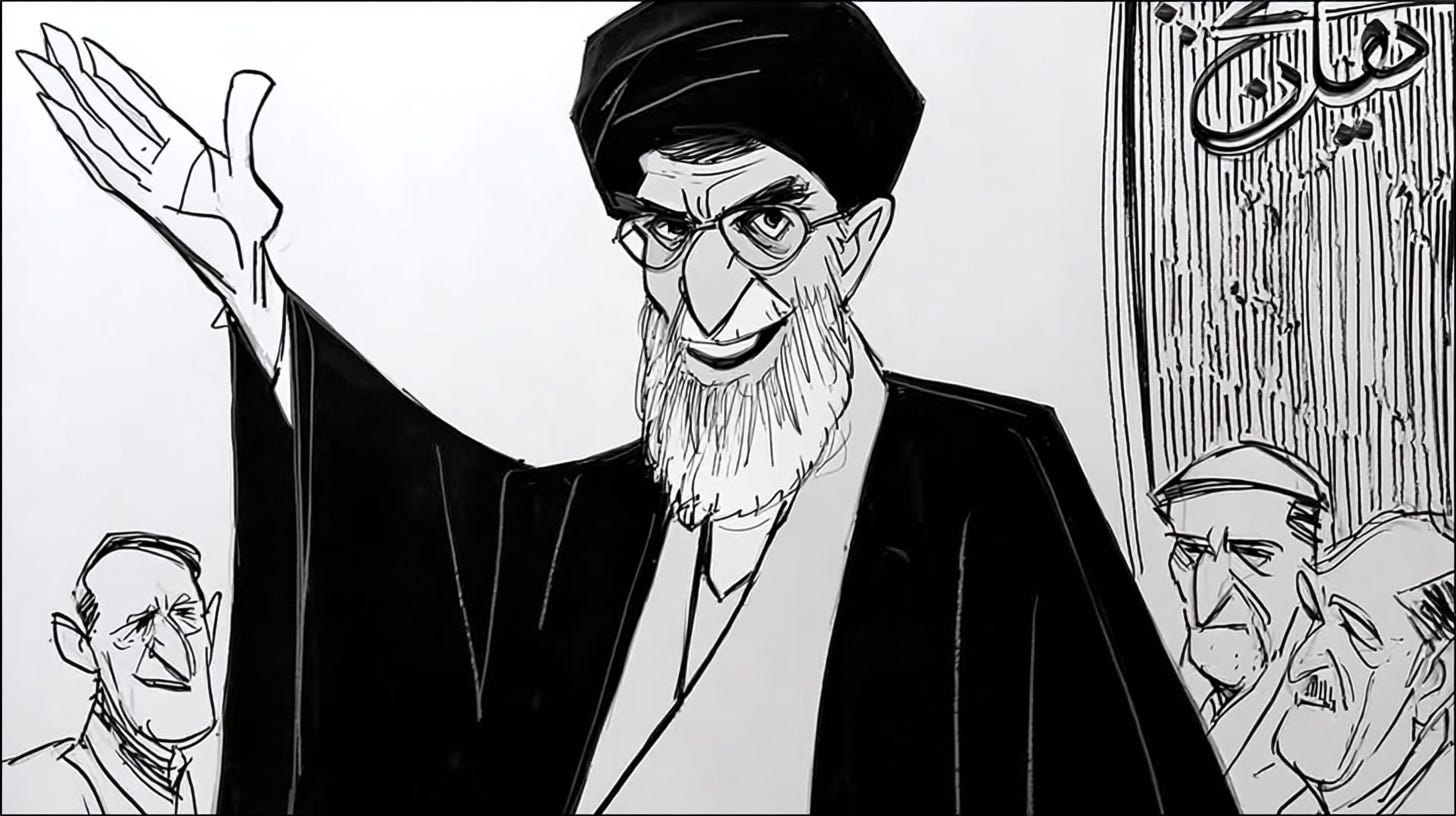
Ayatollah Ali Khamenei is dead, and one need not strain to understand why the streets of Tehran filled with celebration within hours of the confirmation. A man who presided for nearly four decades over a system that imprisoned dissidents, crushed labor unrest, executed thousands, enforced clerical authority with the blunt instruments of police and prison, and treated ordinary lives as expendable in the service of ideological purity was never likely to be mourned by those who endured his rule. The news of his death has produced joy, and that joy is evidence — stark and irrefutable — of how long the Iranian people have been asked to absorb humiliation without recourse.
I recognize in that celebration something legitimate. I will not presume to instruct people who lived under that system about the emotions they are permitted to feel at its apparent weakening. There is a long tradition, in the literature of liberation and in the history of revolutions, of moments that feel like the end of something unbearable. Those moments deserve to be taken seriously on their own terms.
And yet.
What a Courtroom Holds That an Airstrike Cannot
There is something profoundly, structurally unsatisfying about the manner of this departure. Khamenei will not sit in a courtroom. He will not hear the testimony of the families whose sons disappeared into Evin Prison, whose daughters were beaten in the streets during the 2022 uprising, whose livelihoods were consumed by corruption and clerical patronage. He will not be forced to confront the names, the faces, the accusations that history had accumulated against him across thirty-seven years.
This matters more than it might seem.
When we speak of transitional justice — the body of practice and theory developed from Nuremberg forward, refined through South Africa’s Truth and Reconciliation Commission, the International Criminal Tribunal for the former Yugoslavia, and the Rwandan gacaca courts — we are speaking about a process that does something violence cannot. A trial forces a regime to be named. It compels witnesses to speak in public, before their own countrymen, under oath. It makes the state’s crimes into record rather than rumor. It denies the perpetrators the dignity of martyrdom and denies their successors the luxury of myth. When Slobodan Milošević sat in The Hague — however frustrating those proceedings became, however long they dragged — the act of sitting there was itself a statement about what the civilized world believed about power and its limits.
Khamenei will be buried as a martyr of the revolution he spent his life sustaining. His death by American and Israeli bombs will be useful to the very forces most committed to continuing what he built. The Islamic Republic’s founding mythology has always required an external enemy. It has just been handed one at the precise moment it needed it most.
This is what violence from the sky provides: an end to the man, and a gift to the ideology.
The Architecture That Remains
The death of one man — even the man at the apex of a system — does not dissolve the structure that sustained him. This is the truth that the celebrations risk obscuring, and the intelligence assessments available suggest it is a truth American planners have reason to understand.
The Islamic Revolutionary Guard Corps does not vanish with its patron. Over four decades, the IRGC evolved from a parallel military force into something far more durable: a self-financing power structure that fuses battlefield experience with economic capture. It controls Iran’s missile forces, its internal security apparatus, and an economic empire built from sanctioned industries, construction, and the country’s oil infrastructure. These networks of power, profit, and fear do not politely retire because the figure at the top has been removed. If anything, sudden decapitation tends to accelerate the consolidation of power among exactly those mid-level commanders and security managers for whom any compromise represents an existential threat.
Senator Mark Warner, the top Democrat on the Senate Intelligence Committee, was blunt on this point: “I have seen no new intelligence that changes the fact of how complicated regime change would be.” Intelligence assessments prepared ahead of the strike considered multiple scenarios, and several pointed toward the same outcome — whatever formally replaces Khamenei is likely to be a leadership structure in which the IRGC holds real power, regardless of who occupies the religious title.
One scenario that U.S. analysts considered plausible: a surviving IRGC leadership, shorn of its most ideologically invested commanders, that decides compliant pragmatism is more survivable than confrontation. A regime that gives up the nuclear program. A regime that opens economic negotiations. A regime that is, in the familiar phrase, more moderate.
More moderate than what, exactly, must be asked. More moderate than the administration that ordered the January 2026 shoot-to-kill directive against its own citizens? More moderate than the system that executed over two thousand people in 2025 alone? The bar for “more moderate” has been set very low indeed, and the history of such transitions — from the Soviet Union’s collapse to the aftermath of the Arab Spring — gives us no particular reason for optimism that what emerges from IRGC consolidation will be a democratic republic.
Who Gets to Celebrate Liberation
There is a familiar and deeply unpleasant spectacle visible from abroad right now. The diaspora demonstrations in Toronto, Los Angeles, and Munich are genuine expressions of grief transformed into hope — people whose families were marked by this regime, who fled it or lost relatives to it, who have carried its weight across oceans. That grief is real. That hope is legitimate.
But there is also, mixed in with it, the specific satisfaction of those who will congratulate themselves for a liberation they will not have to live through. The people celebrating in London and Los Angeles will not experience the instability that follows this strike. They will not navigate the power vacuum, the potential for factional violence, the economic collapse that was already accelerating before the first bomb fell. They will return to their lives in Toronto with the relief of having watched something they wanted to happen, happen.
The people in the streets of Tehran are living inside a different experience entirely. For them, the celebration and the fear are simultaneous. The joy at the end of a tyrant and the terror of what comes next occupy the same body, the same moment. These are people who know what instability looks like from the inside — who watched 2009 become repression, watched 2019 become massacre, watched 2022 become the systematic targeting of young women in the streets — and who have paid, every time, when hope collapsed back into violence.
What they deserved was a reckoning that belonged to them. A courtroom in Tehran. Their oppressors compelled to face their accusers on Iranian soil, under Iranian law, before the Iranian people. The full accounting of what was done and who did it and in whose name. That process — slow, expensive, imperfect, interminable — is the only one that actually transfers power back to the society from which it was stolen. Everything else is a substitution.
Not Yet Liberation
This is not justice. It is the removal of one man from a structure that predates him and will, in some form, outlast his removal.
The Iranian people have earned their grief, their relief, and their hope. They have earned every emotion available to human beings who have survived what they survived. The January 2026 massacre alone — in which somewhere between seven thousand and thirty-six thousand people were killed, in which hospitals were raided and wounded protesters finished in their beds — places beyond question the moral legitimacy of any desire to see this regime end.
But the end of Khamenei is not the end of the Islamic Republic. Not yet. The prisons do not empty themselves. The institutions built over forty-seven years do not dissolve because one man has died in an airstrike. The question of who holds the guns is not resolved; it is, if anything, made more urgent by the chaos of transition.
History has given us very little reason to believe that chapters written in explosions end the way they are promised they will. The promise from Washington this morning — take over your government, it will be yours to take — is a sentence that has been said before, in other countries, in other decades, and the gap between that promise and what followed is a graveyard of better futures.
What the Iranian people deserve, and what this moment cannot yet deliver, is not a new chapter written by someone else. It is the chance to write their own.
That chance is still, as of this moment, a possibility rather than a reality. It is something to work toward, not something to declare. And anyone who tells you otherwise — from a television studio in Washington, from a protest in Toronto, from the rubble of a compound in Tehran — is selling you something that history has not agreed to honor.
Tags: Ayatollah Khamenei death, Iran regime change 2026, transitional justice Iran, IRGC succession crisis, U.S.-Israel Iran strikes