

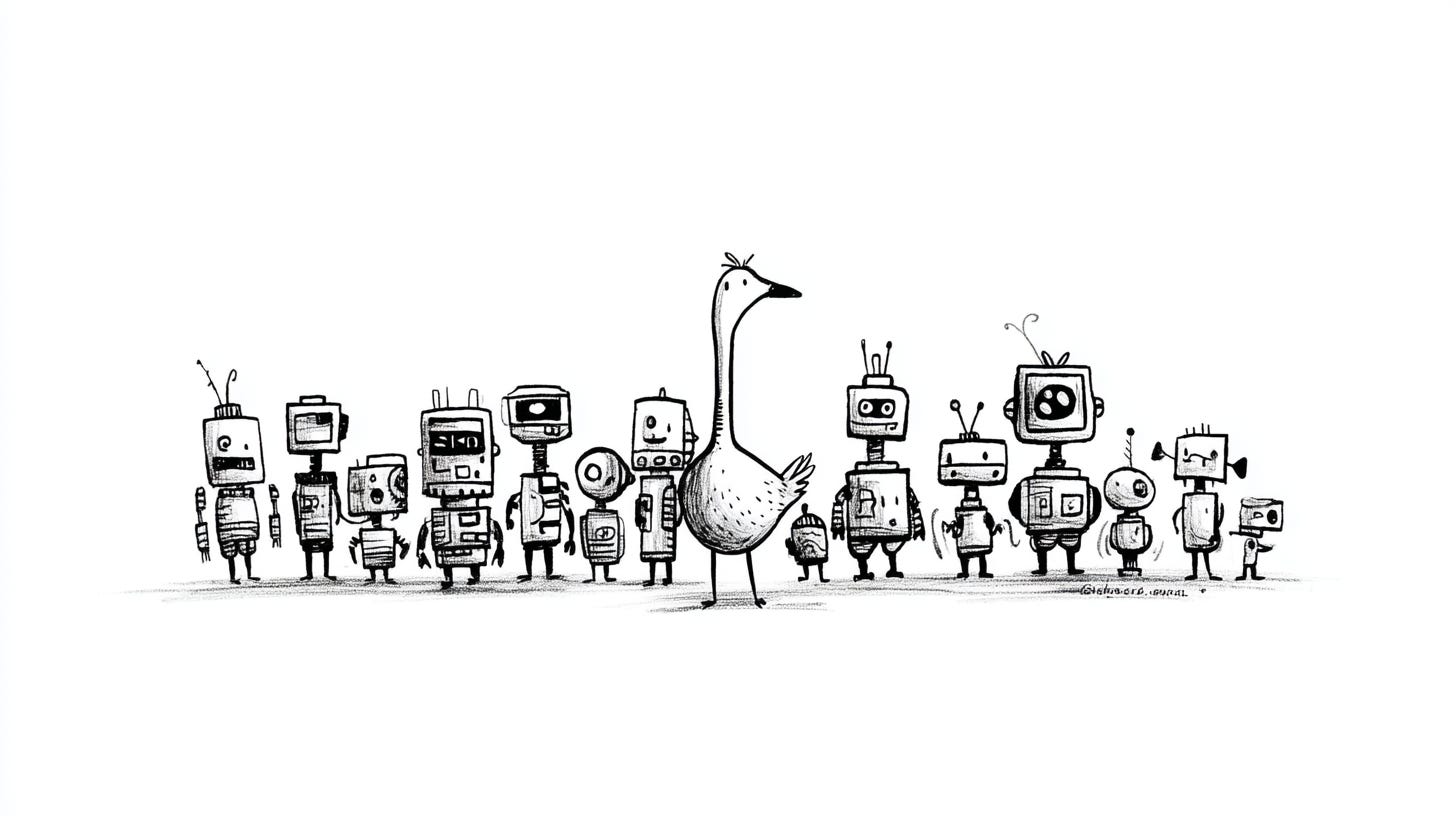
There is a particular cruelty in being required to train the thing that will replace you. Not the cruelty of malice—no executive at Block, Inc. woke up last Thursday thinking about how to humiliate someone—but the cruelty of systems, which is colder and more efficient than anything a single person could engineer. On February 26, 2026, Block announced it was eliminating 40 percent of its workforce: more than 4,000 people, gone, shrinking the company from over 10,000 employees to just under 6,000. Jack Dorsey, the co-founder and CEO, explained it simply. “Intelligence tool capabilities are compounding faster every week,” he wrote in his shareholder letter. A smaller team, using the tools they’ve built, can do more. Can do it better.
He was probably right. That’s the part that should keep us up at night.
I came to this story with the usual skepticism about corporate announcements of revolutionary change. Companies have been promising to do more with less since at least the invention of the spreadsheet. But Block’s restructuring is something different—not in kind, necessarily, but in degree and in candor. Dorsey didn’t claim market conditions forced his hand. He claimed he was early. “I think most companies are late,” he wrote. “Within the next year, I believe the majority of companies will reach the same conclusion.” This is not a defensive posture. It is a declaration. And declarations of this type, made by people with the data to back them, have a way of becoming self-fulfilling.
What the Numbers Actually Mean
Before we can reckon with what Block has done, we have to reckon with what Block had become. The company employed 3,835 people at the end of 2019. By 2022, that number had ballooned to 12,428—a 224 percent increase in three years, fueled by pandemic-era digital demand, cheap capital, and the acquisition of Afterpay. This was not sustainable; everyone in the industry knew it. The question was how the correction would come. Block answered it by arriving at a number—6,000—that looks less like a reduction than a thesis. Not “we over-hired”; but “we now know what we actually need.”
What they need, it turns out, is a framework called Goose.
Goose is Block’s proprietary AI agent, open-sourced in January 2025 and by late that year integrated with approximately 150 internal services. It is not a chatbot. It doesn’t answer questions. It acts: searching codebases, writing and testing code, diagnosing bug reports, managing work tickets, even triggering phone calls through third-party tools. Block’s internal team uses Goose to maintain Goose itself—a recursive loop that would be philosophically interesting if it weren’t also a performance review of every engineer who might otherwise have done that maintenance manually. When a bug appears in the Goose repository, the agent spins up in a container, traces the issue to its root, and opens a pull request with a proposed fix. If it fails, you lose minutes of compute time. If it succeeds, you’ve eliminated hours of human labor.
Multiply that across a company of 10,000 people. Then ask yourself how many of those people you still need.
The Architecture of Perpetual Evaluation
Here is what distinguishes the current AI moment from previous waves of automation: the workers being displaced are not just being replaced by machines. They are being asked, as a condition of their continued employment, to use the machines. To demonstrate proficiency. To generate workflows that benefit their teams. To send weekly emails to the CEO describing what they accomplished—emails that are then summarized by generative AI for Dorsey’s review—performing their own relevance for an algorithm that will determine whether they remain.
This is what “perpetual evaluation mode” means, and it is a precise description of a specific psychological condition. It is not the ordinary anxiety of a performance review, cyclical and bounded. It is continuous, ambient, and recursive. The worker must use the tool. The tool improves on the worker’s usage. The improved tool is then used to justify the next round of cuts. Employees at Block have described the environment as “death by a thousand cuts.” Morale is at record lows. People describe “AI burnout”—the exhaustion of being simultaneously a user, a trainer, and a test case.
None of this is unique to Block. Google mandated exclusive use of its internal Goose-derived models for all engineering tasks in September 2025, effectively banning third-party AI tools and tying career advancement to demonstrated AI fluency. By late 2025, more than 30 percent of code written at Google was AI-generated. At xAI, 500 data annotators—specialists hired explicitly to evaluate and refine AI outputs—were laid off in late 2025 after their work had sufficiently trained the systems that would perform future annotation without them. This is the transition trap made visible: you are hired to build the ladder, and then the ladder pulls itself up.
The pattern has a name in agricultural technology: the “transition trap,” where producers cycle through evaluation of new tools without ever arriving at the promised efficiency gains because the technology keeps moving. But in the tech sector, the trap works differently. The efficiency gains are real. They just accrue to the company, not the worker.
What the Market Rewarded
Block’s stock surged between 23 and 27 percent in extended trading after the announcement. Let that settle for a moment. The elimination of 4,000 jobs—4,000 people who had mortgages and children and professional identities built inside this company—produced nearly a quarter increase in share value within hours. The market was not rewarding Block for achieving something new; it was rewarding Block for finally doing what the market had been implying was necessary for years.
The financial logic is seductive and, on its own terms, coherent. Block achieved what analysts call the “Rule of 40”—combined growth rate and profit margin exceeding 40 percent—in late 2025. Cash App gross profit grew 33 percent year-over-year. Revenue hit $6.25 billion in Q4 2025. The company simultaneously announced a $5 billion share repurchase program. These are not the numbers of a company in distress. They are the numbers of a company that has found a more efficient configuration for existing success.
The question the market doesn’t ask—because the market is not designed to ask it—is: more efficient for whom?
A company that generates $6.25 billion in quarterly revenue and responds by eliminating 40 percent of its workforce is not solving a problem. It is redistributing the gains from solved problems. The productivity is real. The profits are real. The 4,000 people no longer receiving paychecks are also real. Dorsey acknowledged on X that the decision “might feel awkward,” but argued it was more humane than the “drip-drip-drip” of gradual cuts. He provided 20 weeks of severance, six months of healthcare, vested equity through May. By the standards of the industry, this was generous. By the standards of what these workers produced over years of labor, it was the minimum.
What Comes After the Correction
I want to resist the temptation to call what is happening at Block and across the technology sector a straightforward story of greed, because that framing is too easy and too incomplete. What Dorsey is describing—a world where a small team, augmented by AI agents, can do what once required hundreds of people—is not a fantasy. The Goose framework demonstrably exists. The productivity gains are measurable. The “intelligence-native” operating model is a coherent vision, not a euphemism.
But coherence is not the same as justice, and efficiency is not the same as wisdom.
The roles being eliminated first are the ones that built the pipeline: entry-level engineers who would have become senior architects, junior analysts who would have become CFOs, QA testers whose tedium was also their apprenticeship. The developer community has begun to worry about what they call the “maintenance mode trap”—the risk that by cutting so aggressively, companies lose the institutional knowledge and creative instinct necessary for the next generation of products. You cannot automate your way to the future if you’ve eliminated everyone who knows how the past was built.
There is a deeper problem, and it is this: the people who will control the AI infrastructure are not the people who will be displaced by it. The wealth generated by machines overseen by a small technical elite will not distribute itself. It will concentrate. Some labor economists have begun using the term “digital stratification” to describe what happens when a single company can generate the same revenue with half the people—not because the work disappeared, but because the work’s value was captured by shareholders rather than shared with the workers who trained the systems.
Block’s restructuring is not the end of a story. It is the announcement that the story has changed, and that most of us are reading yesterday’s edition.
What We Must Now Ask Ourselves
Dorsey says the majority of companies will follow. He is probably right. The economics are too compelling and the tools are too good. What we are watching is not an aberration but an acceleration—the visible leading edge of a restructuring that will touch nearly every professional sector within a decade.
The question is not whether this transformation happens. It will. The question is whether we decide, collectively, that the productivity gains belong only to the shareholders of the companies that automate, or whether we build the policy architecture—labor protections, portable benefits, retraining investment, profit-sharing mechanisms—to ensure that the people whose work trained these systems share in what those systems produce.
Block’s stock is up 24 percent. Four thousand people are filing for new jobs. These two facts are not in conflict with each other. They are the same fact, seen from different floors of the same building.
We know what the market decided. The market always knows what it decided.
The harder question is what we decide.
Tags: Block Inc layoffs 2026, Jack Dorsey intelligence-native, AI workforce displacement, agentic AI enterprise automation, perpetual evaluation mode