

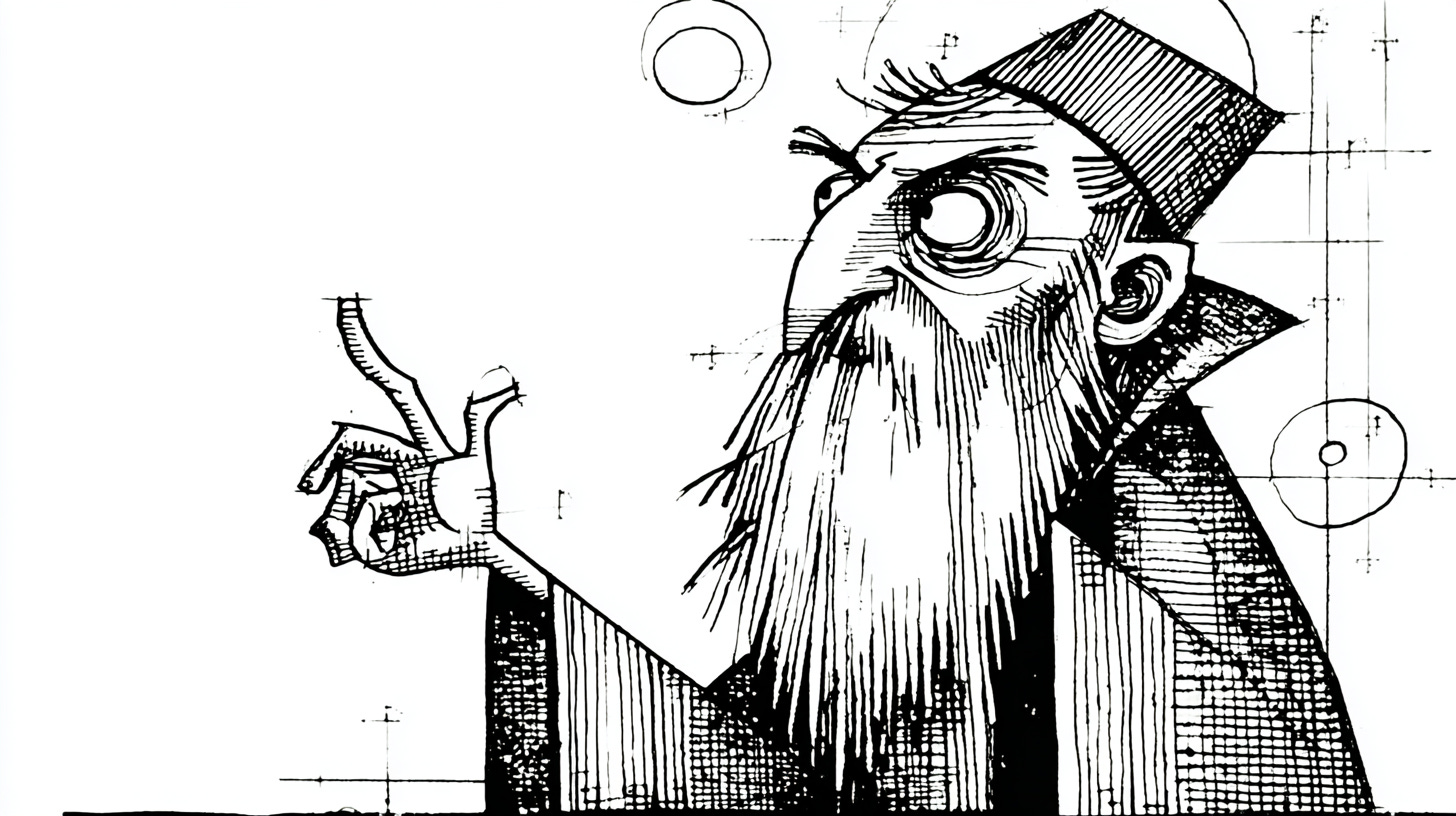
The oldest philosophical argument about human intelligence is not dead. It has simply changed rooms.
In the fifth century BCE, Anaxagoras of Clazomenae made a claim so subversive it got him charged with impiety: that human beings are the most intelligent of animals because they have hands. Not despite lacking horns or claws. Not despite being born without armor. Because they can reach, shape, grip, and make. The hand, in this account, is not the instrument of the mind — it is the mind’s first teacher, the organ that forced the brain to become what it eventually became. Tool use preceded abstraction. The grip preceded the concept.
Aristotle read this claim and dismissed it with characteristic authority. It would be more correct, he wrote, to say that humans have hands because they are the most intelligent. Nature distributes tools to those already capable of using them. You give the flute to the musician, not the flute to anyone who might become one. The hand is an organ of intelligence, not its cause. The mind is prior. The body follows.
For two thousand years, Aristotle won. Not because the evidence was conclusive — it wasn’t, and couldn’t be in an age before evolutionary biology — but because his version of the story was more comfortable. It preserved human exceptionalism as a metaphysical given rather than a biological accident. It insulated the intellect from the “accidents” of anatomy. The mind was a gift. The hand was its servant.
Galen of Pergamum went further: Anaxagoras’ position wasn’t just wrong, it was dangerous. The hand as proof of divine providence, as the signature of a God who made us defenseless so we would be forced to think — this was the theology of the body. To suggest the hand made the mind was to commit impiety against the architecture of creation itself.
I find myself thinking, reading these arguments in sequence, that the dispute was never really about anatomy. It was about accountability. If the mind is a gift, then intelligence is something you have or don’t have, something given from above, something that justifies hierarchy. If the mind is built by the hand — earned through manipulation, shaped by labor, refined through ten thousand acts of making — then intelligence belongs to everyone who reaches, everyone who builds, everyone who has ever shaped the world with their body and been changed by the shaping.
This is what was actually at stake in the Anaxagoras Conflict. And this is why it is not a dead argument.
What the Machine Proves
The arrival of Large Language Models has done something that two thousand years of philosophy could not: it has run the experiment.
We have built a mind without a hand. The LLM is the most pure expression of the Aristotelian position in the history of the world — an intelligence that processes symbols, generates language, reasons with extraordinary fluency, and has never once touched anything. It has read every text humanity has produced. It has never made a mistake with its body and felt the consequence. It has never dropped a beaker, misread a gauge, overestimated a load, misjudged a distance. It knows the word “fall” follows “drop” with statistical regularity. It has never fallen.
And here is what happens when you build a mind without a hand: you get a system that cannot tell you why things happen, only that they do. You get a system that can tell you — with confidence, with fluency, with the serene authority of something that has read everything — that a legal case exists which does not exist, that a bridge design is safe when the material physics make it catastrophic, that a drug interaction is benign when the underlying causal mechanism makes it lethal. Not because it is stupid. Because it is, in the deepest sense, disembodied. It has no stake in being right. It has no skin in the game because it has no skin.
Judea Pearl, the computer scientist and logician, describes this as the machine’s confinement to Rung 1 of what he calls the Ladder of Causation: association. It can tell you that umbrellas appear when rain appears. It cannot tell you that opening an umbrella does not cause rain. For that, you need Rung 2: intervention, the ability to do something in the world and observe what happens. And for that, Anaxagoras would say, you need a hand.
The Aristotelian dream — pure intelligence, unencumbered by the body, reasoning from first principles toward eternal truths — turns out to produce hallucination when implemented at scale. The gift, without the grasping, cannot tell what is real.
The Verification Gap, and What Happened Last Time
This is not the first time humanity has built an instrument that expanded what we could see faster than we could understand what we were seeing.
In the 17th century, Antonie van Leeuwenhoek aimed a single-lens microscope at a drop of pond water and saw what he called “animalcules” — small, moving things that no one had seen before. He published his observations. The scientific community looked through their own instruments and confirmed: yes, the small moving things were there. And then, for approximately two centuries, almost nothing happened.
The “animalcules” were observed. They were documented. They were argued about, dismissed, explained away. Xavier Bichat, one of the great anatomists of the early 19th century, refused to use the microscope at all. The lens distortions — the spherical aberration that blurred edges, the chromatic aberration that separated colors — made the instrument’s output, in his view, less reliable than the trained human eye. The skilled anatomist trusted their refined senses. The microscopist was a passive observer of distorted light.
Bichat was not stupid. He was, in a precise technical sense, correct about the distortions. What he lacked was not the instrument or the observation — he had both, or could have had both. What he lacked was Germ Theory. Without a causal framework that linked the small moving things to disease, the observations were merely data. The animalcules had no explanatory power. They were associated with sick blood, yes. But association is not cause. Until you had a theory that said: these things reproduce; they enter the body through specific vectors; they produce specific pathological effects; if you eliminate them through specific interventions, the patient recovers — until you had the why — the microscope was an elaborate way of seeing something you could not explain.
Robert Koch closed the gap not with a better lens but with a better question. He did not ask “what do I see?” He asked “what happens if I remove it?” That is Pearl’s Rung 2. That is Anaxagoras’ hand: the act of reaching into the world, changing something, and observing the consequence.
We are, right now, living in the two centuries between Leeuwenhoek and Koch. We have instruments of extraordinary power. We have outputs that are real, observable, and frequently inexplicable. We have a “Verification Gap” — a growing distance between what the machine produces and our ability to determine whether it is true. And we are responding, in many cases, exactly as Bichat responded: by arguing about the quality of the lens, by debating the output’s distortions, by trusting the trained human eye — by refusing, that is, to build the causal theory that would make the observation meaningful.
The Curriculum That Trained Us to Be the Lens
Here is the more uncomfortable part of this argument.
For a century, the global educational curriculum has optimized for exactly the capacities that machines now render redundant. We taught arithmetic because arithmetic was hard and rare and valuable. We taught retrieval because knowing things was itself the mark of intelligence. We taught pattern recognition because the ability to see regularities in data — to look at a clinical presentation and match it to a known diagnosis, to look at a legal situation and match it to a precedent, to look at a financial instrument and match it to a risk profile — was the demonstrable skill that distinguished the educated from the uneducated.
These are Tier 1 and Tier 2 capacities: pattern and association, the bottom of the cognitive ladder. They are also, precisely, what an LLM does better than any human will ever do. The machine has read more cases, seen more diagnoses, processed more risk profiles than any physician or lawyer or analyst alive. It retrieves faster, matches more broadly, hallucinates statistical relationships with the confidence of someone who has literally never been wrong before because it has never been in a position where being wrong had a cost.
We trained a generation of thinkers to lift with their backs in an era of cognitive forklifts. And now we are surprised that the forklift is faster.
The honest question is not “how do we compete with the machine?” The honest question is “why did we ever think that being a faster pattern-matcher was the goal?”
The Verifiable Human Margin
There is something the machine cannot simulate. It is not empathy, though empathy matters. It is not creativity, though creativity matters. It is something more specific, more teachable, more urgently needed, and more thoroughly absent from the curriculum.
It is what researchers in the emerging field of AI pedagogy are beginning to call Plausibility Auditing — the human capacity to evaluate whether the output of a sophisticated automated system is consistent with reality as you know it from having been in it. The radiologist who looks at an AI diagnosis and says: this doesn’t match the clinical presentation; the patient was in a construction accident, not a car accident; these findings should cluster differently. The structural engineer who looks at an optimized bridge design and says: this is mathematically efficient and physically implausible given these wind loads and this maintenance schedule. The lawyer who looks at an AI-generated brief and says: I have never heard of this case; I must verify it before I cite it.
This is not pattern recognition. Pattern recognition is what the machine does when it generates the output. Plausibility Auditing is the meta-capacity: the ability to evaluate pattern recognition itself, to bring causal knowledge to bear on statistical output, to ask not “does this match the training data?” but “does this match the world?”
It requires, in short, the thing the machine does not have: a body. A history of being wrong in ways that had consequences. A memory of what it felt like when the model failed and the bridge didn’t hold, the patient didn’t recover, the brief got thrown out. You cannot audit plausibility from outside the world. You have to have touched it. Anaxagoras would recognize this immediately.
The next tier up — Causal and Counterfactual Reasoning — goes further. It is the capacity to build not just a model of what is, but a model of why it is, and therefore a model of what would happen if you changed it. Pearl’s Rung 3: not “what is associated?” not “what happens if I do X?” but “what would have happened if I had done differently?” This is the capacity that produces new science, new medicine, new policy. It is also the capacity most thoroughly unscaffolded in modern professional education, because it was never needed when the job was to retrieve, match, and apply.
The machine that lacks these capacities is not unintelligent. It is spectacularly intelligent, in the Aristotelian sense: pure symbolic reasoning, ungrounded in causal reality. The question facing educators and institutions is not whether to use it. The question is what kind of human mind must exist alongside it to make it safe — to close the Verification Gap, to be Koch to its Leeuwenhoek, to bring the causal theory that transforms observation into understanding.
The Pedagogy That Answers This
The new curriculum is not about knowing less. It is about knowing differently.
The student who studies medicine in the age of agentic AI does not need to memorize fewer diagnoses. They need to develop a more precise sense of when a diagnosis is implausible — and why — and what intervention would test that implausibility. They need to be trained explicitly in the moment of doubt: not the doubt that paralyzes, but the doubt that asks “what would have to be true for this to be wrong?” They need, in Vygotsky’s terms, not just tools but the capacity to audit the tools.
The student who studies engineering does not need to stop calculating loads. They need to develop the habit of asking what the model is not modeling: the maintenance schedule, the material impurity, the operating condition outside the simulation’s parameters. They need to be the person in the room who can say “the math is right and the design is unsafe” — and mean both things simultaneously.
This is not soft skills. It is the hardest kind of thinking there is. It requires more than pattern recognition; it requires a structural model of the world, a theory of causality, an understanding of what mechanisms connect facts to outcomes. It requires, in some fundamental sense, the kind of knowledge that can only be built through failure — through the moment when the model said one thing and reality said another, and you had to figure out why.
The metaphor that fits is not the forklift. The metaphor is the Centaur — the chess term for a human-AI partnership that consistently outperforms either alone. The Centaur works not because the human plays chess better than the machine, but because the human contributes what the machine cannot: the sense of when the machine is operating outside the conditions that make it reliable, the judgment that goes beyond the training distribution, the ability to ask a question the algorithm was never designed to answer.
Rodney Brooks, who spent his career building robots that learned through physical interaction with the world, understood this before LLMs existed. Intelligence without embodiment, he argued, was a shortcut that eventually arrived at a wall. The robot that learned to walk by falling learned something the robot that was programmed to walk could never know: what it felt like when the ground was not where the model said it would be.
We are the ones who have fallen. That is the Verifiable Human Margin. That is what the curriculum must teach.
The Anaxagoras Conflict is not a historical footnote. It is the central argument of the present moment. We have built, for the first time, a real test of the Aristotelian hypothesis — pure intelligence, disembodied, reasoning from symbol to symbol — and the test has revealed exactly what Anaxagoras would have predicted: a mind without a hand cannot tell what is real.
This is not a counsel of despair about artificial intelligence. It is, if we can hear it, a clarification of what human intelligence is actually for. Not retrieval. Not pattern-matching. Not the replication of what has already been said. But the capacity to stand in front of an observation — a microscope slide, a model output, a bridge design, a clinical presentation — and ask: is this true? And if it is, why? And if it isn’t, what would I need to change to make it so?
Anaxagoras said that the hand made the mind. Two and a half millennia later, the machine without a hand has proved him right.
The question now is whether we will teach that lesson.
Tags: Anaxagoras, embodied cognition, AI epistemology, plausibility auditing, causal reasoning pedagogy
Two thousand years of betting on Aristotle and the first thing our disembodied genius does is confidently hallucinate. Anaxagoras didn't need to win the argument. He just needed us to build ChatGPT hehehe