

What Seventeen Projects Reveal About How Change Actually Gets Built
There’s a number that keeps appearing in research on international students navigating the American job market. Not the one you’d expect—not the graduation rate, not the GPA differential. It’s this: 44.6%.
That’s the employment rate for international students after graduation. Their domestic peers, same degrees, same schools, land jobs at 62.1%. The gap isn’t talent. It isn’t effort—international students file twice as many applications. The gap is structural. It’s information asymmetry dressed up as a meritocracy.
Now hold that number. We’ll come back to it.
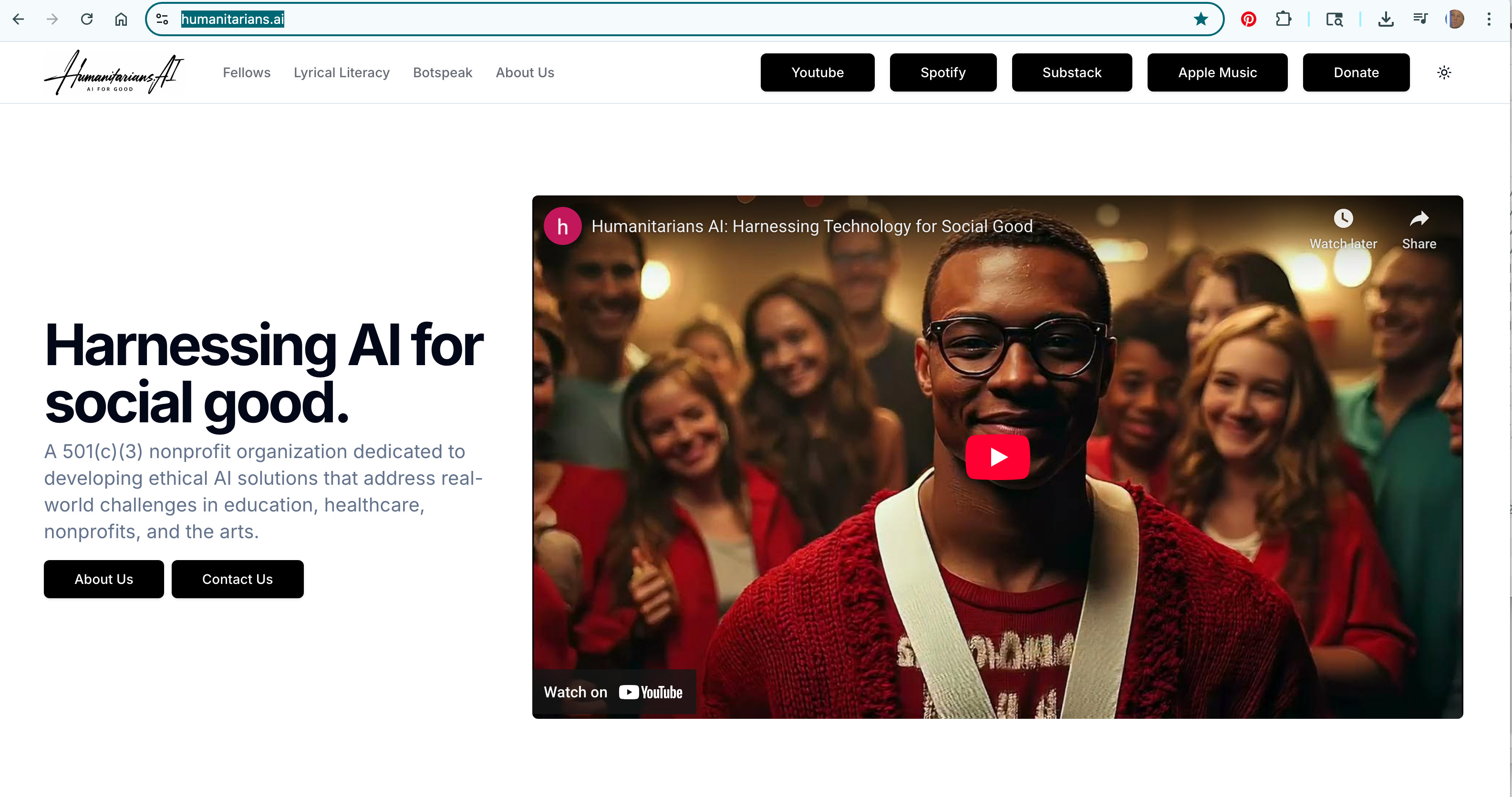
The Humanitarians AI Fellows Program doesn’t describe itself as an ecosystem. It describes itself as a collection of projects. But spend time with the seventeen initiatives operating under its umbrella—the ones teaching job seekers, analyzing wastewater, validating AI systems, telling nonprofit stories, training bioinformatics agents, teaching children through song—and a different picture emerges.
What I’m building isn’t a collection of good ideas. It’s infrastructure. The kind that takes a decade to understand and a generation to use correctly.
The Short Version
What this is: Seventeen open-source AI projects, led by students and recent graduates at Northeastern and beyond, each solving a distinct problem in health, education, democracy, or economic access. All operating under Humanitarians AI, a 501(c)(3).
What connects them: Four shared frameworks—Madison (marketing intelligence), Popper (AI validation), Bellman (reinforcement learning), Boyle (scientific documentation)—that any project can draw on, like a shared toolkit.
Who does the work: Fellows. Graduate students and recent graduates trading 20+ hours a week for real portfolio projects, mentorship, and the experience of shipping something that serves actual users.
The proof it works: The 80 Days to Stay project built a data pipeline from SEC EDGAR filings in under a week. Wilkes published a finished article for an Indian nonprofit—Homes of Hope India—within days of receiving raw footage. The RAMAN Effect project is advancing AI-enhanced wastewater surveillance for pathogen detection at the population level.
Why it matters: Every year, talented professionals face forced departure from the country they trained in—not because they lack skills, but because they lack information. Every year, nonprofits doing necessary work fail to tell their story because they lack bandwidth. Every year, AI systems get deployed without rigorous validation because the tools for doing so don’t exist or aren’t accessible.
These projects are the tools.
The Projects: A Directory
80 Days to Stay — Job tools for OPT/H-1B visa holders using SEC data
Boyle Project — NotebookLM as scientific documentation partner
Branding & AI — Intelligent textbook for INFO 7375, Northeastern
Dayhoff Project — Agent-based AI bioinformatics framework
Humanitarians AI — Central 501(c)(3) hub, project-based volunteering
Lyrical Literacy — Neuroscience of singing for cognitive development
Medhavy — AI-powered textbook platform
Musinique — Spotify curator intelligence for independent artists
Northeastern ISE — Collaborative hub for current students and graduates
Politics and AI — B Wells platform for congressional accountability
Popper — Computational skepticism and AI validation
The Learning Engineer — Engineering approaches to learning design
The Madison Project — Agentic marketing and branding framework
The Mycroft Project — AI-powered investment intelligence, AI sector
The RAMAN Effect — AI + spectroscopy for wastewater epidemiology
Wilkes — AI storytelling infrastructure for nonprofits
Zebonastic — AI creative tools for games and film
The Four Shared Frameworks
Every project in this ecosystem can draw on four foundational tools.
Madison is an open-source agentic marketing intelligence framework—five layers of specialized AI agents that handle intelligence gathering, content creation, research, customer experience, and performance optimization. When an independent musician needs to know which Spotify curators are real humans and which are bot farms optimized for pay-for-placement scams, that’s a Madison problem.
Popper, named after Karl Popper’s falsifiability principle, is the ecosystem’s skeptic. It provides systematic AI validation: bias detection, adversarial testing, causal inference, probabilistic calibration. Every AI project in this ecosystem can route claims through Popper before treating them as reliable.
Bellman brings reinforcement learning to marketing optimization. It’s the reason content testing evolves from one-time A/B experiments into continuous improvement—Thompson sampling, value function learning, sequential decision processes.
Boyle, named after Robert Boyle’s insistence that knowledge only counts if it’s traceable and repeatable, is the documentation system. It uses NotebookLM as an active cognitive partner rather than a passive archive: tutor, critic, operational guide. The insight is deceptively simple—in cloud-based research, you cannot reproduce results without reproducing access.
The Thread Running Through All of It
Return to that number: 44.6%.
The 80 Days to Stay project exists because this gap is an information problem, not a talent problem. Three facts most employers don’t know: OPT/STEM OPT requires no employer sponsorship. Students on F-1/OPT are FICA-exempt, saving employers 7.65% in payroll taxes. Only 25–33% of US employers even consider international candidates—not because they’re opposed, but because they’ve never been told the economics.
The project maps SEC Form D filings—every private offering in the US, public data, free—against DOL Labor Condition Application disclosures and USCIS H-1B employer data to reveal funded startups with the capital to hire and the hiring patterns to do it well. Roughly 500 companies raised $5M+ in the last twelve months in biotech alone. Most international students don’t know they exist. Most of those companies don’t know OPT exists.
The match is one piece of information away.
That’s the pattern. Not one project solving one problem, but seventeen projects each removing one layer of information asymmetry—in employment, in public health, in music, in democracy, in nonprofit storytelling, in AI itself.
The gap between what is known and what is acted upon. That’s the territory this ecosystem occupies.
Appendix: Project Profiles
80 Days to Stay
The problem it solves: International students apply to twice as many jobs as domestic peers and receive 30% fewer offers. Only 44.6% are employed after graduation versus 62.1% of domestic graduates. The barrier isn’t qualification—it’s employer ignorance about OPT, FICA exemptions, and sponsorship timelines.
What it builds: A searchable platform matching visa holders with funded startups. Data sources: SEC EDGAR Form D filings, DOL LCA Disclosure Data, USCIS H-1B Employer Data Hub. Output: funded companies with resources to hire, real-time job openings, direct founder contacts, sponsorship likelihood scores.
The technology stack: Python + SEC EDGAR API, PostgreSQL on Supabase, FastAPI on Railway, React + Tailwind on Vercel. Budget: approximately $0/month.
The structural insight: Auto-rejection of “requires sponsorship” candidates funnels international talent to the same 100 companies with established immigration pipelines, while thousands of funded startups sit idle due to misconceptions. Fixing this requires education, not advocacy.
GitHub: 80-Days-to-Stay | Substack
The Boyle Project
The problem it solves: Research knowledge dies three ways—in people’s heads, in scattered files, in vague meeting notes. Mentors spend 40% of meetings on “what did you do?” instead of strategic guidance.
What it builds: A scientific documentation system using NotebookLM in three simultaneous roles: tutor (teaches correct documentation by referencing project charters and degree requirements), critic (challenges vague or incomplete entries), and operational guide (treats API keys and cloud credentials as experimental context, not administrative noise).
The core insight: In modern cloud research, you cannot reproduce results without reproducing access. NotebookLM’s constraint—it reasons only from uploaded sources—becomes its superpower. It can’t give generic advice. It references your specific project charter, your team’s decisions, your standards.
Branding & AI (INFO 7375)
The problem it solves: Branding education that teaches theory without building. Students graduate without portfolio assets, without real tool experience, without positioning infrastructure to compete in creative technology roles.
What it builds: A living intelligent textbook for Northeastern’s INFO 7375. Two deliverables per student: a technical contribution to the Madison Framework, and a complete professional brand. Every chapter produces a tangible portfolio asset.
Instructors: Nik Bear Brown (AI engineering, Madison framework creator) and Nina Harris (40+ years at Publicis, Saatchi & Saatchi, McCann Erickson, Charles Schwab).
The Dayhoff Project
The problem it solves: Computational biology, epidemiology, and public health work requires coordinating domains—genomic analysis, epidemiological modeling, clinical intelligence, molecular modeling, biostatistics—that don’t naturally communicate.
What it builds: An open-source agent-based bioinformatics framework with six specialized agent categories coordinated by a central orchestration layer. Active sub-projects include PredictaBio (generative AI for novel protein design) and the RAMAN Effect (AI-enhanced wastewater epidemiology).
Named after: Margaret Belle Dayhoff, pioneer of bioinformatics and creator of the first protein sequence databases.
Lyrical Literacy
The problem it solves: Singing is cut from school curricula despite engaging more brain regions simultaneously than nearly any other human behavior. The evidence for its benefits in language acquisition, memory formation, and neural plasticity is substantial. The infrastructure to deploy it at scale isn’t.
What it builds: AI-powered tools, songbooks, and interactive platforms using tools like Suno and Udio, adapted to individual learning objectives and developmental needs. Backed by seven published research papers covering neuroscience of singing, music and second language acquisition, neural and cognitive effects of musical training, and more.
GitHub: Lyrical-Literacy | Substack
Medhavy
The problem it solves: Educational AI that gives the same answer to every student regardless of learning style, prior knowledge, or goals. Generic AI tutors that don’t know what’s in your course materials and will hallucinate citations.
What it builds: A distributed AI-native textbook ecosystem with a two-stage AI pipeline: context analysis followed by retrieval-augmented generation that searches only course-specific materials, enforces TEXTBOOK_ONLY mode, and requires source citation. A dual-prompt model combines instructor persona with learner persona (Pragmatic Professional vs. Aspiring Scholar), stored in Clerk metadata and composed dynamically at query time.
Musinique
The problem it solves: Independent musicians pitch playlists without knowing which curators are real humans, which are bot farms, and which are pay-for-placement scams. Bad placements hurt Spotify’s algorithmic assessment of your music.
What it builds: A curator intelligence database covering 25,000+ Spotify playlists. The Musinique Focus Score (0–100) is derived from entropy analysis: high scores indicate hyper-focused human curation; scores below 20 indicate genre chaos statistically associated with bot farm or pay-for-play behavior. Also tracks weekly turnover rates and average song retention to identify scam patterns (songs dropping off exactly at 7-day paid intervals).
Politics and AI: The B Wells Platform
The problem it solves: Traditional fact-checking is too slow, reaches a fraction of its intended audience, and is perceived as partisan. Politicians assume contradictions won’t be tracked because no persistent, searchable record exists.
What it builds: A multi-agent AI system for political accountability. Core capabilities: automated contradiction detection, visual timelines of position changes, conflict-of-interest surfacing, and paltering detection—catching politicians who mislead through selective omission rather than outright lies.
Design philosophy: Neutral infrastructure, not partisan commentary. The platform presents facts without editorial framing, designed for the “exhausted majority” who can see hypocrisy on both sides and want verifiable evidence.
Named after: Ida B. Wells. “The way to right wrongs is to turn the light of truth upon them.”
Popper (Computational Skepticism)
The problem it solves: AI systems get deployed without rigorous validation. Claims of accuracy go untested. Biases get encoded without detection. Explanations get generated without verification that they reflect actual model behavior.
What it builds: An open-source AI validation framework with ten specialized agent classes: Data Validation, Bias Detection, Explainability, Probabilistic Reasoning, Adversarial, RL Validation, Visualization, Falsification, Graph-Based Reasoning, and Causal Inference. Each class is anchored in a philosophical question—Hume’s problem of induction, Popper’s falsifiability, Wittgenstein’s language games.
The Madison Project
The problem it solves: Marketing intelligence that requires expensive proprietary platforms, massive data teams, and months of implementation. Small brands and independent operators can’t access the same analytical sophistication as enterprise marketing departments.
What it builds: An open-source agentic marketing intelligence framework with five collaborative agent layers, enhanced by Bellman’s RL optimization (content A/B testing becomes continuous Thompson sampling) and Popper’s validation layer (claims undergo falsification testing before driving strategy).
The Mycroft Project
The problem it solves: Individual investors navigating the AI sector face information overload, no systematic validation of research claims, and opaque “black box” analytical tools.
What it builds: An open-source AI-powered investment intelligence framework. Built explicitly to learn what works, not to claim it already knows. Verification Agents independently validate claims across multiple sources. The Mycroft orchestration layer tests approaches to resolving contradictions between agents rather than averaging them.
Named after: Mycroft Holmes—superior analytical ability, preference for orchestrating from behind the scenes.
The RAMAN Effect Project
The problem it solves: Disease outbreaks, drug use trends, antimicrobial resistance, and environmental contamination all leave molecular signatures in community wastewater—but extracting those signals requires analytical capabilities most public health systems don’t have.
What it builds: An integrated public health surveillance system combining Wastewater-Based Epidemiology, Surface-Enhanced Raman Spectroscopy, and machine learning. SERS enhances Raman scattering by factors of 106 to 1014, enabling detection at ultra-low concentrations—sometimes single-molecule levels. Machine learning algorithms achieve 92–96% pathogen identification accuracy.
Proven applications: COVID-19 surveillance (viral RNA detection across 58+ countries), illicit drug monitoring, environmental contaminant assessment.
Wilkes (AI Storytelling for Nonprofits)
The problem it solves: Nonprofits forfeit 23–33% of potential donor revenue annually—not from lack of mission, but from lack of communication infrastructure. The people running these organizations are too busy doing the work to tell anyone about it.
What it builds: A managed AI storytelling service configured specifically for each nonprofit’s voice, mission language, and content history. Input: raw field material. Output: publication-ready content in five formats—Profile, Documentary Arc, Social Entrepreneur Piece, Literary Review, YouTube Package. Nothing is invented. Nothing is embellished.
The proof: Homes of Hope India, Kerala—three weeks from footage on a hard drive to a live Substack with a published article. homesofhopeindia.substack.com
The beta offer: First five nonprofit partners pay nothing. Send one email to bear@humanitarians.ai with subject line “Wilkes Beta.”
Zebonastic
Digital prompts and AI-generated creative work specifically calibrated for games and film production. Substack
Get Involved
Fellows Program: humanitarians.ai/fellows
GitHub: github.com/nikbearbrown
Contact: info@humanitarians.ai
Nonprofit storytelling (Wilkes): bear@humanitarians.ai | “Wilkes Beta”
Humanitarians AI is a registered 501(c)(3). Contributions are tax-deductible to the extent permitted by law.