

You are smaller than you think you are. Or rather, the things that are killing you are smaller than you think—and so, increasingly, are the things designed to stop them.
A nanometer is one-billionth of a meter. A human hair is roughly 80,000 nanometers wide. The machinery of nanotechnology operates somewhere between 1 and 1,000 of those billionths—a scale at which matter stops behaving the way you learned in chemistry class. At the nanoscale, gold isn’t gold-colored. Carbon isn’t just carbon. Surface area explodes relative to volume, and with it, reactivity, magnetism, the ability to slip through biological barriers that have stood for millions of years of evolution. This is not science fiction. It is physics.
And now, quietly, it is medicine.
The Problem with Counting
Here is the frustration at the center of this field: no one agreed on what to call it.
ClinicalTrials.gov, the National Library of Medicine’s registry of human medical studies, holds more than 500,000 registered trials. Somewhere inside that number are the nanomedical trials—studies testing liposomes, polymeric nanoparticles, micelles, metallic nanoparticles, mRNA delivery systems. But the registry has no dedicated field for nanotechnology. There is no checkbox that says “this trial uses nanoscale materials.” Researchers register their trials using whatever terminology feels right to them. One team writes “liposomal doxorubicin.” Another writes “Doxil.” A third writes “nanoencapsulated anthracycline.” They are all describing the same category of intervention.
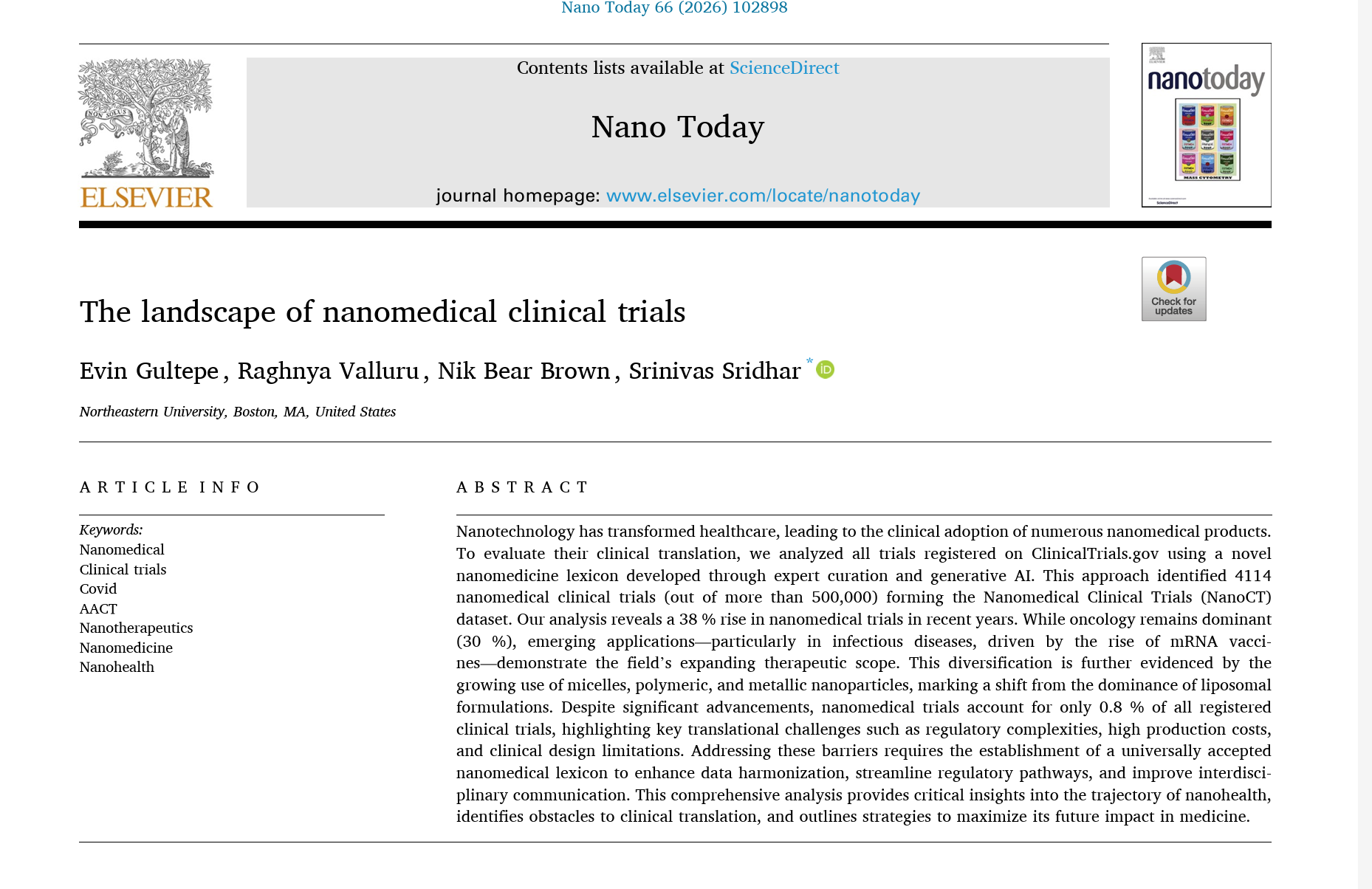
So when my colleagues Evin Gultepe, Raghnya Valluru, and I set out to map the full landscape of nanomedical clinical trials—working with Srinivas Sridhar at Northeastern University—we faced a lexicon problem before we faced a data problem.
The solution was to build the dictionary first.
We developed a nanomedical lexicon through a multi-stage process: expert curation seeded a foundational list, then a fine-tuned version of GPT-4o-mini expanded it against scientific literature and trial databases, and then domain experts reviewed every proposed term, pruning the irrelevant and annotating the essential. The AI demonstrated 94% precision and 97% recall against the expert-curated standard—an F1-score of 96%. That is not a small thing. That number means the machine understood the language of the field well enough to find nearly everything a human expert would find, and almost nothing they wouldn’t.
With that lexicon in hand, we searched the AACT database—the backend relational database behind ClinicalTrials.gov, containing 53 interconnected tables—using PostgreSQL. We filtered on titles, brief descriptions, detailed descriptions. What emerged: 4,114 nanomedical clinical trials out of more than 500,000 registered studies.
That is 0.8%.
Hold that number. We will return to it.
1995: The Year the Clock Started
The era of nanomedicine’s clinical translation has a birth year. It is 1995.
That is when the FDA approved Doxil—liposomal doxorubicin—for AIDS-related Kaposi’s sarcoma. Doxorubicin is a powerful chemotherapy drug with a serious problem: it damages the heart. Encapsulate it in a liposome—a tiny lipid sphere—and the drug’s circulation time extends, its accumulation in tumors increases through what researchers call the enhanced permeation and retention effect, and its cardiotoxicity drops. Same molecule. Different architecture. Dramatically different outcomes.
Doxil was not just a drug approval. It was a proof of concept for an entire philosophy: that the container could be as important as the contents.
For the next decade, nearly all nanomedical clinical trials were liposome studies. The data confirm this. Between 1991 and 2000, the overwhelming majority of trials involved liposomal formulations, with doxorubicin as the most commonly encapsulated drug. The field had one hammer, and it was a good one.
Then, around 2000, the diversification began.
Between 2011 and 2015: 700 nanomedical trials.
Between 2016 and 2020: 1,072.
Between 2021 and 2024: 1,476.
That last number covers only four years. The 38% increase it represents is not merely the field growing—it is the field accelerating. And it is accelerating faster than clinical research as a whole. Total clinical trial registrations actually decreased by 0.4% in the most recent period, largely due to pandemic-related disruption. Nanomedical trials grew by 38% during the same window. Something specific is happening in this corner of medicine.
The something has a name: mRNA.
The Pandemic as Laboratory
Suppose you had to design a molecule to trigger an immune response. You would want something that tells the body’s cells to manufacture a specific protein—the spike protein of a novel coronavirus, say—long enough to train the immune system, but not so long that it causes lasting harm. The molecule is mRNA. Messenger RNA. The instruction manual, not the machinery.
The problem: naked mRNA is fragile. It degrades in seconds in biological fluids. It cannot cross cell membranes on its own. It triggers inflammatory responses. For decades, this made mRNA therapeutics a promising idea that kept failing in practice.
The solution, which earned Katalin Karikó and Drew Weissman the 2023 Nobel Prize in Physiology or Medicine, was nanoscale delivery. Lipid nanoparticles—tiny spheres of ionizable lipids, cholesterol, and PEG-lipids—wrap around mRNA strands, protect them from degradation, fuse with cell membranes, and release the payload inside. The nanoparticle is not the drug. The nanoparticle is the reason the drug works.
When SARS-CoV-2 emerged and its genome sequence was shared in early 2020, the first clinical trials of mRNA vaccines launched within months—a timeline that would have been unimaginable in any prior era of vaccine development. Our analysis identified 505 nanomedical COVID-19 trials, with mRNA vaccine studies accounting for more than 80% of that number. Within four years, COVID nanomedical trials reached a Phase 3 rate of 17%—nearly double the 9% Phase 3 rate seen across the broader NanoCT dataset over the prior decade.
The pandemic did not just accelerate nanomedical research. It compressed timelines that had been considered physically fixed, and it did so because the infrastructure for nanoscale delivery had been built, quietly, for twenty years.
The 0.8% Problem
Return now to that number.
4,114 trials out of more than 500,000. Less than one percent of all registered clinical trials involve nanotechnology. In a field that has produced Doxil, Abraxane, the COVID-19 vaccines, liposomal amphotericin B for fungal infections, and nanoparticle systems designed to cross the blood-brain barrier—less than one percent.
This is not a failure of ambition. It is a failure of translation.
The barriers are structural, not scientific. First: regulatory complexity. The FDA does not classify nanotechnology by size alone—it evaluates whether nanoscale properties alter safety or behavior, which requires additional scrutiny and tailored testing protocols that do not yet have standardized frameworks. The result is that sponsors face uncertainty about what will be required of them before they begin.
Second: production costs. Nanotherapeutics require precision manufacturing at scales that are technically demanding and expensive. A liposomal formulation that performs beautifully in a Phase 2 trial may be nearly impossible to manufacture consistently at Phase 3 volumes without significant additional investment.
Third, and most fundamental: the lexicon problem we started with. Without standardized terminology, data cannot be harmonized across registries, meta-analyses are harder to conduct, regulatory submissions are harder to evaluate, and the field speaks to itself in dialects rather than a common language.
The National Cancer Institute recognized one of these gaps and established the Nanotechnology Characterization Laboratory in partnership with the FDA and NIST—a facility specifically designed to provide preclinical characterization and safety testing for nanoparticles, bridging the gap between research and regulatory approval. It is the right kind of institution. There are not enough of them.
Beyond Cancer
Oncology accounts for 30% of all nanomedical clinical trials. This makes sense: cancer has the biological microenvironments—particularly the EPR effect, which allows nanoparticles to accumulate preferentially in tumor tissue—that make nanotechnology especially effective. And the mortality stakes justify the investment.
But the disease distribution is shifting.
Infectious diseases now account for 14% of NanoCT trials, driven largely by the COVID response. Neurological diseases—particularly conditions requiring drugs to cross the blood-brain barrier—represent a growing frontier. The blood-brain barrier is one of the most formidable obstacles in pharmacology: a selective wall that keeps most therapeutics out of the brain even when the brain is where the disease lives. Nanoformulations including liposomes, polymeric nanoparticles, and metallic nanoparticles are being designed to cross it. A liposomal neuroprotective agent called Talineuren is currently in Phase 1 trials for Parkinson’s Disease. Cardiovascular applications are emerging, including a trial investigating nanoparticle-enhanced plasmonic photothermal therapy for angioplasty.
The nanomedical toolbox is also expanding beyond liposomes. Liposomes still dominate—appearing in 1,425 clinical trials—partly because FDA approval of one liposomal formulation lowers regulatory barriers for subsequent formulations using similar carriers with different payloads. But polymeric nanoparticles, micelles, and metallic nanoparticles are growing. The field is diversifying its containers along with its contents.
The most commonly reformulated drugs tell their own story: paclitaxel appears in 384 trials, doxorubicin in 362, bupivacaine in 241. These are not new molecules. They are old molecules being given new architectures—better delivery, better targeting, fewer side effects. This is the quiet philosophy of nanomedicine: not always to discover new drugs, but to make existing ones work the way they were supposed to.
What the Numbers Cannot Tell You
The United States leads nanomedical clinical trials with 1,602—more than triple China’s 420, which ranks second. France (246) and Germany (195) follow. The distribution correlates roughly with overall research infrastructure and nanomedicine market size, with one notable exception: Europe conducts more nanomedical trials than the Asia-Pacific region despite the Asia-Pacific region having a larger nanomedicine market.
What that gap represents—whether regulatory environment, academic infrastructure, or something else—is a question the data raise but cannot answer.
The phase distribution raises questions too. In the early years of nanomedical trials, 70% were in Phase 1 or Phase 2. By 2021–2024, that proportion had dropped below 40%. But Phase 3 and Phase 4 rates have remained roughly constant. The missing percentage is accounted for by “Phase: Not Applicable” trials, which grew from 2% to over 20% of all nanomedical studies.
This is not a regression. It is expansion. “Not Applicable” trials include observational studies, device-based interventions, and diagnostic applications that do not follow the traditional drug approval pathway. Nanohealth is no longer only about drugs. It is about devices. About imaging agents. About theranostics—systems that simultaneously deliver therapy and enable real-time monitoring of drug distribution and tumor response. The field is exceeding the categories designed to contain it.
The Question That Remains
Can nanomedical research translate at the rate it is developing? The 38% growth in trials is striking. The 0.8% penetration of all clinical research is sobering.
The answer, almost certainly, is not yet—not without intervention. The lexicon problem must be solved, and it must be solved collaboratively, across regulatory agencies, research institutions, and industry. The manufacturing scalability problem must be solved through investment in precision production infrastructure. The regulatory pathway must become more predictable without becoming less rigorous.
The science is ready. The biology of the nanoscale is understood well enough to deliver drugs to tumors, cross the blood-brain barrier, and produce a vaccine in nine months against a novel pathogen. The machinery works.
What has not kept pace is the infrastructure designed to evaluate, approve, and deploy that machinery. That is not a scientific failure. It is an institutional one. And institutional failures, unlike biological ones, are correctable.
The invisible frontier is real. The question is whether the visible institutions can move fast enough to meet it.
This piece is based on research conducted with Evin Gultepe, Raghnya Valluru, and Srinivas Sridhar at Northeastern University, published in Nano Today (2026). The NanoCT dataset analyzed 4,114 nanomedical clinical trials drawn from the AACT database through October 2024.
Reference
Evin Gultepe, Raghnya Valluru, Nik Bear Brown, Srinivas Sridhar, “The landscape of nanomedical clinical trials,” Nano Today, Volume 66, 2026, 102898, ISSN 1748-0132. https://doi.org/10.1016/j.nantod.2025.102898. (ScienceDirect)