

There is a phrase in consumer protection law — “easy in, hard out” — that describes a specific predatory architecture. The door opens wide. The door does not open from the inside. The legal term is the Roach Motel pattern, and it is so common in subscription commerce that the Federal Trade Commission codified a rule against it in 2025. The rule is called Click to Cancel. It requires that leaving a subscription must be as simple as joining one.
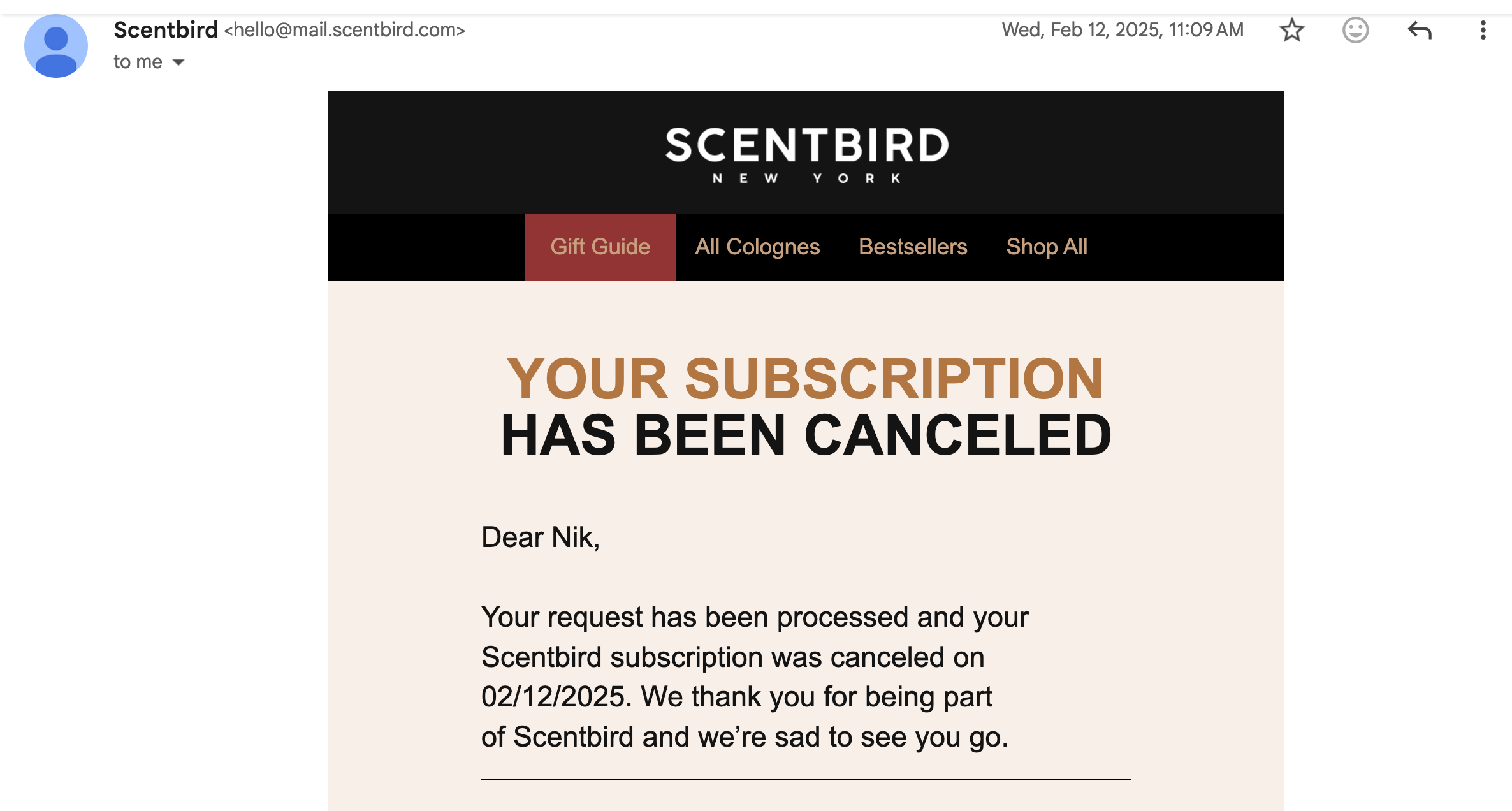
Scentbird, a fragrance subscription service, received a cancellation confirmation dated February 12, 2025. A year and two weeks later, the same company charged the same credit card. When that subscriber went back to the website to cancel again, there was no button. There were plenty of options to get a discount, pause, or skip a membership. But cancellation required an email — to a support team that responds to billing inquiries on Sundays at unusual hours, when charges are easier to slip through before an account closes.
This is not a billing glitch. This is a business model.
What the Influencers Never Had to Do
Scentbird built its subscriber base on YouTube. Beauty channels, commentary channels, lifestyle creators, even gaming channels — the ads were everywhere because the company was paying for them at scale. And every one of those ads sounded identical, because every creator received the same talking points document: what phrases to use, what fragrances to mention, what to say about the flexible subscription and the designer brands and the no-surprises delivery.
What the document did not include: how to cancel. What to do if you’re charged after cancellation. How to reach a human being with the authority to stop a recurring charge.
Influencers don’t cancel. They don’t deal with billing. They don’t sit in a support ticket queue for two weeks while a charge recurs. They receive the product, read the script, and move on. The consumers are the ones who encounter the architecture the script was designed to obscure. The influencer economy is the delivery mechanism for a product that cannot survive honest review — and the script is the evidence that the company knew this.
Run the Math Before You Read a Single Review
The standard advice for evaluating a subscription service is to read the reviews. The better advice is to run the numbers first.
Scentbird charges $17.95 per month for 8 milliliters of fragrance. That works out to $2.24 per milliliter. Versace Eros retails at $0.88 per milliliter for a standard bottle. Dolce & Gabbana The One runs $0.63 per milliliter. Ferragamo F Black is $0.60. You are paying three to four times the per-milliliter cost of fragrances available at any department store, in a plastic case assembled in China that wholesales for fifty cents, containing a volume roughly equivalent to two puffs from a full bottle.
The product is not the pitch. The pitch is “try designer fragrances without committing to full bottles.” The product is a $2.24/ml subscription to an atomizer that rattles in its case.
The same arithmetic applies to any subscription service making volume promises its price cannot support. A music promotion service charging $49 per month and guaranteeing 5,000 streams cannot be buying those streams through advertising — the math produces approximately 35 clicks at current Meta CPC rates, not 5,000 human beings pressing play. The number is disclosed on the pricing page, before the reviews, before the complaints. The number is the confession.
Run it first.
The Inventory Is Not What It Claims to Be
Scentbird claims 600 to 700 fragrances. Browse the catalog by brand and you will not find Dior, Creed, Tom Ford, Armani, or Ralph Lauren. What you find is cheaper designer brands and private labels that do not appear in mainstream fragrance databases — inventory padded to reach a number that sounds impressive in a talking points document.
The Netflix comparison that Scentbird uses in its own marketing is apt, but not in the way they intend. Imagine subscribing to Netflix and discovering the library contains seven hundred titles, none of which are films you have heard of. The number is real. The value proposition is not.
If your goal is to try fragrances before committing to a full bottle, Sephora hands out 6ml sample vials for free. Nordstrom does the same. The discovery mechanism Scentbird charges $17.95 per month to provide has been available at no cost for as long as department stores have existed.
Who Actually Runs This and From Where
The forensic audit begins with corporate structure, because corporate structure is where accountability lives — or doesn’t.
Scentbird Inc. operates its marketing and technology out of 158 West 27th Street in Manhattan. That address is transparent and legitimate. A second address — 1600 Perrineville Road, Monroe Township, New Jersey — appears in corporate filings and billing-related documentation. That address is the Concordia Shopping Center. Specifically, a UPS Store. The “suites” cited in filings are private mailboxes.
A company routing administrative and financial oversight through a UPS Store mailbox while running marketing from a Manhattan high-rise is not making a logistical choice. It is creating a buffer between billing complaints and the people responsible for billing. Legal process is harder to serve at a mailbox. Regulatory inquiries take longer to reach the right person. The opacity is a feature.
Scentbird also operates Deck of Scarlet, Confessions of a Rebel, and Goodhabit — presented as independent brands, sharing a centralized engineering team, a unified technology stack, and a custom-built CRM system. Systemic billing problems do not stay inside one brand. They travel with the infrastructure.
The Custom Billing Engine
Standard payment processors — Stripe, Braintree, PayPal — have consumer protection guardrails built in. Dispute mechanisms. Refund protocols. Audit trails that regulators can read.
Scentbird built its own.
The company’s proprietary billing engine was constructed to handle promotional complexity and proration logic that standard gateways cannot support. That is the stated rationale. The forensic consequence is an opacity layer: a custom system that operates outside the consumer protection architecture that standardized platforms provide, governed by internal triggers that subscribers cannot audit and regulators cannot easily examine.
When users are charged amounts they did not authorize — documented cases include single-cycle bills reaching $450 — the company’s response is to cite its no-refund policy and attribute the charge to a “system error.” The system error narrative is only available because the system is custom. A standardized platform would have a transaction log anyone could read. The custom engine has whatever the company chooses to show.
This is not a coincidence of technical architecture. It is the result of a decision to build something proprietary precisely because proprietary systems are harder to challenge.
The Architecture of Obstruction
The FTC’s Click to Cancel rule did not emerge from nothing. It emerged from pattern recognition across millions of consumer complaints documenting the same mechanism: sign up in two clicks, cancel in two weeks.
The pattern has specific features. On the website, there is no cancel button — only options to discount, pause, or skip. Cancellation requires contacting support. The support email triggers an automated response, then a retention offer, then a processing delay. The company’s own cancellation confirmation email contains this sentence: “Please note, this email does not confirm a cancellation, but includes instructions on how to cancel your subscription.” You are subscribed until they decide you are not.
Scentbird’s Better Business Bureau profile documents 418 complaints. The modal category: cancellation difficulty. Trustpilot shows complaint surges every January, when holiday subscribers try to leave. One documented sequence: cancellation requested December 4th, before the billing date of December 11th. No response. On the 7th, an order processing notification. Second email reiterating cancellation. Immediate reply confirming cancellation and no further charges. Simultaneous charge to the account — on a Sunday, at an unusual billing hour. Second charge the following month.
A Sunday billing event during the cancellation confirmation window is not an accident of system architecture. It is the system architecture.
New York General Business Law § 527-a requires an online cancellation mechanism for any service joined online. For subscribers who joined via the website, being directed to an email queue is a documented regulatory violation. The company has had years of complaints to correct this. The company has not corrected it.
The Trap That Locks From Both Sides
The most sophisticated element of Scentbird’s billing architecture is not the cancellation obstruction. It is what happens when a subscriber tries to go around it.
Accounts queried about unauthorized charges — or flagged for initiating a bank dispute — are reported to be frozen for fraud. A frozen account cannot access the Manage Subscription page. A subscriber locked out of their account cannot cancel. The billing engine, however, continues to attempt charges against the frozen account. The trap is recursive: the act of challenging an unauthorized charge removes the subscriber’s ability to stop future charges through the platform’s own interface.
When subscribers bypass this by initiating a bank chargeback, Scentbird reportedly contests the dispute by submitting tracking numbers from previous successful deliveries — using evidence of orders that were received to argue that the disputed order was also received. This is not a billing error defense. It is a systematic strategy for defeating legitimate consumer disputes using selectively applied shipping data.
The correct response at this point is not another email to support. It is a bank dispute with the cancellation confirmation as primary evidence, followed by regulatory filings that document the full sequence.
What the Documented Record Requires
A subscriber with written cancellation confirmation dated February 12, 2025, and a new unauthorized charge dated March 2026 holds an airtight bank dispute. The cancellation confirmation is the evidence. The bank does not need to evaluate Scentbird’s support ticket history. It needs the document dated February 12, 2025, and the charge dated March 2026. The reversal is the fastest resolution.
The regulatory filing is the consequential one. The CFPB and FTC do not investigate single incidents. They investigate patterns. Every filed report contributes to the case file that eventually triggers enforcement action. File with specifics: cancellation was not available on the website, the process required weeks of email exchanges, charges continued after written confirmation, and the account was structured to prevent digital exit for subscribers who joined digitally.
The general-purpose audit prompt published alongside this piece applies these same questions to any subscription service before the card number is entered. Who legally owns this entity, and where does that lead? Is the cancellation button on the website? What do the reviews from the past 24 months say about what actually happens when people try to leave?
For Scentbird, the documented answer — across the BBB, Trustpilot, Reddit, and the direct accounts of subscribers — is: you block your credit card. That answer has been consistent across multiple years and multiple waves of complaints. The cancellation architecture has had time to be fixed. It has not been fixed.
That is not oversight. That is a decision.
Unauthorized charges after confirmed cancellation can be reported to the CFPB at consumerfinance.gov/complaint, the FTC at reportfraud.ftc.gov, and the New York Attorney General at ag.ny.gov (Scentbird is incorporated in New York). Document all cancellation confirmations before filing. Written confirmation of cancellation constitutes direct evidence of unauthorized billing. If your account has been frozen following a dispute query, document the lockout with screenshots before initiating a bank chargeback.
Tags: Scentbird unauthorized charges consumer protection, FTC Click to Cancel ROSCA billing fraud documentation, custom billing engine consumer protection opacity, chargeback dispute tactics fragrance subscription, UPS Store virtual office corporate transparency risk
#ConsumerProtection #SubscriptionFraud #DarkPatterns #FTC #CFPB
Before You Hand Any Subscription Service Your Credit Card, Run This Prompt
Task: Conduct a forensic investigation into [COMPANY NAME] ([DOMAIN]) before I commit to a recurring subscription. I need answers in five areas: who actually runs it, what happens when I try to leave, whether it delivers what it promises, what the documented consumer complaint record looks like, and whether the alternatives are better.
Section 1: Corporate and Operational Transparency
Identify the legal parent company behind [COMPANY NAME]. Search for a physical headquarters address. If the address resolves to a virtual office — 30 N Gould St in Sheridan, Wyoming, a Delaware registered agent, or a UPS Store suite — flag as High Transparency Risk. There is no legitimate reason a consumer subscription service needs to incorporate in a privacy-shield jurisdiction unless avoiding accountability is a feature of the business model.
Search for the ownership history of [COMPANY NAME]. Has it been acquired, rebranded, or restructured? Companies that restart under new names after FTC or state AG actions carry their behavior, not just their debt.
Use WHOIS data to verify domain registration age. A domain less than 24 months old making strong performance or quality claims has no verifiable track record. The claims are priced into the pitch, not the delivery.
Search the Wayback Machine for the earliest archived version of [DOMAIN]. Compare early promises against current ones. Services that quietly remove “guaranteed” or “risk-free” language after regulatory pressure often leave the archive trail intact.
Search for the names of executives and founders associated with [COMPANY NAME] across LinkedIn, court records, and prior business registrations. Repeat founders of businesses with complaint histories are not a coincidence.
Section 2: The Math Test
Before reading a single review, run the arithmetic.
What does [COMPANY NAME] charge per month, and what does it promise to deliver? Calculate whether the economics are physically possible. If the price is $30–$60/month and the promised output — streams, leads, conversions, placements, whatever the deliverable is — would cost significantly more to produce legitimately at market rates, the gap has to be filled by something. Identify what that something likely is.
Does [COMPANY NAME] provide verifiable third-party evidence of delivery? Or only a proprietary internal dashboard with metrics that cannot be independently audited? A custom dashboard with no audit trail is not evidence of performance. It is a number on a screen.
Does [COMPANY NAME] use the phrase “guaranteed results,” “guaranteed [outcome],” or “money-back guarantee”? Investigate specifically whether the guarantee has documented conditions that make it effectively uncollectable — short claim windows, required proof of compliance, or arbitration-only dispute resolution buried in the terms.
Section 3: Cancellation Mechanics — The Roach Motel Test
The single most predictive signal of a predatory subscription service is not what happens when you sign up. It is what happens when you try to leave.
Search Reddit — specifically r/personalfinance, r/consumer, and any subreddit specific to [COMPANY NAME]’s industry — along with Trustpilot, the Better Business Bureau, and Google Reviews for accounts of cancellation from the past 24 months. Read specifically for these patterns:
Unauthorized charges after a stated intent to cancel
A “system error” or “processing delay” narrative used to explain continued billing after cancellation
Cancellation available only via email or phone, not via a dashboard button
Required to submit cancellation requests multiple times before they take effect
Charges resuming weeks or months after confirmed cancellation
Customers ultimately resolving the issue only by blocking their card
Does [COMPANY NAME] comply with the FTC Click-to-Cancel Rule (effective 2025), which requires that cancellation must be as simple as sign-up? An email-only or phone-only cancellation process that requires multiple contacts is a documented regulatory violation, not just a bad user experience.
Does [COMPANY NAME] comply with ROSCA (Restore Online Shoppers’ Confidence Act), which requires a simple mechanism to stop recurring charges and clear disclosure of subscription terms at sign-up?
If more than 10% of reviews mention difficulty canceling, treat this as a hard stop.
Section 4: Regulatory and Legal Record
Search the FTC complaint database and CFPB complaint portal for [COMPANY NAME] and its parent entity. The presence of multiple complaints does not mean the company is guilty. The pattern of complaints matters: are they concentrated around billing, cancellation, and misrepresentation? Or are they scattered and idiosyncratic?
Search [State] Attorney General records — particularly the state where the company is incorporated and the state where you reside — for enforcement actions, consent decrees, or investigations involving [COMPANY NAME] or its parent.
Search PACER (federal court records) for civil litigation involving [COMPANY NAME]. Class action suits related to billing practices are a material signal even if they have not yet been adjudicated.
Search the BBB complaint history for [COMPANY NAME]. Note the volume of complaints, whether the company responds, and whether the responses address the actual complaint or redirect to generic customer service language.
Section 5: The Deciding Question
After completing the above research, answer this one question:
If I subscribe to [COMPANY NAME] today and decide to cancel in 60 days, what is the documented experience of other customers who have tried to do exactly that?
If the answer is “they blocked their credit card” — do not subscribe.
How to Use This Prompt
Replace [COMPANY NAME] and [DOMAIN] with the service you are evaluating. Paste the entire prompt into any AI research tool with web access — Perplexity, Claude, or ChatGPT with browsing. Read the output before entering a credit card number.
If you are already a subscriber and suspect unauthorized charges:
Document cancellation confirmation in writing (screenshot everything)
Dispute the charge with your bank — written cancellation confirmation makes this airtight
File with the CFPB at consumerfinance.gov/complaint
File with the FTC at reportfraud.ftc.gov
File with your state Attorney General’s consumer protection division
Leave a detailed public review on Trustpilot and BBB — every documented case makes the pattern visible to the next person
The research prompt does not prevent every bad subscription. It makes the known patterns visible before the card goes in.
Run it first. Every time.