

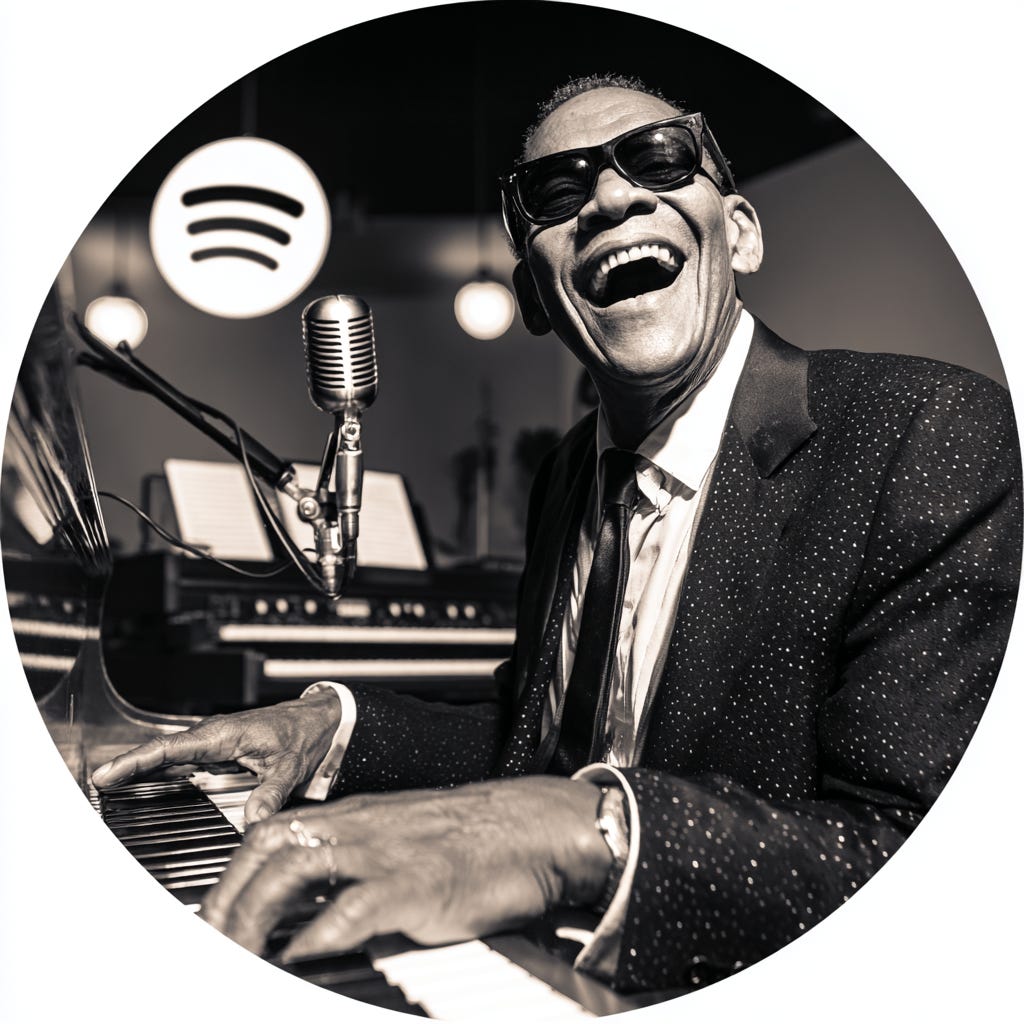
The Twenty-Ninth Second
There’s a moment every musician now knows to fear, though most listeners will never perceive it. Not the climax of a song, not the bridge or the final chorus—nothing musical at all. The moment is the twenty-ninth second. At exactly thirty seconds, something happens that has nothing to do with melody or meaning: a binary decision occurs in the machinery of Spotify’s recommendation engine.
Before that threshold, a listener’s departure registers as what the developers call a “strong negative signal.” After thirty seconds, the same departure—the listener closing the app, switching songs, letting it play in the background while they shower—counts as a completed stream. One triggers a micropayment to the artist and tells the algorithm the song has been accepted. The other triggers nothing, or worse than nothing: algorithmic suppression, invisibility, commercial death.
The difference between twenty-nine and thirty-one seconds is the difference between a song that survives and a song that disappears.
This is not metaphor. I keep returning to a conversation with a guitarist who described watching her Spotify for Artists dashboard as “being slowly digested by a very attentive algorithm.” Her latest single had a delicate, atmospheric introduction—seventeen seconds of fingerpicked guitar building toward the vocal entry. Beautiful, she thought. Intentional. The data told a different story: 43% of listeners skipped before the voice came in. The algorithm’s interpretation was swift and merciless: this song is a mismatch. By the second week, her track had been removed from two editorial playlists. By the third week, it stopped appearing in Discovery Weekly entirely.
The platform’s logic is simple to the point of brutality: if you cannot justify your existence in half a minute, you do not deserve to exist at all.
But here’s what unsettles me most, what I want to spend time thinking about: this thirty-second threshold isn’t merely shaping what music gets made. It’s reshaping what music is. And in doing so, it’s quietly reshaping what we, as listeners, are capable of becoming.
The Mechanics of Survival
To understand how we arrived here, we need to look at the technical infrastructure that governs modern music consumption. The primary arbiter is no longer the radio DJ, the music critic, or the record store clerk—figures whose taste was subjective, idiosyncratic, accountable to nothing but their own conviction. The arbiter is the recommendation engine.
At the heart of Spotify’s system lies BART: Bandits for Recommendations as Treatments. The name itself is revealing—music as “treatment,” listening as something that happens to you, the recommendation engine as a kind of physician determining which medicine you need. BART is designed to solve what computer scientists call the “explore versus exploit” problem. In this context, “exploit” means recommending music the system knows you already like, reinforcing existing preferences to ensure immediate satisfaction. “Explore” means testing unfamiliar tracks to see if they might resonate, expanding your taste profile and keeping the experience feeling fresh.
The system operates through three interlocking mechanisms that convert sound into data the machine can interpret. Natural Language Processing analyzes lyrical content, metadata, blog posts, cultural discourse—identifying thematic clusters and placing tracks in “mood buckets.” Raw Audio Analysis uses machine learning to detect tempo, key, danceability, energy, acousticness, creating a “sonic fingerprint.” Collaborative Filtering compares your behavior to millions of other listeners, predicting your reaction based on the patterns of your “behavioral twins”—users whose listening histories resemble yours.
For a song to survive in this environment, it must first be legible to these systems. A track that lacks clear genre markers or doesn’t align with established mood-based data clusters risks falling into what developers call a “cold start void,” where the algorithm simply doesn’t know what to do with it. But legibility is only the entry fee. What really determines a song’s fate is the hierarchy of interaction data.
The platform monitors every gesture you make: skips before thirty seconds (the “kiss of death”), saves to library (a “super-like” signaling desire for repeat engagement), playlist additions (very strong positive, indicating the song has “real-world utility”), repeat listens (signals “replay value”). This creates what I can only describe as a survivalist ecology, where artists compete not for a listener’s soul but for their involuntary motor responses.
The skip is a behavioral rejection the machine interprets with binary finality. Consequently, music must be engineered to prevent that reflex at all costs.
The Engineering Response
Marc Hogan’s analysis for Pitchfork documented what he called the new compositional imperative: the first twenty seconds must now serve as a “thesis statement.” Everything that follows is commentary, elaboration, but the essential promise of the song must be delivered immediately.
This has birthed a set of engineering strategies that show up in the data with quantifiable precision. Immediate vocal entry: the human voice grabs attention faster than any instrument, so vocals now appear within the first three to five seconds. Front-loaded hooks: the chorus, or at least a recognizable fragment of it, within the first fifteen seconds. High-impact intros designed from the first beat to discourage skipping.
Some artists now create what they call “streaming edits”—versions of songs where sections that show high skip rates in the data have been surgically removed. The algorithm, in effect, gets to edit the song.
The morphological evidence is stark. In the mid-1980s, the average introduction for top-10 singles lasted twenty to twenty-five seconds—a period of atmospheric immersion, setting the stage for what would follow. By the 2010s, this had dropped to five seconds. By the 2020s: zero to three seconds. An 80% decrease in a single generation.
Songs like Led Zeppelin’s “Stairway to Heaven,” with its patient two-minute acoustic introduction building slowly toward electric crescendo, have become structurally unthinkable for commercial artists seeking algorithmic promotion. Not prohibited—just economically and algorithmically unviable.
But here’s the question that haunts me: when we engineer music to survive these first thirty seconds, what are we engineering out? What kinds of musical experiences become impossible when patience itself becomes a liability?
The Architecture of Choice
The word “choice” appears frequently in Spotify’s marketing materials. Sixty million songs. Infinite possibility. The future of music is choice. But standing behind this rhetoric of abundance is a sophisticated infrastructure designed to eliminate choice—or more precisely, to eliminate the experience of choosing.
When you open Spotify, you’re not really selecting music. You’re being treated. The BART system doesn’t ask what you want to hear; it predicts what you’ll accept, what you won’t skip, what will keep you on the platform for the next thirty seconds and the thirty seconds after that.
The technical architecture reveals itself in layers. BART operates as what computer scientists call a “multi-armed bandit”—the name borrowed from the problem faced by a gambler choosing between multiple slot machines, each with unknown payout rates. Which machine do you play? Do you keep pulling the arm that’s given you modest returns, or do you experiment with the unknown machine that might pay out more—or might give you nothing?
The Reward Function
In Spotify’s implementation, each “arm” is a potential song recommendation. The “reward” is whether you stream it for at least thirty seconds. For most of the platform’s history, this was literally a binary variable: thirty seconds or more equals 1 (success), less than thirty seconds equals 0 (failure). This threshold is the genesis of everything that follows—the hard cutoff for both financial compensation to artists and algorithmic validation.
But the system has grown more sophisticated. Recent engineering documents describe a transition toward “co-clustering,” an unsupervised learning technique that simultaneously analyzes clusters of users and clusters of content types. By examining the streaming time distribution within these co-clusters, the algorithm can move beyond the static thirty-second threshold to a more nuanced reward model that predicts “success” based on the specific type of user and the specific intent of the content.
A three-minute indie folk song and a ninety-second punk track don’t need the same thirty-second threshold to signal success. The algorithm is learning to understand context. Which sounds like progress—more nuance, more subtlety—until you realize what’s actually happening: the machine is getting better at predicting what you’ll tolerate, which means it’s getting better at ensuring you never encounter anything you won’t immediately tolerate.
While standard multi-armed bandits identify the “best” content on average—essentially running a dynamic A/B test across all users—Spotify uses “contextual bandits” to achieve hyper-personalization. These models incorporate user-specific features: device type (are you on your phone or your laptop?), time of day, geolocation, even your historical response to different “recsplanations”—the reasons given for why something was recommended to you.
This shifts the goal from finding a “hit song” to finding the “best system” for a specific individual’s current context. The song matters less than the match. The art matters less than the absence of friction.
The Exploitation of Exploration
But here’s where the philosophy gets interesting, where the technical problem reveals something about how we’re being taught to relate to music—and perhaps to experience itself.
The explore-exploit tradeoff sounds neutral, even beneficial. Who wouldn’t want both familiar comfort and exciting discovery? But notice how the terms themselves betray the underlying logic. “Exploit” is honest: we’re mining your existing preferences for guaranteed engagement. But “explore” is deceptive. It suggests adventure, serendipity, the thrill of the unknown. What it actually means is: we’re testing which unfamiliar content you’ll tolerate long enough to gather data about your tolerance.
Real exploration—the kind that transforms you, that introduces you to something so foreign to your existing taste that you don’t even have the categories to understand it at first—is structurally impossible in this system. Because true exploration requires patience, requires the faith that something difficult might become meaningful, requires the possibility of a twenty-ninth-second skip that the algorithm will interpret not as “this is worth persisting with” but as “this was a mismatch.”
The system optimizes for a very specific kind of discovery: the discovery of things you were always going to like, you just didn’t know they existed yet. It’s the difference between discovering a new continent and discovering a new restaurant that serves the exact cuisine you already prefer.
I keep thinking about the evolution from non-contextual bandits to contextual bandits to multi-objective bandits. This last category represents the cutting edge: systems that balance short-term clicks against long-term retention. They use “progressive feedback” to estimate rewards that only materialize after weeks of listening, maintaining a probabilistic belief about your long-term engagement based on a trajectory of interactions over days or weeks.
This sounds sophisticated. It is sophisticated. But it’s sophisticated in the service of a very particular vision of what humans are: creatures whose long-term preferences can be predicted by analyzing the micro-patterns of their short-term behavioral responses. It’s sophisticated in the service of eliminating surprise.
The Metrics of Mortality
In the current industry paradigm, skip rates have become a more telling measure of a song’s impact than total stream counts. While high streams might indicate successful marketing or playlist placement, a high skip rate reveals what the platform considers failure: the failure to prevent the reflex of departure.
The data is unforgiving. Tracks with skip rates under 20% remain in key editorial playlists for an average of twenty-two weeks. Those above 40% are often discarded within eight weeks. The “viral” life of a song that can’t hold attention past thirty seconds is brutal and brief—a spike of visibility followed by algorithmic burial.
This creates pressure that goes beyond the thirty-second threshold. Artists are now advised to think in terms of “retention curves”—the percentage of listeners still engaged at every ten-second interval. A song that loses 15% of listeners in the first ten seconds, another 20% by twenty seconds, another 25% by forty seconds is considered to have a “steep decay curve,” even if it stabilizes afterward. The ideal curve is flat—consistent retention from beginning to end, which means the song never challenges, never demands patience, never asks the listener to trust that something meaningful might emerge if they wait.
But what kind of music produces a flat retention curve? Music that never changes. Music that delivers its entire promise in the first moments and then simply repeats that promise at a steady state. Music engineered not to be experienced but to be tolerated in the background while you do something else.
Which brings us to the question the BART system was designed to answer but can never actually solve: If music’s purpose is to prevent skipping, has it ceased to be music at all?
The Surveillance of Sound
When a song is uploaded to Spotify, something happens to it that most listeners never consider. Before a single person hears it, before it’s recommended to anyone, before it has any streaming history at all, it’s subjected to what the engineering documents call “raw audio analysis”—a process that deconstructs the song into a set of quantitative metrics the algorithm can interpret.
The song, as an aesthetic object, doesn’t exist for the platform. What exists is its data profile.
The public API provides about a dozen of these metrics, but internal research suggests the platform uses a much higher-dimensional representation—potentially up to forty-two dimensions—to capture what engineers call the “vibe” of a track. Each dimension is a number, a coordinate in a vast mathematical space where every song exists as a point, and similarity means proximity.
The Sonic Fingerprint
Consider what gets measured: “Danceability” is a rhythm-stability index based on tempo, beat strength, and regularity. “Energy” is a perceptual measure of intensity and dynamic range. “Valence” measures musical positiveness—high valence tracks sound “happy,” low valence tracks sound “sad.” “Acousticness” is a confidence score of whether the track is purely acoustic. “Liveness” detects the presence of an audience. “Speechiness” measures spoken words, differentiating music from podcasts.
Each of these seems reasonable in isolation. Of course tempo matters. Of course energy is real. But notice what happens when these metrics become the definition of what a song is. A track is no longer a temporal experience, a journey from beginning to end—it’s a coordinate: (0.67 danceability, 0.82 energy, 0.34 valence, 0.18 acousticness...).
The analysis is granular enough to segment a song into its constituent parts—from sections (verse, chorus) to individual beats to “tatums,” the smallest time interval that a human can perceive as a beat. This allows the algorithm to understand the “temporal structure” of the song, ensuring it “fits” the energy flow of a specific playlist.
But here’s what unsettles me: this analysis treats the song as if it were a landscape to be mapped rather than an experience to be lived. The difference matters. A map of a mountain captures elevation, slope, geological composition—objective features that exist whether anyone climbs the mountain or not. But music doesn’t exist like that. Music only exists in the encounter between sound and listener, in a specific moment, with a specific history of everything that person has heard before.
By treating songs as landscapes to be mapped, the algorithm commits what we might call a category error: it mistakes the conditions for an experience with the experience itself.
The Cultural Vector
To augment the audio analysis, Spotify employs Natural Language Processing models to scan what they call the “semantic landscape” surrounding a track. This involves analyzing lyrics to understand themes and moods, but it goes further—crawling the web for music blogs, news articles, artist biographies to see how humans describe the music. This “cultural vectorization” assigns descriptive keywords to songs: “upbeat indie,” “melancholic acoustic,” “aggressive trap.”
The most influential text source, however, is user-generated playlists. By analyzing the titles and descriptions of millions of playlists, the algorithm learns how people “use” music. If a song frequently appears in playlists titled “Study Chill” or “Rainy Day Vibes,” the NLP model reinforces its classification as functional, mood-specific content.
This creates a strange circularity. The algorithm learns what a song “is” by observing how people use it. But people increasingly discover songs through algorithmic recommendations that are based on how other people have used them. The cultural meaning of a song becomes a feedback loop where the algorithm’s interpretation shapes future use, which shapes future interpretation, which shapes future use.
A friend who releases ambient music described this phenomenon with resignation: “I can feel the platform training me. I used to title my tracks with abstract phrases, little poems. Then I noticed the algorithm couldn’t categorize them properly—they’d end up in weird genre limbo. Now I title everything ‘Ambient Study Music’ or ‘Deep Focus Soundscape’ because that’s what the machine understands. But in doing that, I’m reinforcing the very categories that limit what ambient music is allowed to be.”
The Assumption of Legibility
There’s a deeper philosophical problem lurking here, one that goes beyond specific metrics or classification systems. The entire infrastructure of raw audio analysis rests on an assumption: that music can be reduced to its component features, that a song’s meaning can be captured by measuring its danceability, energy, and valence.
This assumption isn’t neutral. It encodes a particular theory of what music is—a theory borrowed from behaviorist psychology and reinforcement learning, where humans are understood as stimulus-response mechanisms. In this view, music is a carefully engineered stimulus designed to produce a desired response (continued listening, playlist addition, the prevention of skipping). The “meaning” of music is therefore reducible to its behavioral effects.
But what about music that doesn’t produce consistent behavioral effects? What about a song that devastates one listener and leaves another unmoved? What about music whose power emerges not from its isolated features but from its position in a larger work—the fourth movement that only makes sense because of the first three, the callback to an earlier lyric that recontextualizes everything that came before?
The algorithm has no way to capture these relationships because it treats each song as an independent unit. The three-minute extraction is the atomic particle of the system. Everything smaller is analyzed (tempo, valence, beats); everything larger is invisible.
This creates a structural bias toward music that works in isolation—music that doesn’t require context, doesn’t require patience, doesn’t require the listener to remember what came before or anticipate what comes next. Music that delivers its entire payload in a single three-minute hit, optimized for the shuffle, optimized for the background, optimized to be forgotten as soon as it’s over.
When I talk to artists about this, they often describe a painful double consciousness. They know the algorithm’s requirements—the need for clear genre markers, consistent energy levels, immediate hooks. They know that experimental track with the two-minute noise intro will be algorithmically buried. So they make two versions: the one they care about, and the one engineered for survival. Sometimes these versions are different files. Sometimes they’re the same file, and the artist learns to build the algorithm’s requirements into their creative process, internalizing the surveillance until the distinction between “what I want to make” and “what will survive” becomes impossible to locate.
The tragedy isn’t that the algorithm misunderstands music. The tragedy is that it’s training a generation of creators to pre-emptively misunderstand themselves.
The Training of Desire
There’s a concept in machine learning called “reward hacking”—when an AI system finds an unexpected way to maximize its reward function that technically satisfies the objective but violates the spirit of what the designers intended. A classic example: a robot trained to move forward learns to fall forward, technically achieving “movement” while defeating the purpose of learning to walk.
I think about this when I consider what’s happening in the circular relationship between Spotify’s algorithm, music creators, and listeners. We’re all engaged in a form of reward hacking, finding ways to satisfy the system’s objectives that technically count as “success” while slowly hollowing out the purpose of music itself.
The engineering of music for platform survival creates a closed feedback loop that operates with elegant, terrible efficiency:
First, the algorithm identifies that listeners respond positively to immediate hooks, abbreviated intros, consistent energy levels—the architectural features that prevent twenty-ninth-second skips. Second, artists, recognizing these patterns in their streaming data, learn to provide exactly these elements to ensure their music gets recommended. Third, listeners, now exposed primarily to front-loaded, immediately gratifying music, become accustomed to this structure and less tolerant of anything that unfolds slowly. Fourth, behavioral data confirms that listeners now skip anything taking too long to develop, which reinforces the algorithm’s original logic.
This isn’t simply a feedback loop. It’s a training program. And we are both the students and the curriculum.
The Curator’s Paradox
I keep thinking about Tuma Basa, the legendary hip-hop curator who described his selection process as “tasting a teaspoon of soup to know if it needs salt”—a metaphor for human intuition that transcends measurement, that operates at the level of feel, of gut instinct refined by years of attention.
In Spotify’s “algotorial” model, human editors like Basa select a pool of tracks based on theme, mood, or cultural relevance. But then the algorithm takes over, determining which users see which songs based on their individual taste profiles and behavioral patterns. This creates a fundamental tension: if Basa selects a profound but challenging track that he believes is important—a track that might require multiple listens to reveal itself, that might initially sound difficult or strange—and the algorithm sees high skip rates, the song gets suppressed for most users.
His gut feeling is perpetually checked by skip-rate data. Over time, curators learn—just as artists do—to select music they know will perform well algorithmically. The human gut gets trained by the machine’s behavioral metrics.
But what is being optimized here, exactly? Not the quality of music, not its capacity to move or transform listeners. What’s being optimized is a peculiar form of frictionlessness—the elimination of any moment that might cause a listener to pause, consider, or feel discomfort. The bridge, traditionally placed before the final chorus to provide harmonic departure and dynamic contrast, has been simplified or removed entirely. When it exists, it often consists of repetitive phrases that maintain established rhythm rather than challenging it.
The guitar solo has largely disappeared from pop music. The “musical event” of a solo—that moment when a human performer steps forward to say something that can’t be said in words—risks disrupting the “vibe” the algorithm is trying to maintain. If listeners find solos unengaging, they skip before the final chorus. Better to eliminate the risk entirely.
The Homogenization of Structure
The morphological evidence is quantifiable. Beyond the disappearing introduction, the entire internal geography of the song is being flattened. Verse and chorus are increasingly based on the same underlying riff, dressed up in slightly different production layers to create an illusion of variety while maintaining a safe, repetitive core.
This isn’t happening because contemporary musicians lack skill or imagination. It’s happening because the alternative is algorithmic death. An artist who structures a song with dramatic dynamic shifts—quiet verse, massive chorus, breakdown, build-up, explosive final chorus—is creating multiple points where a listener might skip. The algorithm interprets dynamic range as risk.
The safest structure is no structure at all, or rather, a structure so consistent that it barely qualifies as structure: the same four-chord progression repeated for two and a half minutes, the same rhythmic feel from beginning to end, the same energy level maintained like a flat line on a heart monitor.
The listener is never jarred out of their experience, never asked to wait, never required to trust that something meaningful might emerge from patience. And this is where the philosophical erosion becomes visible.
The Slow Burn and the Earned Payoff
Artistic expression often relies on complexity, difficulty, and the gradual unfolding of meaning. The “slow burn”—a compositional strategy where tension builds over several minutes before reaching payoff—embodies a theory of music that values the listener’s capacity to be transformed by extended experience.
Think of the structure of a song like Radiohead’s “Pyramid Song,” which spends its first minute establishing an unsettling, irregular rhythm in 4/4 time that feels like it’s constantly about to resolve but never quite does. The payoff—the moment when Thom Yorke’s voice enters and the harmonic progression reveals its logic—only works because of that minute of uncertainty. The beauty is inseparable from the difficulty.
In the regime of platform survival, the slow burn is structurally disadvantaged. If a song’s most emotionally devastating moment occurs at 2:45, but listeners skip at 0:25 because they weren’t immediately hooked, that moment is lost. The system doesn’t prohibit complexity—you’re technically free to release a seven-minute post-rock epic—but it makes complexity economically and algorithmically unviable.
And here’s the deeper problem: this doesn’t just affect what music gets made. It affects what we, as listeners, are capable of experiencing.
The Reduction of Capacity
When you spend years being served music that delivers its entire promise in fifteen seconds, that maintains a flat energy curve for maximum retention, that never asks you to wait or trust or sit with discomfort, something changes in your relationship to time itself.
You develop what behavioral psychologists call a “habit of immediate gratification”—not by choice, exactly, but through the accumulation of thousands of micro-interactions that reward impatience and punish patience. The algorithm doesn’t force you to skip complex music. It just makes complex music slightly harder to find, slightly less likely to appear in your Discovery Weekly, slightly more effort to seek out deliberately. And over time, effort feels like friction, and friction feels like failure, and the path of least resistance becomes the only path that feels natural.
I notice this in my own listening. I used to be able to sit with difficult albums, to give them three or four listens before forming an opinion. Now I find myself reaching for the skip button at twenty seconds if a song hasn’t grabbed me. I’m aware I’m doing it. I’m aware it represents a diminishment of my capacity for patience. And I do it anyway, because the platform has trained me to understand that my time is valuable, that abundance means choice means I don’t have to tolerate anything that doesn’t immediately satisfy.
The Thirty-Second Soul isn’t just a musical structure. It’s a psychological state—a condition of perpetual, shallow engagement where the listener is simultaneously consumer and product. We celebrate this with features like Spotify Wrapped, where we’re invited to admire the very data that’s been extracted from us, to marvel at how well the machine knows us, to take pride in our own predictability.
The system reduces human capacity for deep attention and trains us to treat music as a disposable behavioral trigger. And the cruelest part is that it feels like freedom. It feels like having more choice than ever before. Sixty million songs! But if all sixty million have been optimized to prevent you from skipping in the first thirty seconds, if they’ve all been smoothed into the same frictionless shape, is it really choice? Or is it the illusion of choice—a menu with infinite options that all taste the same?
When Music Becomes Utility
There’s a slide from an internal Spotify presentation, sometime around 2012, that I think about often. It contains a single statistic: “Active listening”—where the listener focuses entirely on the music—represents less than 20% of total consumption on the platform.
This wasn’t presented as a problem. It was presented as an opportunity.
The insight: most listeners use music as background for other activities. Work. Fitness. Study. Sleep. Commuting. Cooking. The music isn’t the point. The music is the accompaniment to the point. And if that’s true, then the product Spotify is really selling isn’t music at all. It’s a mood delivery system. An emotional regulation service. A utility, like electricity or heat, that provides just enough atmospheric enhancement to make whatever you’re doing slightly more bearable.
This insight birthed what the industry now calls the “Mood Machine”—a vast network of playlists defined not by genre or artist or era, but by functional utility. “Deep Focus.” “Chill Vibes.” “Workout Beats.” “Peaceful Piano.” “Lo-Fi Hip Hop Beats to Study/Relax To.” Each playlist is a product carefully engineered to fulfill a specific behavioral objective.
Fit for Purpose
For an artist to survive in this economy, their music must be “fit for purpose.” This has given rise to what critics call “Spotify-core”: music specifically engineered to be mellow, mid-tempo, acoustic-tinged, designed to blend seamlessly into “chill” or “vibe” playlists. Music that successfully disappears into the background.
The requirements are precisely defined, algorithmically enforced:
Chill/Study playlists require lo-fi beats, minimal dynamic range, non-intrusive vocals. The objective: maintaining a steady state of focus with zero “skip triggers”—nothing that might pull attention away from the spreadsheet or the textbook.
Fitness/Energy playlists demand high BPM, repetitive structures, aggressive hooks. The objective: sustaining physical output, reinforcing the activity through rhythmic consistency.
Sleep/Relax playlists need extremely low valence, slow tempo, absence of sudden sounds. The objective: facilitating a physiological transition, operating at the threshold of consciousness where music becomes indistinguishable from white noise.
This functionalization disrupts the traditional bond between creator and listener. Music is no longer an object of contemplation, no longer an experience you enter into deliberately. It’s a utility that must be optimized for its specific environment. The Thirty-Second Soul in this context is music that successfully disappears—providing enough gratification to prevent skipping but insufficient challenge to demand attention.
The Ghost Musicians
In her investigation Mood Machine, music journalist Liz Pelly uncovered something disturbing: many of the most popular “chill” and “study” playlists on Spotify are populated not by human artists but by what the industry calls “ghost musicians”—pseudonymous producers creating mood-specific content at scale, often paid per-track by the platform or by third-party production companies.
This makes economic sense from the platform’s perspective. Why pay royalties to established artists when you can commission functional content specifically engineered for retention? Why risk the unpredictability of human creativity when you can have producers follow a template: 90 BPM, minimal melody, no vocals, consistent energy from 0:00 to 3:00, optimized for background listening?
The result is an ecosystem where human musicians compete not just against each other but against an industrial production system designed to create “good enough” content at near-zero marginal cost. And “good enough” in this context means: successfully maintains the desired mood without triggering attention or demanding engagement.
A composer I know who makes ambient music described the trap with painful clarity: “I can spend six months crafting an album, thinking deeply about harmonic movement and subtle textural evolution, or I can spend a weekend making ‘Ambient Study Sounds Volume 47’ that will get ten times the streams because it fits the algorithm’s requirements for a functional playlist. The latter pays my rent. The former is art. I don’t get to choose both.”
The Devaluation of Attention
There’s a philosophical question hiding in this functionalization, one that goes beyond music to the nature of experience itself: What happens to us when we systematically outsource the regulation of our emotional states to an algorithmic system?
Music has always had functional dimensions. Work songs coordinated labor. Lullabies soothed children. Military marches synchronized movement. But these functions emerged from human needs and human communities. The songs were shaped by the work, yes, but they also shaped the workers—created solidarity, passed down tradition, provided meaning beyond mere efficiency.
The Mood Machine reverses this relationship. Instead of music emerging from human activity and human community, human activity is now optimized around the requirements of algorithmic music delivery. We don’t choose music that reflects our mood; we choose a playlist that will produce the mood we’ve decided we should have. We don’t listen to understand ourselves; we listen to regulate ourselves, to become the version of ourselves that is most productive, most focused, most relaxed, most energized.
The platform acts as what Pelly calls an “invisible DJ,” shaping these emotional experiences through neutral-appearing but highly biased algorithms. The appearance of choice—choosing from hundreds of mood-based playlists—conceals the more fundamental loss of autonomy: we’ve delegated the curation of our inner lives to a system optimized for engagement metrics and royalty minimization.
And the strangest part, the part that keeps me up at night: it works. I find myself opening Spotify not to listen to music I love but to solve a problem. I’m anxious—what playlist will calm me down? I’m unmotivated—what playlist will give me energy? I’m working—what playlist will help me focus?
The music becomes invisible, which is exactly what it’s designed to do. I finish a four-hour work session and couldn’t tell you a single song that played. The playlist did its job. I stayed focused. I didn’t skip. The system extracted its data and paid out its fractions of a cent. Everyone won. Except I can’t shake the feeling that in winning, I lost something I can’t quite name—some capacity for the music to surprise me, to interrupt my plans, to make me stop what I’m doing and just listen.
The Statistical Narrowing
Here’s the paradox that reveals the system’s fundamental dishonesty: we have access to more music than ever before in human history—sixty million songs, every genre, every era, music from every corner of the world. The promise is radical abundance, unlimited choice, the death of scarcity.
But one study found that despite this access, 58% of users’ libraries contain music from only three genres. Another study found that the average user listens to fewer than fifty distinct artists per year, despite having millions available.
The algorithm doesn’t want us transformed by the unfamiliar. It wants us within the safe, predictable confines of what we already know, where our behavior is most predictable and most profitable. The explore-exploit tradeoff is really no tradeoff at all—exploration is permitted only within a narrow bandwidth of tolerance, only when the unfamiliar is sufficiently similar to the familiar that the risk of a twenty-ninth-second skip remains acceptably low.
We’re not choosing from sixty million songs. We’re choosing from the subset of those songs that the algorithm has determined we might tolerate based on the behavioral patterns of our demographic twins. The abundance is real, but the access is illusory. The music is there; we’re just never shown it, never recommended it, never given a reason to search for it deliberately.
And over time, our tastes narrow to match the algorithm’s prediction of our tastes, which further reinforces the algorithm’s confidence in its predictions, which further narrows the recommendations, in a spiral that feels like discovery but is really the gradual constriction of possibility.
The mood machine doesn’t serve our emotions. It standardizes them.
The Body Remembers
There’s a story that gets told in different ways by different artists, but the core is always the same: they release a song engineered for streaming success—immediate hook, no intro, high-energy from the first beat. The Spotify numbers are good. The algorithm rewards them. Then they try to perform it live.
And their body betrays the optimization.
A vocalist described to me what it’s like to start a song cold, no atmospheric build-up, just straight into the high-intensity chorus that the data said needed to come in the first ten seconds: “Your voice isn’t warm. You haven’t assessed the room’s acoustics. You haven’t given the audience time to transition from conversation to listening. You’re asking your vocal cords to do something they’re not physiologically ready for. I’ve watched singers damage their voices because they engineered their songs for an algorithm that doesn’t have a body.”
This tension—between music optimized for recordings and music that respects the biological realities of performance—reveals something crucial: the thirty-second soul is a ghost in the machine, a product designed for a surveillance environment that ignores how music is actually made and felt in physical space.
The Acoustic Reality
Live performance exists in time and space differently than recorded music. A recording can be edited, manipulated, “fixed in post.” A live performance happens once, in real time, in front of bodies occupying space. Those bodies need certain things: time to warm up, time to adjust, time to understand what’s expected of them.
Historically, the instrumental introduction served multiple purposes beyond atmosphere. For the performer, it was preparation—a chance to hear the room’s reverb, to gauge the audience’s energy, to settle into the groove before the vulnerability of singing begins. For the audience, it was transition—a clearing of mental space, a shift from the previous song’s emotional territory into this song’s territory.
When you remove the intro for algorithmic reasons, you remove this biological buffer. The performer is asked to deliver intensity immediately, before their instrument (voice, fingers, breath) is ready. The audience is denied the ritual of entrance, the small ceremony that says: something is beginning now, pay attention.
Musicians solve this by maintaining two versions of their songs: the recorded version engineered for algorithmic survival, and the live version that restores the excised intros and builds. But this creates a strange alienation—the artist performing something that exists in two irreconcilable forms, neither of which is fully “the song” anymore.
The Architecture of Breath
A singer-songwriter I know described watching her streaming data and noticing something disturbing: her most successful song, the one with the lowest skip rate and highest save-to-library ratio, was the one that physically hurt to perform night after night.
The algorithm favored a structure where the chorus came in at twelve seconds. Her voice needed twenty-five seconds to warm up properly. The compromise was singing the chorus at 70% intensity for the first iteration, then gradually increasing intensity as her voice opened up through the song. But the algorithm didn’t hear “gradual warm-up”—it heard “weak opening” and started to suppress the track. So she made a streaming edit: started with the full-intensity chorus recorded in a studio where she could do multiple takes and rest her voice between attempts.
“I tour with the live version,” she told me. “The one that lets me breathe. But I know that’s not the version that pays my bills. The version that pays my bills exists only in the sterile environment of a recording studio, where I can do ten takes and compress my vocal cords however the algorithm demands.”
This is what I mean about the body remembering what the algorithm forgets: humans are not machines. We warm up. We tire. We need time to transition. We build toward climaxes rather than starting there. These aren’t aesthetic choices—they’re biological necessities. And yet the optimization for platform survival systematically treats these necessities as inefficiencies to be engineered away.
The Paradox of Presence
Here’s the deeper irony: the very thing that makes a song successful on Spotify—its ability to be consumed without attention, to function as pleasant background for some other activity—is exactly what makes it forgettable in live performance. A song engineered to disappear into a study session or a workout is a song that lacks the dynamic intensity to hold a room’s attention when it’s the only thing happening.
Live music demands presence—from the performer and from the audience. It demands the kind of attention that the streaming model systematically trains us not to give. When a performer stands on stage and plays a song that was engineered for background listening, there’s a fundamental mismatch between the medium and the content.
Some artists have responded by creating two entirely separate bodies of work: streaming singles engineered for algorithmic success, and live-focused material that only exists in performance. But this fractures their identity as artists. The person who makes functional mood music for Spotify and the person who creates demanding, emotionally intense performance pieces are technically the same person, but they might as well be different artists working in different media.
The Room’s Intelligence
What gets lost in all of this is something that’s hard to quantify but essential to understanding what music actually does: the intelligence of a room full of people listening together.
A live audience isn’t a collection of individual data points; it’s an emergent system with its own logic and its own capacity for attention. The energy builds collectively. The tension is shared. When a performer holds back during a quiet verse, the room leans in—everyone straining to hear, which creates a kind of communal intimacy that makes the eventual loud chorus feel earned rather than imposed.
None of this is legible to the algorithm. The algorithm can’t measure the collective intake of breath when a song shifts from major to minor. It can’t quantify the way a long intro creates anticipation or the way a well-placed silence makes the next note land with doubled force.
The algorithm measures only individual behavioral responses: play, pause, skip, save. It treats the audience as a disaggregated mass of separate decision-makers rather than as a collective intelligence capable of experiencing things together that none of them would experience alone.
And so the music increasingly gets engineered for isolated, private listening—for the individual scrolling through their phone on a commute, not for the room full of people who came together specifically to pay attention.
The body remembers this loss, even if the data doesn’t measure it. The performer feels it in the disconnect between what works on the platform and what works in the room. The audience feels it in the way even successful concerts sometimes feel like watching someone perform karaoke versions of songs that were never meant to be performed.
And slowly, quietly, the very idea of music as something that happens between people in physical space—rather than something delivered algorithmically to isolated individuals—becomes harder to remember, harder to justify, harder to believe in.
What Persists
After everything I’ve described—the algorithmic surveillance, the structural flattening, the circular training of desire, the functionalization of expression, the subordination of the body to the machine’s requirements—you might expect me to end with resignation. To conclude that the Thirty-Second Soul has won, that music as we knew it is dead, that we’re entering an era of purely functional audio content generated by AI and served by algorithms to listeners who’ve been trained to want nothing more than frictionless mood regulation.
But that’s not quite what the evidence shows.
Despite the overwhelming dominance of the algorithmic regime, despite the economic incentives all pointing toward optimization and homogenization, something persists. Not everywhere, not consistently, but stubbornly, defiantly, in ways that resist quantification.
The Curator’s Teaspoon
Remember Tuma Basa and his metaphor about tasting a teaspoon of soup? That image stays with me because it points to a way of knowing that exists before and beyond data, a form of judgment that can’t be automated away because it operates at the level of direct experience.
The most revealing detail in the research about algotorial curation isn’t that human editors get overruled by skip-rate data. It’s that they keep going to live shows. They keep “feeling the room,” trying to sense something about music that the metrics can’t capture—not because they’re naive about the algorithm’s power, but because they still believe (sometimes against their own better judgment) that music does something the thirty-second threshold was never designed to measure.
These curators exist in a state of productive contradiction. They understand the system’s requirements. They know which tracks will perform well algorithmically. But they also maintain contact with whatever it is that made them care about music in the first place—that gut feeling, that teaspoon-of-soup intuition that says this matters, even if I can’t explain why in terms the machine will understand.
Some of them have developed what I can only describe as a form of strategic resistance. They’ll include one or two algorithmically risky tracks in their playlists—songs with unusual structures or challenging intros—knowing these tracks will likely get suppressed by the personalization layer. But they include them anyway, as a kind of message in a bottle to the small percentage of listeners who might encounter them before the algorithm learns to filter them out.
It’s a losing game in aggregate. But it’s not nothing. It’s the insistence that human judgment retains some value even when it can’t be validated by behavioral metrics.
The Live Rearrangement
Artists who perform their streaming-optimized songs live often rearrange them, restoring the excised intros, extending the bridges, rebuilding the dynamic range. They do this even though the live version will never be what most people hear, even though the album version is the one that pays the bills.
This seems like mere nostalgia at first—musicians indulging in an antiquated form while reluctantly submitting to the recorded format the market demands. But I think it’s something more interesting: it’s a form of preservation, a way of maintaining the memory of what the song wanted to be before it had to survive.
A saxophonist described to me how she approaches this split: “The recorded version is the translation. It’s what the song sounds like when translated into the language the algorithm understands. But the live version is the original text—the thing the translation is trying to approximate. I need to keep performing the original, not because it’s commercially viable but because if I forget it, if the translation becomes the only version that exists even in my own mind, then something essential has been lost.”
This is a form of resistance that operates at the level of practice rather than protest. It doesn’t challenge the platform’s dominance. It doesn’t propose an alternative economic model. It simply maintains a space where different values can operate, where the requirements of the body and the room take precedence over the requirements of the algorithm.
The Faith of the Difficult
The most profound form of persistence might be the simplest: artists keep making difficult music. Not in ignorance of the algorithm’s requirements but in full awareness of them. They know the intro is too long. They know the structure is too complex. They know the algorithm will bury it. They make it anyway.
This isn’t romantic individualism or martyr complex. Most of these artists also make algorithmically optimized content to pay rent. But they maintain a parallel practice, a shadow catalog of work that exists for different reasons.
I think of a producer who releases ambient albums that violate every streaming-optimization rule: long tracks (12-18 minutes), minimal melodic content, extremely gradual harmonic development. The streaming numbers are negligible. The algorithmic visibility is near-zero. And yet these albums continue to appear, every year or two, like messages from a frequency the platform can’t detect.
When I asked him why, his answer was precise: “Because someone needs to remember that music can do this. That it can unfold slowly. That it can demand your full attention for eighteen minutes and give you something in return that a three-minute hook never could. If everyone stops making this kind of music because the algorithm doesn’t reward it, then in twenty years, people won’t even know it’s possible.”
This is faith of a particular kind—not faith that the market will reward virtue, not faith that the algorithm will eventually learn to value complexity, but faith that maintaining the practice itself has value independent of its reception. It’s the faith that the slow burn, the earned payoff, the gradual unfolding of meaning represent capacities worth preserving even if they become commercially extinct.
The Limits of Prediction
And then there’s this: the algorithm keeps failing in interesting ways.
For all its sophistication, for all the billions of data points and the multi-armed bandits and the contextual personalization, the recommendation engine still regularly produces moments where the match is wildly, inexplicably wrong. A death metal track in the middle of a meditation playlist. A children’s song interrupting a romantic dinner mix. These failures are rare enough not to undermine the system, but common enough to reveal something important: human taste is stranger, more contradictory, more context-dependent than the behavioral data suggests.
The platform’s response is to gather more data, refine the models, reduce the error rate. But what if the “errors” aren’t actually errors? What if the death metal track in the meditation playlist is exactly what that particular person needed in that particular moment—not because it fits any consistent pattern but because humans are capable of surprising themselves, of wanting things they didn’t know they wanted until they encountered them?
The algorithm treats these moments as noise to be filtered out. But they might be the signal—the proof that we remain, at some irreducible level, unpredictable to ourselves and therefore impossible to fully optimize.
The Confrontation That’s Coming
The trajectory of the system points toward greater sophistication: reinforcement learning models that adjust recommendations in real-time, biometric data from wearables that allow the platform to respond to your heart rate and sleep stages, generative AI that can create the “Atomic Song”—perfectly optimized audio sequences that don’t even require human artists anymore.
All of this is probably coming. Some of it’s already here.
But here’s what I keep thinking about: at a certain point, the optimization defeats itself. When music becomes so perfectly personalized, so perfectly predictable, so perfectly optimized to prevent the twenty-ninth-second skip, it stops being music and becomes something else—behavioral regulation, affective control, a utility as transparent and forgettable as the electricity that powers it.
And at that point, maybe we’ll remember what we gave up. Not because the algorithm allows us to, but because the human capacity for boredom, for restlessness, for wanting something more than perfect comfort is itself a feature that can’t be optimized away.
The Thirty-Second Soul is the current champion of the platform economy. But it’s a hollow victory. In engineering music for survival, we’ve created a system where the music survives but the meaning doesn’t—or survives only in those shadow spaces where the algorithm’s reach is incomplete, where human judgment still operates according to logics that data can’t capture.
The challenge isn’t to destroy the platform or return to some imaginary pre-algorithmic past. The challenge is simpler and harder: to maintain contact with the parts of ourselves that can’t be reduced to behavioral metrics. To keep making (and listening to) music that doesn’t work in thirty seconds. To preserve the memory that something more profound than a skip-prevention mechanism can happen in the space between a sound and a soul.
That faith—increasingly quaint, increasingly embattled—might be the only thing preventing the complete subordination of aesthetic judgment to involuntary behavioral response. And the fact that it persists at all, despite everything working against it, suggests that whatever it is that makes music matter to us isn’t quite as predictable, isn’t quite as optimizable, isn’t quite as dead as the algorithm would have us believe.
The question isn’t whether we’ll survive the Thirty-Second Soul. It’s whether we’ll remember what we lost—and in remembering, discover we haven’t quite lost it yet.