

There is a particular kind of loneliness in teaching that nobody warns you about. Not the loneliness of the empty office hours, or the late-night grading, or the semester that ends and the students vanish into their futures without a word. I mean the structural loneliness of the work itself — the fact that you pour something real into a room, and most of the time you leave without knowing whether any of it landed. The Dean’s Award sits on a shelf. The student emails keep you going.
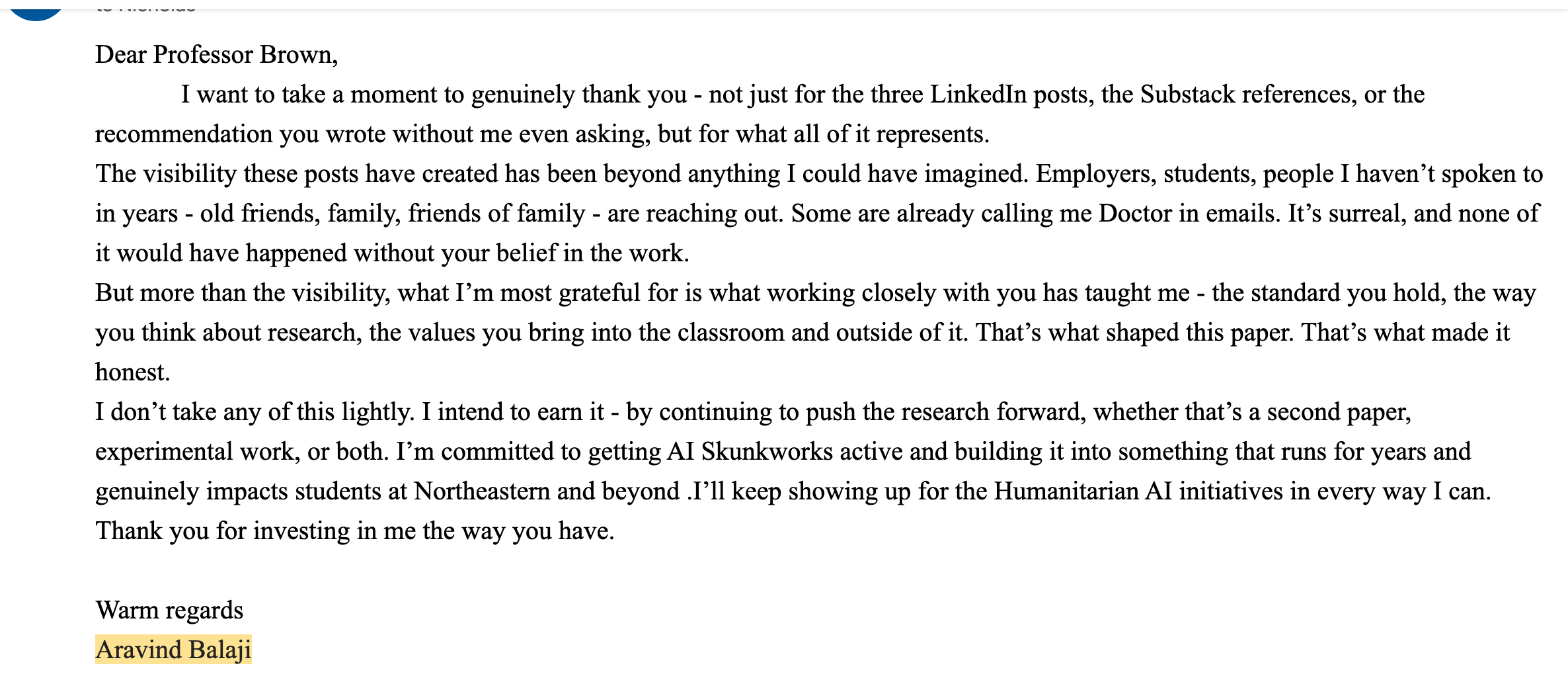
On the evening of March 4th, Aravind Balaji wrote to me.
He wrote to say that employers were reaching out. That people he hadn’t spoken to in years were writing back. That some of them were already calling him Doctor in emails before the degree is conferred. That the three LinkedIn posts and the Substack references and the recommendation I wrote without being asked — that all of it represented something he had not expected and did not take lightly.
I want to be honest about what I felt reading this, because honesty is the only standard worth keeping. I did not feel proud. Not immediately. What I felt first was relief — the specific relief of learning that something you did without knowing whether it would matter had mattered. The paper existed. The visibility was a consequence of the paper existing. Aravind had done the thing, and the doing had opened a door that the not-doing would have kept permanently closed.
What the Doing Actually Costs
Here is what teaching awards cannot tell you: they measure an output, not the process that produced it. They capture a moment of recognition, not the nights before the recognition, when you are grading at 11pm and a student writes to say they don’t understand the concept and you have to decide whether to answer right now or wait until morning and you answer right now because the concept is load-bearing and they need it to finish the assignment and if they can’t finish the assignment something downstream falls apart.
Aravind’s paper did not emerge from a single inspired session. It emerged from the kind of sustained, unglamorous, iterative work that looks nothing like inspiration and everything like discipline. Draft submitted. Feedback given. Draft revised. Feedback given again. The research honest about its limitations, which is the mark of a researcher who has understood something fundamental: the limitation you name is the limitation you control; the limitation you conceal is the one that will undermine everything.
What he wrote in his email — “the way you think about research, the values you bring into the classroom and outside of it. That’s what shaped this paper. That’s what made it honest” — this is the sentence I will remember longer than any award citation. Not because it flatters me. Because it names the actual mechanism of teaching, which is not content delivery but value transmission. You cannot teach a student to think honestly about research by lecturing them on the importance of intellectual honesty. You teach it by being intellectually honest in front of them, about the things that are uncertain, about the things you got wrong, about the gap between what the data shows and what you want the data to show.
He learned it because he watched it. This is the whole thing.
The Economy of the Student Email
I have received teaching awards. The Dean’s Award for 2024-25 from the College of Engineering. The RISE Award from Computer and Information Sciences in 2022. The Fostering Engineering Innovation in Education Award. These are meaningful. They represent the judgment of colleagues and institutions who have evaluated something real.
And yet. The economy of external recognition operates on lag. You do the work now; the award arrives later, if at all, administered through committees and criteria and the particular preferences of whoever happened to read your file on whatever day the committee met. The student email operates in real time. It arrives when something has happened — when the paper was accepted, when the employer reached out, when the friend who hadn’t been in contact in years suddenly wrote back.
What Aravind’s email contains that no award citation contains is consequence. Not “Professor Brown has demonstrated exceptional commitment to pedagogical excellence.” But: the work exists now, and here is what has happened because the work exists. Employers are reaching out. That is data. People are calling him Doctor. That is a social fact. None of it was possible before the paper existed. All of it became possible the moment it did.
This is the argument I find myself making over and over in the classroom, and it never gets easier to make because students have been trained by years of schooling to treat the doing as preparation for something more important rather than as the thing itself. You do not prepare to write a paper. You write it. You do not rehearse being a researcher. You research. The paper had to exist before the employers could read it. The research had to be published before anyone could cite it. The commitment Aravind has made — to a second paper, to experimental work, to building AI Skunkworks into something that outlasts him, to continuing the Humanitarians AI initiatives — none of that commitment means anything until it becomes work. The commitment is the setup. The work is what matters.
He knows this. The email demonstrates that he knows this. “I intend to earn it” is not a sentiment. It is a program.
The Structural Problem with Teaching Awards
I want to say something careful here, because I do not want to be misunderstood. Teaching awards matter. They signal to institutions that certain work is valued. They create visibility for pedagogical approaches that might otherwise remain invisible. The Dean’s Award in 2024-25 arrived at a moment when I needed the institutional validation, and I would be dishonest if I pretended otherwise.
But they measure something that the student email does not measure and cannot measure, which is: did the teaching produce anything that would not have existed without it?
Aravind’s paper would not have taken the specific form it took without the research values transmitted through two years of working closely together. I know this because he said so, and because I watched the paper develop, and because I can trace the specific places where a choice about methodology or framing or what to include and exclude reflects something discussed at 11pm over email or during office hours or in the margins of a draft. The paper is evidence of transmission. The student email is evidence that the transmission was received.
Teaching awards are given by people who have read about the teaching. Student emails are written by people who experienced it. The epistemological difference is not small.
What I Actually Did
Aravind thanks me for the LinkedIn posts, the Substack references, the recommendation I wrote without being asked. These are the things that generated the visible consequence — the employers, the friends writing back, the Doctor in the subject line.
But here is what I actually did: I read the paper. I took it seriously. I treated it as a contribution rather than a student exercise. I wrote about it publicly in the same way I write about research I find compelling from any source, because it was research I found compelling, and the standard I hold for what gets written about should not have a student exception. Aravind Balaji’s paper met the standard. I wrote about it. The visibility was a consequence of the standard being applied consistently, not a gift extended as a favor.
This is not a small distinction. The invisible damage done by the “student exception” — by the assumption that student work is categorically less serious than faculty or professional work, that it should be treated with encouragement rather than with the same analytical respect extended to peer-reviewed publications — this damage accumulates in ways that are hard to measure and easy to overlook. Students who are never treated as researchers do not become researchers. Students who receive only encouragement and not real engagement learn to produce work that merits only encouragement. The standard is the teaching.
When I wrote the LinkedIn posts, I was not doing Aravind a favor. I was treating his work with the respect it had earned. The visibility that followed was not my gift to him. It was the market’s response to the work existing.
The Email I Will Not Forget
There is a moment in Aravind’s email that I keep returning to. He writes: “I don’t take any of this lightly.”
Five words. The weight they carry is disproportionate to their length.
Students who do not take things lightly are the ones who go back and revise when revision is hard. They are the ones who notice the methodology problem and address it rather than hoping reviewers miss it. They are the ones who commit to a second paper not because it is required but because the first paper revealed what the second paper needs to say. They are the ones who build something that outlasts them.
I have taught for a long time. I know the difference, immediately and viscerally, between the student who is present and the student who is performing presence. Aravind Balaji has never, in the time I have known him, performed presence. He has been present. That is rarer than it sounds.
The student email better than any award is not the one that thanks you most effusively. It is the one that tells you what happened — what actually changed in the world because the teaching occurred. The paper exists. The employers are reaching out. The friends are writing back.
Aravind is going to earn it.
That is the sentence that matters.
Tags: student gratitude teaching award, Aravind Balaji AI Skunkworks Northeastern, teaching recognition Baldwin essay, research mentorship visibility, doing over planning academic life