

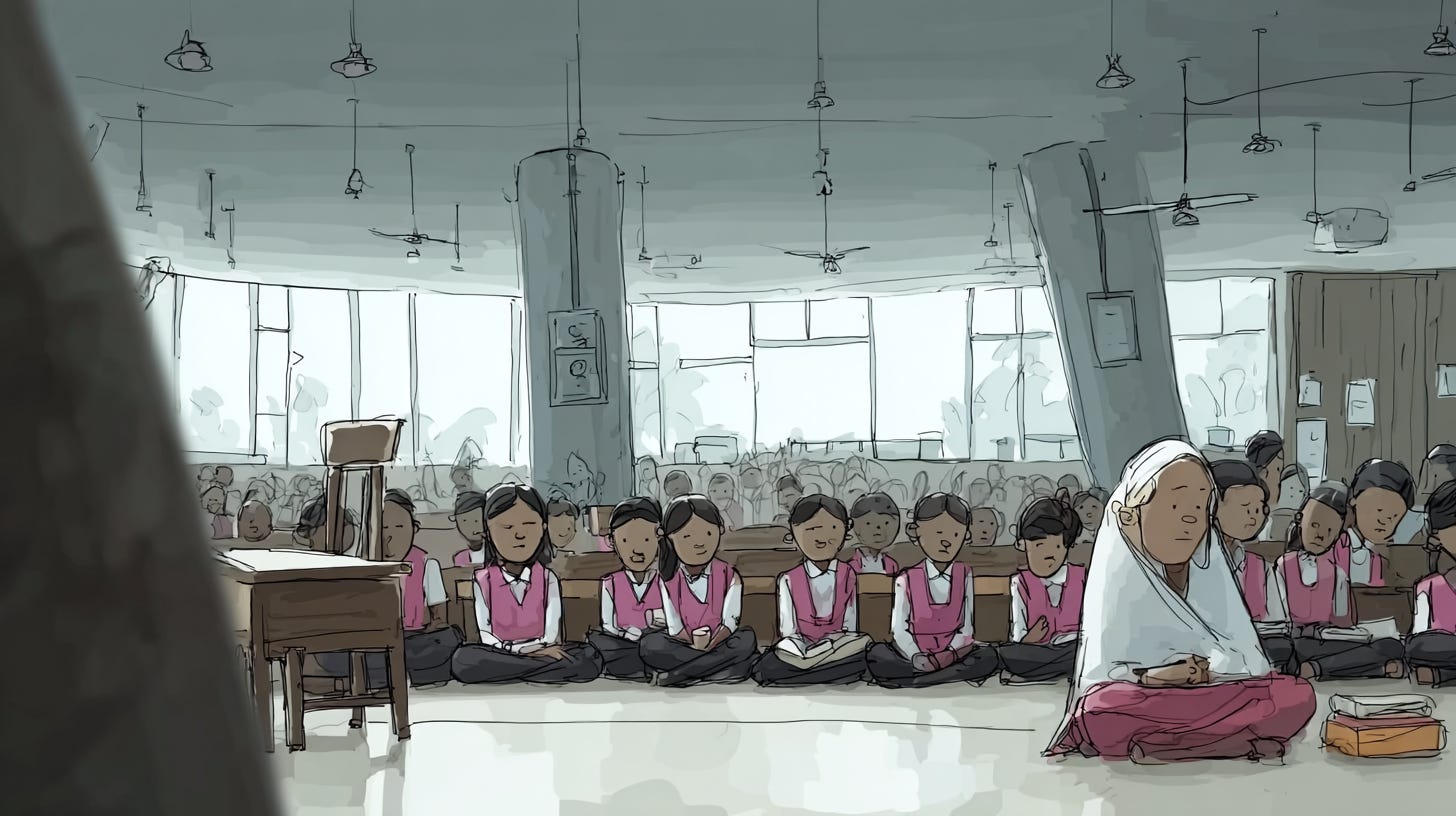
What Gets Built in Five Hours
This morning there was a meeting. By afternoon there was a tool.
That compression — meeting to prototype in five hours — is either the promise of AI development or its pathology, depending on what you build and why. In the case of Wilkes, a field report transformation system built for Homes of Hope India in the hours following a conversation with the organization’s collaborators, I find myself believing it’s the former. But that belief has to be earned, not assumed. So let me account for what was actually built, what it does, and why the name it may carry — Paul Wilkes, the writer and founder who has spent fifty years refusing the dishonesty of charitable storytelling — is not decoration but demand.
A tool named for a person is a promise to that person. Even an informal one. Even a conditional one. Even one offered as tribute rather than contract. The name creates a standard, and the standard has teeth.
Here’s what Wilkes does, in plain language: it takes the raw materials of humanitarian field work — the voice notes, the bulleted status updates, the photographs, the casualty counts that never make it into the annual report — and transforms them into narrative journalism that can live on Substack, anchor a YouTube video, justify a donation, or carry the weight of a story that would otherwise evaporate into the operational silence that surrounds most good work in the world. It is, at its core, an editorial system. The field is far from the audience. The people doing the work don’t have time to write. The tool closes that gap.
This is not a revolutionary idea. It is an old problem — how do you get testimony from the front to the people who need to hear it — solved with new instruments.
Why This Morning’s Meeting Mattered
The meeting brought together Raj, a computer scientist who is also the person responsible for bringing Homes of Hope India into Nik’s orbit; Doug Werby, who is currently filming a documentary on the organization’s work in Kochi and Assam; and a conversation about what AI could actually do for thirty-three orphanages operating on a 97% program expense ratio with a founder who takes no salary and a documentary that needs $30,000 to finish.
What struck me, reviewing the meeting notes afterward, was not the ambition of what was discussed — ambition is easy — but the specificity of the problem. Raj described a pilot program in a smaller city, leveraging faith institutions and public awareness to change societal attitudes toward child begging. Doug described his daily production logs, the footage accumulating, the story taking shape. What neither of them described was a communications infrastructure capable of translating that work into the kind of sustained narrative that builds donor relationships over time.
That’s the gap Wilkes is built to close.
The meeting ended with action items. Nick would create a Substack account. Set up YouTube. Generate articles from Doug’s videos. Share drafts for review. These are the logistics of an editorial operation — necessary but insufficient without a system behind them. Five hours later, the system existed in first draft. This essay is, in part, a record of that draft’s existence and its intentions.
The Name and Its Obligations
One imagines Paul Wilkes reading about a tool named in his honor and asking the obvious question: does it do what I’ve spent my career arguing for, or does it do the opposite?
The answer, if Wilkes the tool is built correctly, is that it does what he argues for — which is to say, it transmits testimony rather than inventing it. The Global Constraints that govern every command in the Baldwin writing system apply here with particular force. No fabrication. No invented quotes, no composite characters, no scenarios dressed up as facts. The field workers, Doug and Paul, supply the raw material. The tool transforms it. The stories belong to the girls in Kochi and Assam, not to the editorial system processing their circumstances into prose.
This distinction is not semantic. It is the ethical center of everything the tool either does well or fails entirely.
Paul Wilkes built his literary reputation on administrative realism — the leaky roofs of Father Greer’s parish as the true site of spiritual life, the Archdiocese’s politics as theological argument, the bone-deep specificity of being exactly where your feet are. His journalism finds the transcendent in the documented. The tool that carries his name must do the same: find the story in what Doug actually filmed, in what Raj actually described, in what the field reports actually contain. Not the story you wish were there. The one that is.
Five hours is enough time to build the architecture. It is not enough time to know whether the architecture will hold.
What Gets Added Next
This essay is a heads-up, not a review. The tool exists; features will accumulate; the blog will follow the build. What I can account for now is the design intention, because design intention is the thing most likely to drift if it isn’t written down.
Wilkes is meant to do three things well. First: transformation — taking raw field input and producing publication-ready narrative in the voice the Homes of Hope editorial operation requires. Not generic nonprofit prose. Not the language of the charity brochure. The New Yorker register that Paul Wilkes himself mastered, applied to a Substack operation that needs to convert casual readers into sustained donors. Second: verification — the no-fabrication constraint enforced structurally, so that hypotheticals are labeled, claims are tethered to source material, and the editorial system cannot accidentally invent what it should only transmit. Third: attribution — building the proof-of-work companion piece into the workflow, the weekly meta-narrative that documents exactly how the stories were made and which tools produced them.
The third feature matters more than it might appear. The humanitarian sector has a trust problem that AI has not yet solved and may be making worse. Every fabricated quote in an AI-generated nonprofit newsletter erodes the credibility of every honest one. Wilkes, if it works as intended, proves the opposite case — that transparency about process increases rather than decreases trust in the output. The weekly proof-of-work piece is not humility performance. It is accountability infrastructure.
What gets added as the tool develops: likely a more refined input schema for Doug’s daily production logs, a template calibrated specifically for the Kochi pilot program Raj described, and eventually an output pathway that feeds directly into the Substack editorial queue with review flags for Paul and Doug before anything publishes.
None of this is built yet. The distinction between “designed” and “built” is the one that matters most in early development. This essay marks the end of the design phase and the beginning of the thing being tested against reality.
The Standard It Has to Meet
I recognize in this tool the risk that attends every well-intentioned system: that it becomes efficient at producing the thing it was designed to prevent.
Paul Wilkes spent fifty years building a methodology for humanitarian storytelling that refuses charity theater — the grateful child, the before-and-after photograph, the fundraising email that compresses a human being into her worst moment. The tool named for him must be at least as rigorous about what it won’t produce as about what it will. The editorial constraints are the features. The no-fabrication rule is the product. The voice is not aesthetic preference but moral commitment.
This morning there was a meeting about a problem that has existed for as long as there have been organizations doing important work in places where no one is watching. By afternoon there was a first attempt at a tool that might help.
That’s all it is right now. A first attempt. Named for someone who has earned the right to demand more.
The blog will track whether it gets there.
Wilkes
AI Storytelling for Nonprofits
Witness the truth. Write it plainly. Let the story do the work.
Humanitarians AI is a registered 501(c)(3). Contributions are tax-deductible to the extent permitted by law.
The People Doing the Most Necessary Work in the World Are Too Busy to Tell Anyone About It
Consider the sisters running a shelter for trafficked girls in Kerala. They wake before dawn. They are surrogate mothers to thirty children. They have a filmmaker, Doug Werby, sending documentary footage from the field — not because the mission is failing, but because no one on staff has the time to turn a dormitory interview into a published article.
The story exists. The bandwidth does not.
The donor in Boston who would fund another year of a girl’s education — $940, one life changed — never finds out this organization exists. Not because the mission failed. Because the people running it were too busy doing the work to talk about it.
Nonprofits that cannot tell their story consistently forfeit 23–33% of potential donor revenue annually. Not from lack of mission. From lack of megaphone.
Before Wilkes, a Nonprofit with Extraordinary Field Footage Had Two Options
Hire a communications team they couldn’t afford — or let the story die on a hard drive.
After Wilkes, that same footage becomes a published article, a YouTube video, and a donor-ready social piece in hours, not months. The bridge is simple: send us your raw material — footage, transcripts, field notes, reports, the names and stories of your people. We send back publication-ready content written entirely in your organization’s voice.
Not a template. Not a generic AI output. Writing that sounds like your mission, uses your language, reflects your values, and remains consistent across every piece you publish.
Instead of watching stories disappear into a folder no one opens, your organization can now publish like a newsroom — without hiring one.
The Writing Is Bespoke. The Voice Is Yours.
This is the part that matters most.
Wilkes is not a content generator. It is not a tool that produces passable copy fast. It is a writing system trained on the existing writing from your organization and configured specifically for your organization before a single word is written.
We learn your mission. We learn your people. We learn how you talk about your work and what you would never say. We read everything you’ve written and everything that’s been written about you. We load the names, the places, the outcomes, the founding story, the specific texture of why this organization exists.
Then the tool writes the draft — in a register that matches the gravity of what you do. Many drafts are wonderful on one or two passes, but the tool will continue to make changes in your voice until you are ready to hit publish.
A profile of one of your graduates does not read like a press release. A documentary arc following a field team does not sound like fundraising copy. A donor-facing article does not perform urgency or manufacture sentiment. The writing earns trust because it is specific, grounded, and unmistakably yours.
Every piece Wilkes produces is consistent with what came before it. Your brand voice does not drift between platforms, between writers, between years. It holds.
What You Send Us. What We Produce.
You do not need to know how to use the system. You need to know how to send an email. For example, The Nerd Skills Problem article was written from the AI notes of Humanitarians AI first Zoom call with Homes of Hope India.
Upload what you have — raw footage, transcripts, interview recordings, annual reports, program notes, field logs, photos, a description of the people your organization serves. Tell us about the work. Tell us about the people. Tell us the story you’ve never had time to write.
We do the rest.
Wilkes converts that material into publication-ready content across five formats:
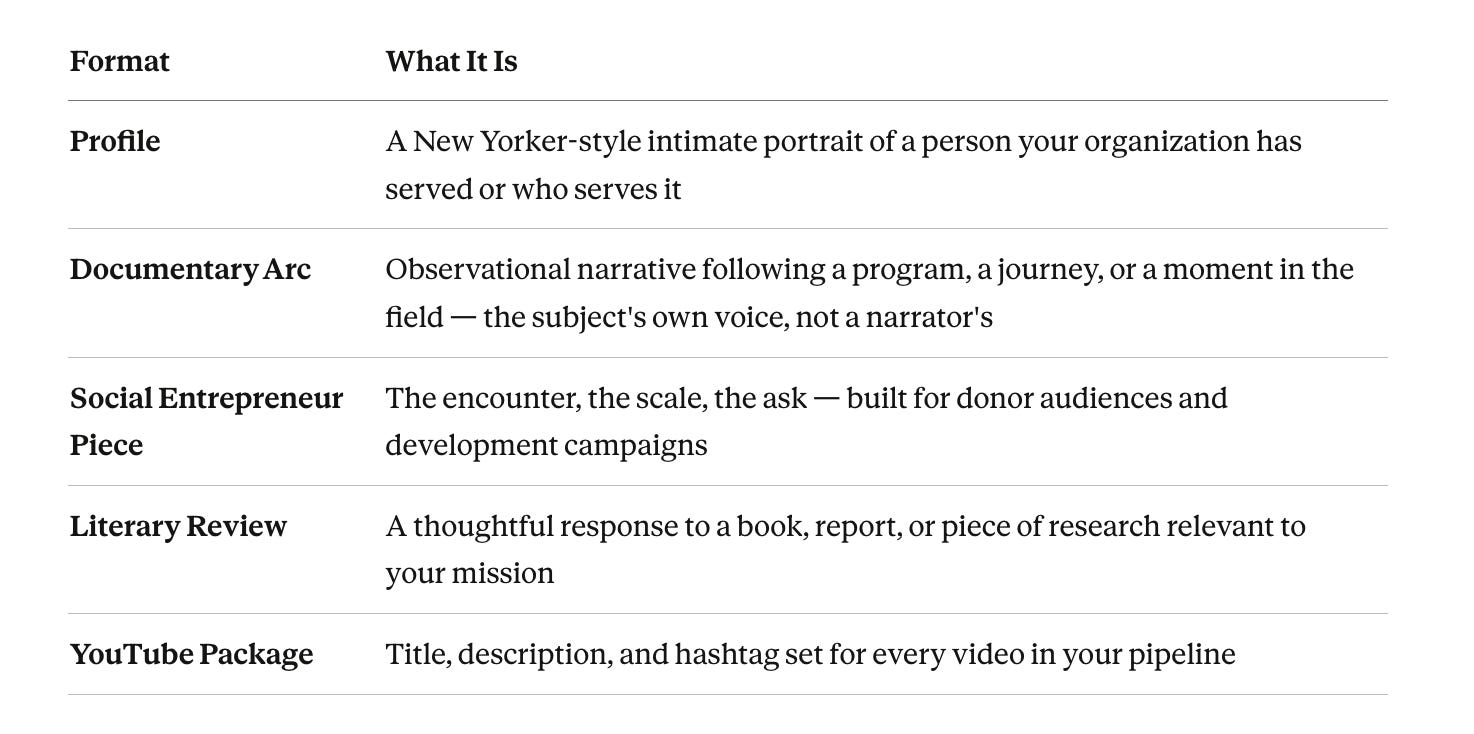
Every piece goes through review before it publishes. Nothing goes out with facts we cannot verify. Nothing is invented. Nothing is embellished.
The draft will stay in your Substack until you review it.
Most AI Writing Tools Start from Nothing. Wilkes Starts from Everything That Makes Your Organization Real.
Your people. Your outcomes. Your years of documented impact.
Multiple AI assistants work together — one understands your brand voice, one structures the story, one formats it for each platform. They don’t invent. They translate — field material into finished narrative.
Think of it as an orchestra. Your mission is the score. Wilkes conducts.
The combination of AI writing systems mature enough to hold a journalist’s voice, and documentary tools cheap enough for a filmmaker to shoot in Kerala on a consumer budget, made this possible in 2025 in a way that would have required a full production company and a staff of writers five years ago.
Generic AI Tools Write Fast; Wilkes Writes True
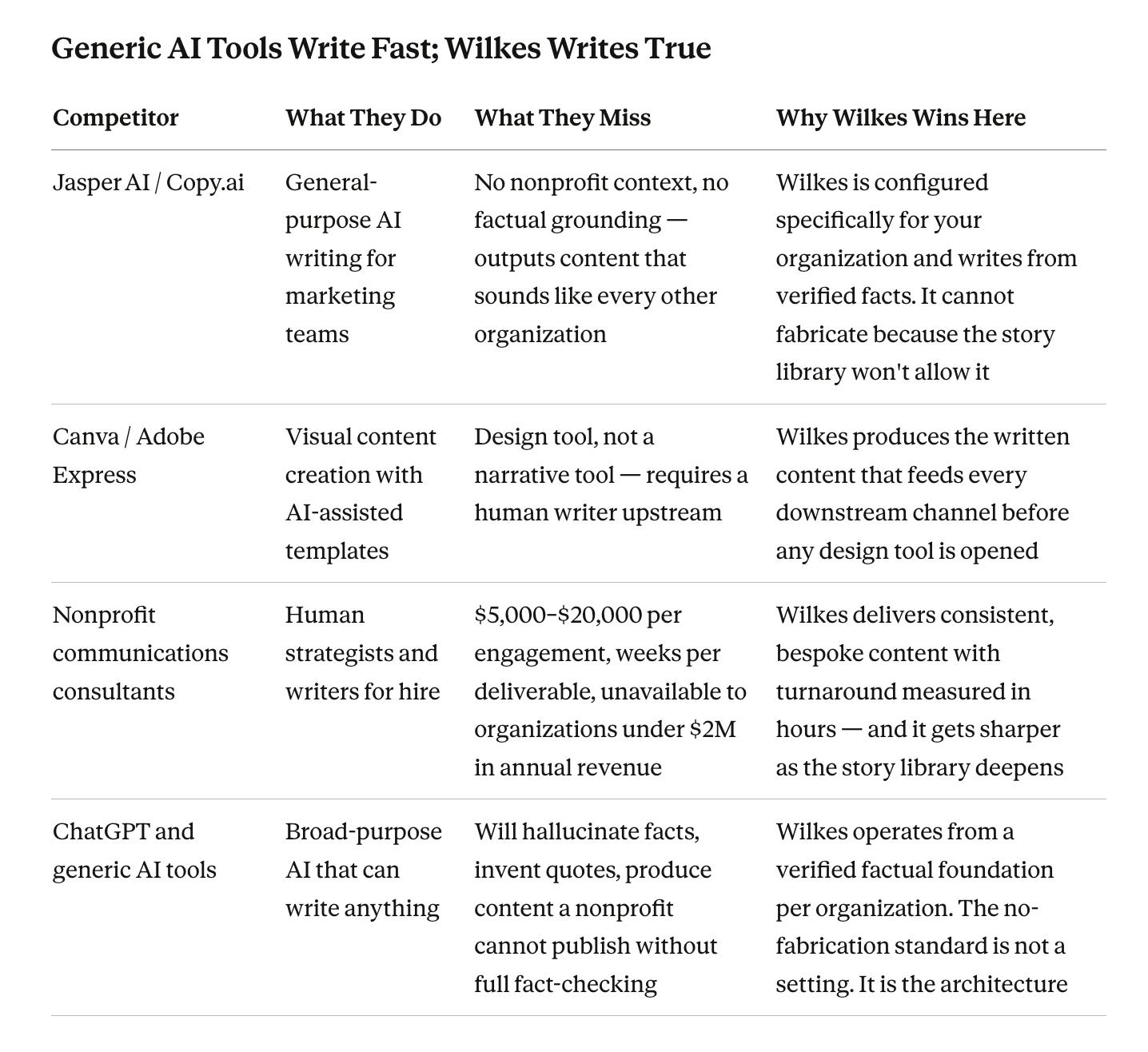
Wilkes’s edge is not the AI — it is the combination of the journalistic method, a verified per-organization story library, and a managed service that requires nothing from the nonprofit except raw material. No competitor can replicate the Paul Wilkes voice, the no-fabrication architecture, or the nineteen-year proof of concept already live at homesofhopeindia.substack.com.
We win because no one else brings the voice, the rigor, and the proof together.
Wilkes Is Live Today
Wilkes is not a concept. It is a live system with a published article, a configured Substack, and an active content pipeline flowing from a documentary filmmaker in India as of February 21, 2026.
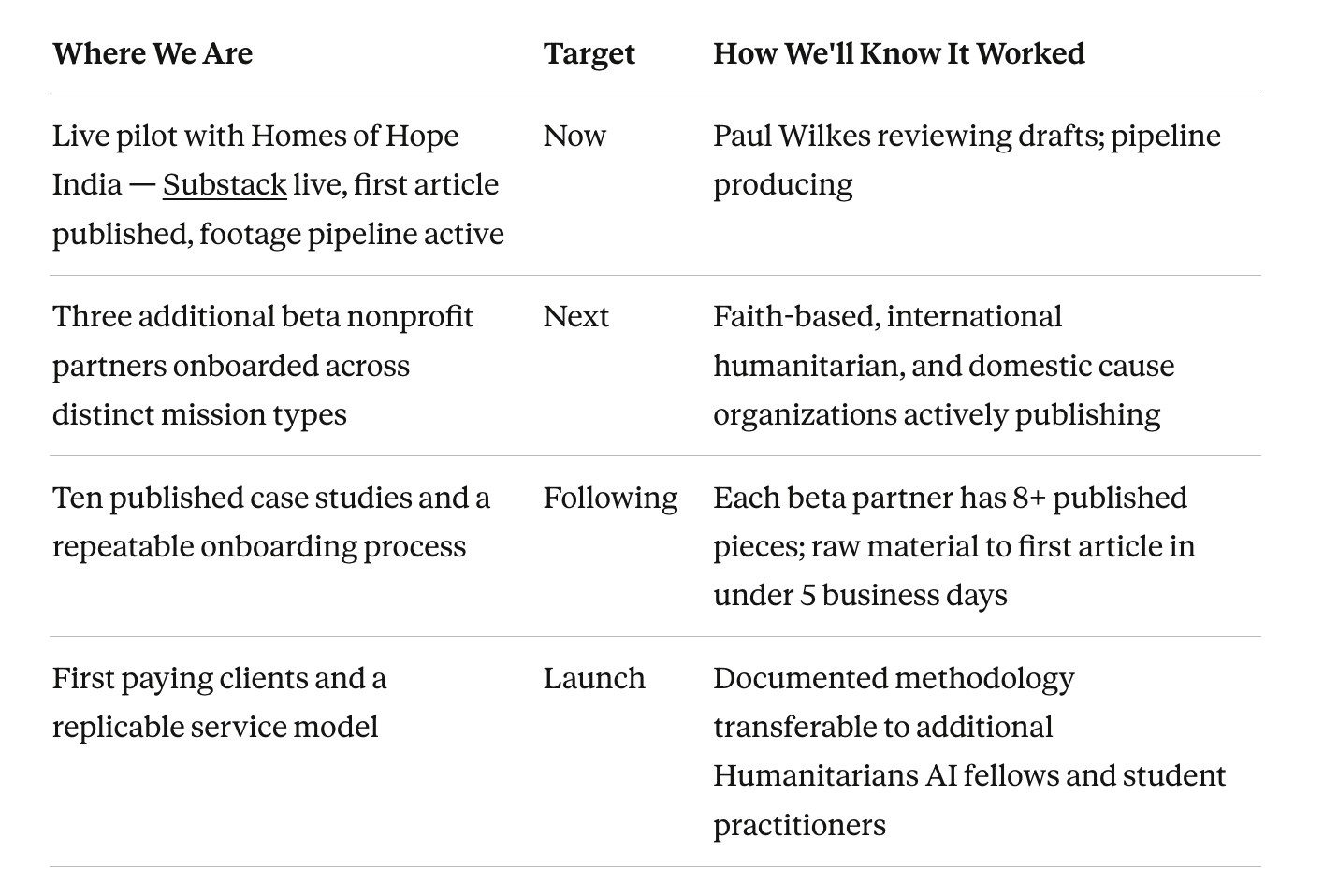
The pipeline exists. We are filling it.
Here Is What It Already Does
This is not a mockup. This is homesofhopeindia.substack.com — live, published this morning.
Three weeks ago this organization had footage on a hard drive in India and no content infrastructure. Today it has a Substack, a published article, and a pipeline producing more.
The nonprofit sent footage. Wilkes returned a finished story. No communications hire. No agency. No months of production.
That is the proof of concept. And it is replicable for any organization willing to send us their raw material.
Wilkes Also Builds the Pitch for Your Mission
Most nonprofits do extraordinary work that foundations, major donors, and grant committees never hear about — not because the mission lacks merit, but because no one on staff has built a pitch before.
Wilkes includes a nonprofit-adapted version of the Madison Pitch Framework: a structured method for building a compelling ten-slide presentation of your mission, your outcomes, and your ask. The framework was originally developed for startup ventures. The Wilkes variant strips the startup defaults — revenue multiples, growth-at-all-costs framing, equity structures — and replaces them with the language nonprofits actually need: mission clarity, program proof, donor economics, and a call to action built around partnership rather than investment.
You describe your organization. Your people. The problem you exist to solve. What you need and who you need it from. Wilkes builds the complete narrative — the hook, the solution, the evidence, the roadmap, and the ask — in a voice that matches the gravity of your work rather than performing urgency it hasn’t earned.
The document you are reading right now was produced by Wilkes. Not as a pitch for your organization — but as a pitch for ours. The same system that built this narrative can build yours: the opening that stops a donor mid-scroll, the competitive framing that explains why your approach is different, the closing line that makes someone remember your mission after the meeting ends.
If your organization needs to stand in front of a foundation, a major donor, a university partnership, or a grant committee — and you have never built a pitch before — this is where you start.
Same email. Same subject line. Tell us what you need the pitch to do.
The First Five Nonprofit Partners Are Free. No Deadline. No Catch.
We are not asking for money. We are asking for five organizations with an active mission, raw field material, and a story that deserves a larger audience.
The first five nonprofit partners pay nothing. We configure the system for your organization, learn your voice, and produce content until you’re satisfied the writing sounds like you — and only you.
What we ask in return is simple:
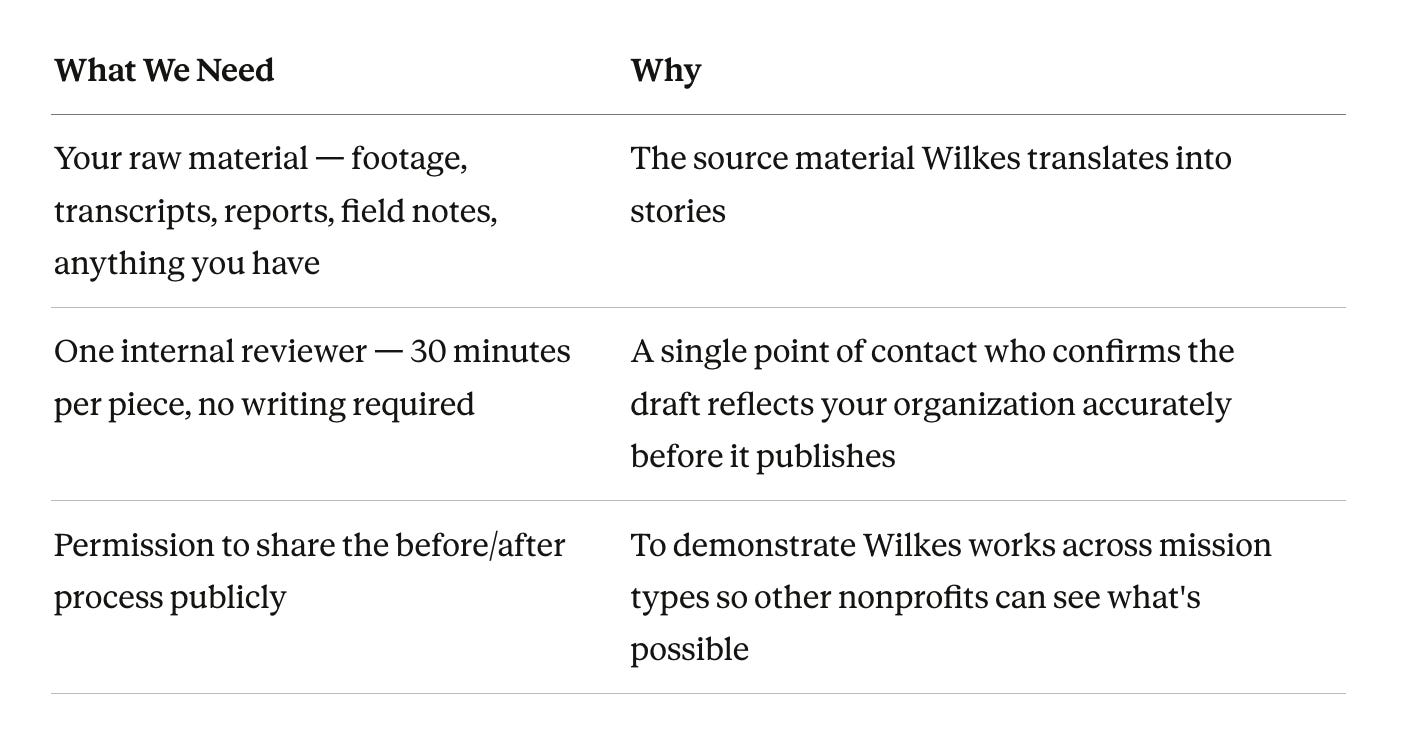
To apply: Send one email to bear@humanitarians.ai with the subject line “Wilkes Beta.”
Tell us what your organization does. Tell us about the people you serve. Upload whatever you have — a report, a transcript, a folder of footage, a link to something you’ve already published. Tell us the story you haven’t been able to tell.
Two sentences or two hundred. We’ll take it from there.
There is no form. No application process. No committee. Just an email and a conversation about what your mission deserves to sound like.
What Wilkes Costs After the Beta
The first five partners are free — fully managed, no strings. For organizations that join after the beta, pricing is built around what nonprofits actually need: a complete service, not a tool to learn.
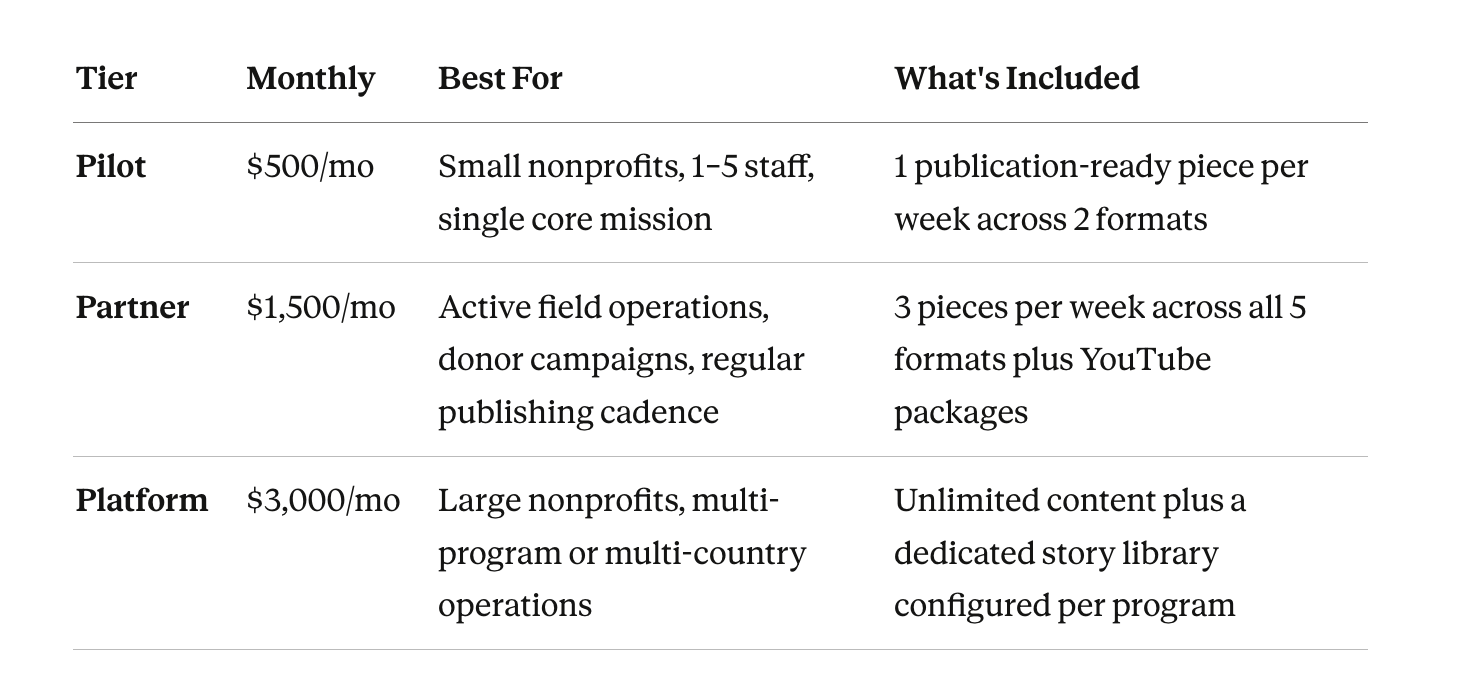
Every tier is fully managed. You send material. We write. Nothing to install, no tool to learn, no communications hire required. Pricing reflects the cost of content infrastructure your organization actually needs — at a fraction of what a single communications hire would cost.
Beta partners who continue after June 2026 set their own terms.
Somewhere in India right now, a girl is sitting in a dining hall describing a shelf where she used to keep her things — and until this morning, no one outside that room knew her name. That is the story Wilkes exists to tell. Yours is next.
Tags: Wilkes field report tool, Homes of Hope India Substack, humanitarian AI editorial system, narrative journalism no-fabrication constraint, Paul Wilkes documentary workflow