

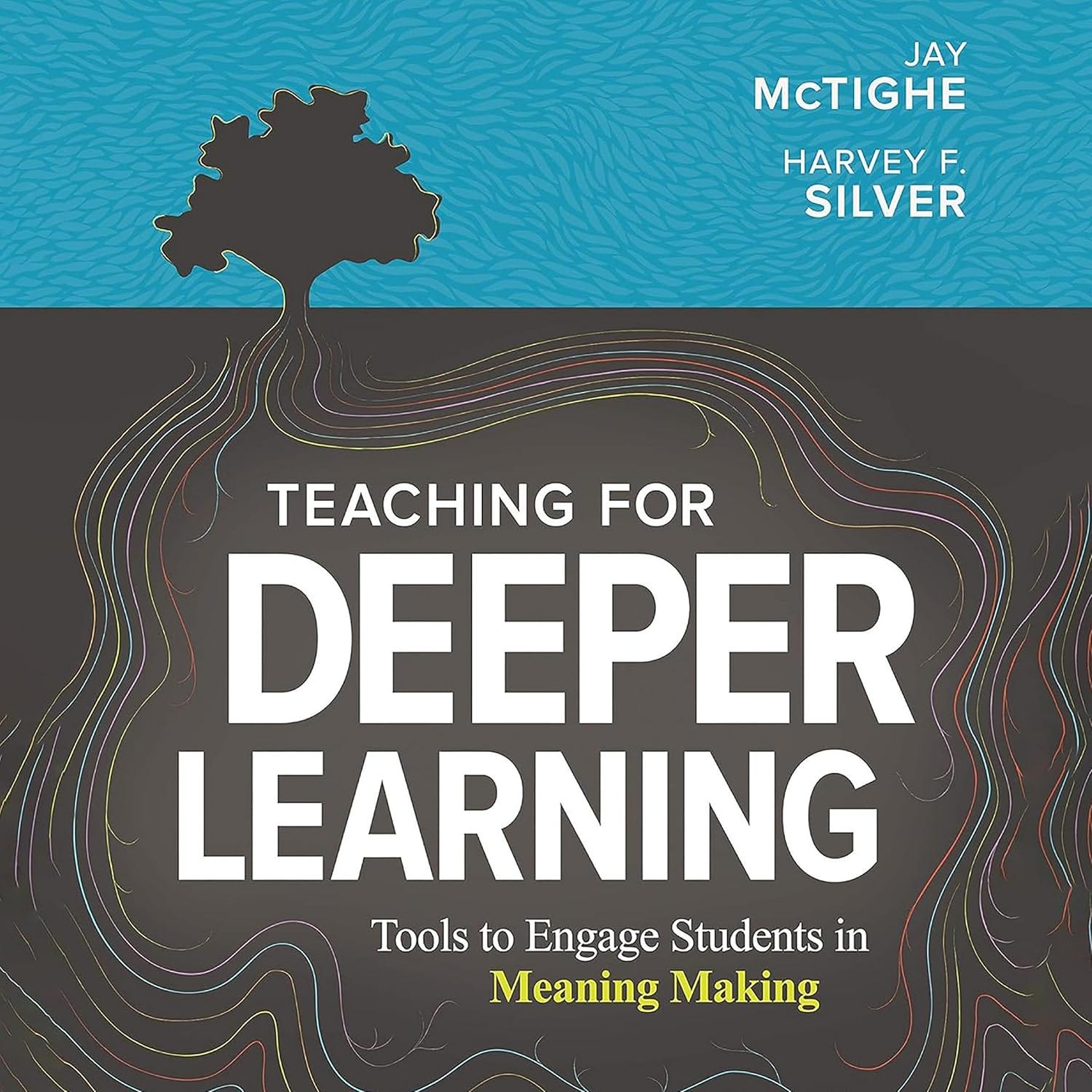
There is a moment in the introduction to Teaching for Deeper Learning — a moment that reveals, without quite intending to, the book’s central tension. Jay McTighe and Harvey Silver invoke Buckminster Fuller’s four design questions: Does it meet its purpose? Is it functional? Will people like it? Is it beautiful? Then they describe feedback from their workshops: the response from educators has been “extremely positive and enthusiastic.” The book, in other words, passes the Fuller test on the metric that requires the least scrutiny. Whether it actually meets its intended purpose — whether the seven thinking skills and their associated tools produce the deep, transferable understanding the authors promise — is the question the enthusiasm answers only indirectly.
This is not a criticism of good faith. McTighe is the architect of Understanding by Design, one of the most consequential curriculum frameworks of the past thirty years. Silver leads the Thoughtful Classroom project, with deep roots in teacher development and classroom implementation. Their synthesis here is coherent, their tools are thoughtfully designed, and their conviction that schooling must shift from knowledge transmission to meaning-making is correct and important. The problem is not what this book says. It is what the book cannot say within its chosen form.
What the Book Gets Right
The central claim is elegant: deep learning requires active meaning-making; meaning-making requires seven specific thinking skills; those skills can be taught using structured tools. The seven — conceptualizing, notemaking and summarizing, comparing, reading for understanding, predicting and hypothesizing, visualizing and graphic representation, perspective-taking and empathizing — are presented as both the means by which students develop understanding and the ends that constitute transferable intellectual competence.
Two of the seven carry real external validation. Comparative thinking benefits from substantial meta-analytic support. Dean, Hubble, Pitler and Stone (2012) and Marzano, Pickering and Pollock (2001) document significant achievement gains from explicit instruction in comparing and contrasting. Notemaking and summarizing draw on a multi-study evidence base. For these two chapters, the authors make the right methodological move: they distinguish between the general strategy, supported by research, and their specific tools, which are theoretically grounded and classroom-tested but not independently evaluated. That distinction — between what the research shows and what follows from it — is intellectually honest. It is also, unfortunately, rare in this kind of book.
The chapter on framing learning around big ideas is the book’s most quietly radical contribution. The core curriculum design argument — that knowledge expands too fast to cover, that expert knowledge organizes around concepts not facts, that transfer requires conceptual understanding — is grounded in the National Research Council’s 2000 findings on expert cognition and is genuinely, enduringly important. McTighe has been making this argument for thirty years, and it has not become less true. The tools for big-idea framing — A Study In, Concept Word Wall, Essential Questions — are among the most immediately implementable in the book. What the chapter cannot address is why, given decades of advocacy for concept-based curriculum, most classrooms continue to operate on a coverage model. The structural answer — high-stakes tests measuring factual recall, pacing guides, content-dense syllabi, the accountability machinery that punishes depth and rewards breadth — is the book’s most significant omission. Teaching for Deeper Learning is written for teachers who have the freedom to redesign their curriculum around big ideas. For many teachers, that freedom is substantially constrained, and the book says almost nothing to those teachers about how to navigate the constraint.
The Engagement Problem
The deepest unresolved issue runs through nearly every chapter, often invisible. I want to name it directly: the engagement-learning conflation.
The mystery format in Chapter 6 makes hypothesizing engaging by presenting content as a puzzle. Students receive clues, group them, generate hypotheses, check against sources. The book presents this as evidence that hypothesizing can be taught and that students respond to it with enthusiasm. What it does not establish — and what the mystery format cannot establish from inside itself — is whether the engagement translates into superior retention, comprehension, or transfer of the content being studied. A student who genuinely enjoyed solving the mystery of why the Age of Exploration happened in the fifteenth century may or may not have encoded a more durable understanding of its causes than a student who read a well-structured textbook chapter and answered discussion questions. The book cannot tell us, because the evidence is not there.
The same pattern appears in Chapter 8’s “a day in the life,” which asks students to write from the perspective of a white blood cell, a chrysalis, a historical figure. The examples are vivid and students produce interesting work. Whether that work reflects deeper understanding of the concept being studied — or primarily reflects engagement with a familiar creative writing convention — is not established. A student who writes a first-person account of a white blood cell hunting a virus may have learned more about narrative perspective than about immunology. This matters. Classroom time is finite. An engaging activity that does not produce deeper understanding has an opportunity cost — the time spent on the engaging activity is time not spent on something that might have produced both engagement and learning.
There is a sentence in Chapter 7, on visualization and graphic representation, that I keep returning to. Discussing concept maps, the authors note that “students should be taught to use the tool independently.” It is the most pedagogically realistic moment in the book. The research on graphic organizers and concept maps is clear about one thing: untrained students produce maps that often do not reflect their actual understanding, and map quality is notoriously difficult to assess. The caution embedded in that single sentence — show students how — acknowledges something the book’s overall tone resists: tools can be used badly, and the gap between assigning a tool and developing the thinking skill it is meant to scaffold is exactly where most classroom implementation fails.
The book is almost entirely success-case oriented. There are no examples of a tool producing unintended outcomes, no examples of a well-designed lesson that failed to produce the expected understanding, no acknowledgment of the research on transfer of thinking skills — which consistently finds that transfer is difficult to achieve, highly context-dependent, and rarely as durable as practitioners hope. This is not surprising. The genre of the practitioner design book selects for examples that illuminate the design. But it leaves the reader without any way to calibrate risk, which is precisely what a teacher deciding where to invest finite instructional time most needs.
What the Evidence Actually Shows
The book’s most proven claims are also its most foundational: meta-analytic evidence supports comparative thinking as a high-impact strategy; the three-phase model of proficient reading (before, during, after) is well-grounded in reading research; organizing curriculum around big ideas and essential questions has strong theoretical and practitioner support; notemaking and summarizing broadly benefit from multi-study evidence.
The book’s most significant unproven claims are also its most ambitious: that the specific tool implementations described produce the achievement gains attributable to the broader strategies they instantiate; that student engagement with the tools translates into independent transfer of the embedded thinking skills; that the tools work equivalently across all content areas and grade levels. The universality claim — seven skills for all grades and subjects — is partly rhetorical. Visualization benefits documented in controlled studies are stronger for narrative than for abstract content. Empathy tools are at home in history and literature and stretch considerably in STEM applications. Predicting works differently in reading comprehension (anticipation guides) than in scientific hypothesis generation. The book acknowledges some of these distinctions in passing, but the toolkit structure — seven skills, roughly equal treatment, similar confidence level across — obscures a gradient that matters for practitioners deciding where to invest time.
Dual coding theory (Paivio, 1990) has robust experimental support for paired associate learning. Its application to complex disciplinary content — concept maps, story maps, split-screen notes — involves a meaningful extrapolation. Inductive learning is attributed to Taba’s foundational mid-century work without engaging decades of subsequent research on whether inductive instruction outperforms deductive instruction, and under what conditions, and for which learners. These are not pedantic objections. They are the questions a practitioner needs answered to decide whether to spend three class periods on an inductive learning lesson or two class periods on direct instruction followed by application.
The Practitioner’s Inheritance
Where does this leave the intended reader — a teacher, an instructional coach, a curriculum designer?
With genuinely useful tools and a framework that is more inspirational than operational, more theoretically grounded than empirically validated. For teachers who have never thought systematically about the difference between note-taking and notemaking — copying versus constructing — this book offers a real conceptual shift. The window notes format is a better design than conventional copying. The T-chart is structurally superior to the Venn diagram for most comparison purposes. The reading stances model gives teachers a richer vocabulary for asking students to engage with texts at multiple levels. The four-reading-phases in Chapter 5 — before, during, after — provide an immediately actionable frame for reading instruction in every content area. These are genuine contributions to practice.
The book’s most honest moment is also its most instructive one. In Chapter 9, the synthesis chapter, McTighe and Silver present a curriculum mapping matrix — a planning tool for aligning units, thinking skills, and big ideas across an entire year. It is the most structurally ambitious recommendation in the book, and also the one where the gap between design and implementation is most visible. Mapping a full year of curriculum around seven thinking skills and a set of conceptual frameworks is not a weekend task. It requires collaborative planning time, curricular freedom, administrative support, and a willingness to renegotiate relationships with pacing guides and standardized tests. None of those conditions are addressed. The matrix is an elegant design. It is also a design that assumes a set of professional conditions that many teachers do not have.
This is the toolkit problem, finally stated plainly. A good toolkit can be used well or badly. A hammer does not build a house; a carpenter does. The book provides the tools and extensive guidance on how to use them. What it cannot provide is the practitioner judgment required to know which tool to reach for when, at what depth, for which students, in which content area, given the specific constraints of a given classroom. That judgment develops through deliberate practice and formative feedback — the very kind of active meaning-making the book recommends for students.
The deepest implication of Teaching for Deeper Learning may be that the same principles it advocates for students apply with equal force to the teachers who are supposed to enact them. If understanding must be earned through active construction — if it cannot simply be transmitted by telling — then no book, however well-designed, can shortcut that process. The tools are real. The thinking skills are worth developing. The transformation from coverage teaching to meaning-making instruction is both urgent and genuinely difficult. The book makes the first of those three things very clear. It is quieter about the other two.
Nik Bear Brown, Associate Teaching Professor of Computer Science and AI, Northeastern University / Founder, Humanitarians AI (501(c)(3))
Tags: Teaching for Deeper Learning McTighe Silver review, meaning-making pedagogy deep learning critique, big ideas curriculum design evidence base, seven thinking skills practitioner toolkit, engagement-learning conflation educational research