

There is a specific moment when an institution reveals what it actually believes about the people it serves. It is not the moment of the announcement — the press release, the partnership ceremony, the dean’s email promising a “transformative new tool.” It is the moment of the first failure. What does the institution say? What does it do? What does it pretend didn’t happen?
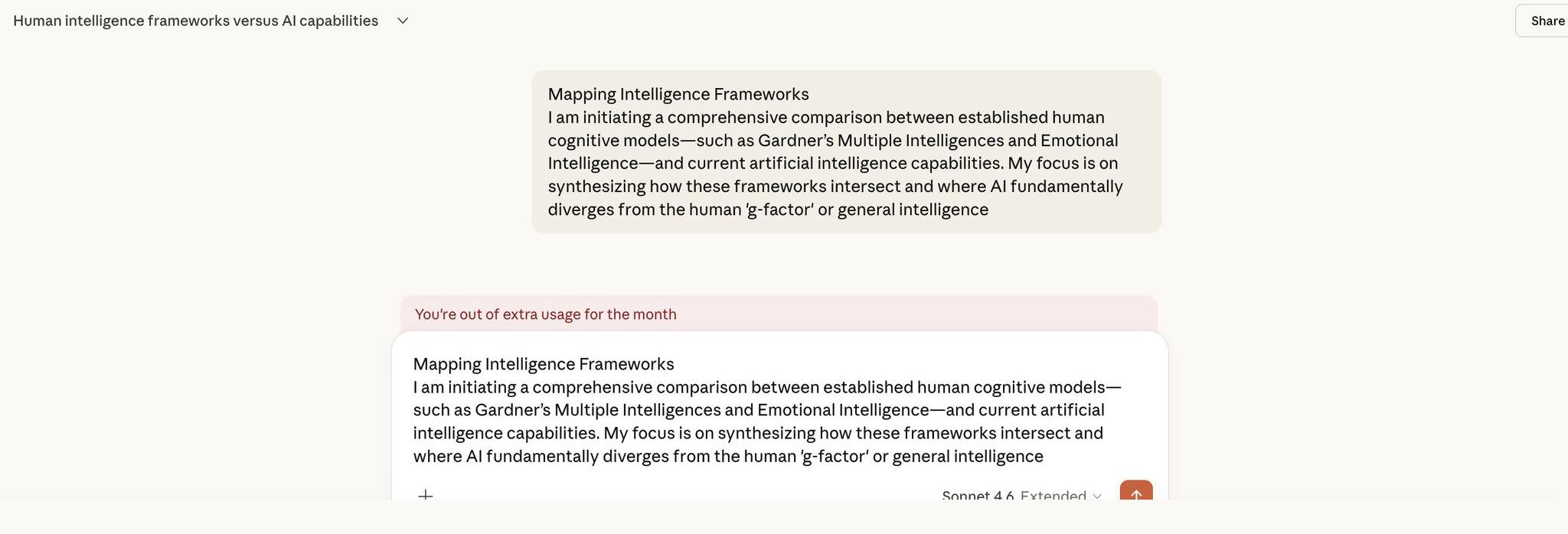
At Northeastern University in March 2026, ten days into the monthly billing cycle, a significant portion of the student and faculty body found themselves locked out of Claude — the AI system the university had been actively promoting as essential to their work and identity as an institution. The official IT status page read: “All Systems Operational.” Students sat in front of error messages. The gap between those two facts is not a technical story. It is a trust story. And trust, the research tells us, is a critical variable that ultimately determines whether AI in education works or doesn’t.
What the Research Is Actually Saying
The literature on human-AI interaction has converged on a deceptively simple finding: the goal of an AI deployment is not high trust. It is calibrated trust — a state where a user’s confidence in a system accurately matches the system’s actual reliability. Calibration in either direction carries costs.
Over-trust produces cognitive outsourcing. Students who trust AI too completely stop verifying, stop questioning, stop reasoning independently. They perform worse on assessments of genuine understanding than students who never used the tool at all. This is the failure mode that administrators who are afraid of AI worry about, the one that drives surveillance architectures and plagiarism detection software.
But under-trust is equally corrosive, and less discussed. When students don’t trust an AI tool — or when they trusted it and then didn’t — they exhibit what researchers call “algorithmic aversion.” They disengage. They work around the system. They pay for alternatives from their own pockets. The tool sits at full enterprise cost, touching nobody’s learning.
The Northeastern crisis is a near-perfect case study in how under-trust is manufactured. Not by incompetence alone, though the operational failures were real. By something more specific: the violation of what psychologists call the “benevolence” dimension of trust. Users weren’t just asking whether Claude was capable. They were asking whether the institution providing Claude was acting in their interest. The answer they received — a silent cap, a status page claiming no incidents, an IT desk that confirmed limits were “not a glitch” without explaining anything — was unambiguous. The institution was managing its budget. Students are not confused about the difference between that and being served.
The Honeypot Effect and Why It Matters More Than Capability
When a university deploys an AI tool with institutional endorsement — the implicit promise that this system has been reviewed and is appropriate for academic work — students calibrate their workflows accordingly. They build projects inside the system. They structure their thinking around the assumption that the tool will be there tomorrow. They invest.
This is the Honeypot Effect: the tool attracts investment and dependency, and then the terms change.
The research on digital service failures is precise about what happens next. Process failures — how an outage is handled — are more damaging to long-term trust than outcome failures. Students can forgive an outage. They cannot forgive being told there is no outage when they are locked out of their work.
The March 2026 situation mapped onto this with uncomfortable precision. A monthly hard cap — structured, notably, as an inferior arrangement compared to a commercial Claude Pro subscription, which offers rolling resets rather than monthly lockouts — combined with zero proactive communication, no real-time usage dashboard, and a status page asserting operational health during the height of the crisis. The students who described this as a “bait-and-switch” were not being hyperbolic. They were applying the correct term.
The long-run damage from this kind of violation is non-linear. Trust adoption research consistently identifies a threshold effect: below a critical level of institutional credibility and technical reliability, investments in AI personalization and capability deliver negligible return. Capability becomes irrelevant once the cliff has been reached.
The Adversarial Trap
The Northeastern crisis illustrates one dimension of institutional AI failure: operational incompetence creating a trust deficit. But the broader research landscape points to a second, arguably more pervasive failure mode: institutions that build their AI strategy around surveillance rather than partnership.
The history of academic integrity technology is a history of arms races. Turnitin arrives; students learn mosaic plagiarism. Contract cheating evolves; proctoring software expands into students’ homes. AI detection tools emerge; students develop multi-stage workflows that transform and reframe AI-generated content until statistical signatures disappear.
What this cycle produces is not a reduction in dishonesty. It produces something more concerning: a population of students systematically trained in AI evasion. Recognizing machine-generated patterns. Understanding what detection algorithms look for. Manipulating output to satisfy statistical models. These are, paradoxically, skills of high AI literacy — acquired in service of dishonesty, and acquired because the institution framed AI as a threat rather than a partner.
The psychological mechanism is well-documented in self-determination theory. When institutions threaten student autonomy through mandatory surveillance, students experience a motivational state to restore that freedom. Externally controlled environments consistently produce lower intrinsic motivation, shallower engagement, and greater strategic behavior than autonomy-supportive ones — and the “presumption of guilt” embedded in detection-first frameworks is about as externally controlling as educational environments get. The surveillance doesn’t just fail to prevent cheating. It teaches students that the institutional relationship is adversarial, which makes genuine engagement less likely and strategic evasion more appealing.
The Bias Problem That No One Discusses Loudly Enough
There is a specific injustice embedded in AI detection tools that deserves more attention than it typically receives. These algorithms are trained on patterns in text — statistical signatures that correlate with machine generation. What they have learned to flag is writing that is grammatically conservative and syntactically predictable. Writing that avoids linguistic risk. Writing that carefully follows the rules.
This is also the writing style of people who are learning English as an additional language.
Research has documented that popular AI detectors produce substantially higher false-positive rates for multilingual writers than for native English speakers. The system designed to catch cheaters disproportionately accuses international students of cheating for the crime of writing carefully.
The resulting harm is compounded. Students who have been falsely accused don’t re-engage with genuine enthusiasm. They become defensive users of every system the institution provides — withholding context, minimizing engagement, performing compliance rather than pursuing understanding. The tool meant to protect academic integrity undermines the psychological safety that learning requires.
What Calibrated Trust Actually Requires
The research synthesis across 2024–2026 identifies institutional practices that reliably increase AI trust. They are not complicated. They are almost entirely about transparency and communication.
Real-time usage visibility. If Northeastern had given students a dashboard showing their monthly token consumption and projected exhaustion date, the March crisis becomes a different event. Not pleasant, but not a betrayal. A student who can see they have 80 messages left and adjusts accordingly has been respected as an adult. A student who wakes up to an error message with no context has been managed.
Service recovery protocols. When failures occur — and they will — what matters is the institution’s response. Acknowledgment within hours, not days. A genuine explanation, including the fiscal pressures if those were the cause. Tangible remediation. The institutional literature on trust repair is consistent: the response to failure affects long-term trust more than the failure itself. Silence is not a neutral choice.
Cooperative rather than adversarial assignment design. Assessments that assume AI assistance and make the human contribution irreplaceable — through oral defense, reflective metacognition, process documentation — collapse the incentive structure for dishonesty. The student who has been asked to explain their thinking in real time cannot outsource that explanation. This is not naive. It is more effective than the arms race.
AI literacy as a curriculum commitment, not an afterthought. Students who understand how large language models work — what they are good at, where they fail, why they produce confident errors — are less susceptible to both over-trust and under-trust. They are also less susceptible to surveillance anxiety, because they understand the limits of detection technology. Literacy is the operating system. Access is just the hardware.
The Learning Environment Argument
It would be easy to read the operational failures described here as purely administrative. They are not. They are pedagogical.
Self-determination theory and its successors have established that learning requires a specific psychological climate: one in which a student feels safe to be confused, to admit incomplete understanding, to ask the question they were afraid to ask in lecture. This climate is not automatic. It is produced by consistent experiences of competence, autonomy, and genuine relatedness — the sense that the people and systems around you are acting in your interest.
The AI equivalent of this climate is calibrated trust. A student who trusts a tool accurately — who knows what it can do, knows it will be available when promised, and knows the institution is being transparent about its constraints — is in a cognitive state to learn. A student who is managing uncertainty about whether the tool will be there tomorrow, whether the status page is honest, whether the institution’s interests align with theirs, is not.
The decision to implement a monthly hard cap without transparency, without a usage dashboard, without proactive communication, is not merely an operational decision. It shapes the psychological conditions under which students attempt to learn. That is the argument for getting this right — not efficiency, not reputation management, but the actual thing universities say they are for.
The Experiment Northeastern Is Running Whether It Intends To or Not
Joseph Aoun’s “Robot-Proof” framework argues that universities must prepare students to work in ways that complement AI rather than be displaced by it. This is correct. What the March 2026 disruptions revealed is that you cannot prepare students to work alongside AI while treating the AI deployment as an afterthought to be managed rather than a relationship to be sustained.
The “living laboratory” that Northeastern aspires to be does not end at the moment of deployment. It includes the operational decisions, the communication choices, the response to failure. If the experiment is genuinely about understanding what AI in education can become, then the March crisis is data: this is what happens when trust infrastructure lags capability by more than users can absorb.
The recommendations that follow are not technically difficult. Real-time usage dashboards. Rolling reset windows rather than monthly hard caps. Tiered access by academic need. Proactive communication when service changes. These are operational choices that signal a single underlying commitment: that the students and faculty using these tools are partners in the experiment, not problems to be managed within a budget.
The question was never whether Claude 4.6 Opus is capable. It is.
The question is whether the institution deploying it has earned the right to ask students to build their learning around it.
That question is answered not in April, at the press conference. It is answered in March, when the tool goes down and the status page says nothing.
Tags: AI trust higher education adoption, Northeastern Claude enterprise failure case study, calibrated trust algorithmic aversion learning, institutional AI transparency usage limits, cooperative versus adversarial AI education frameworks