

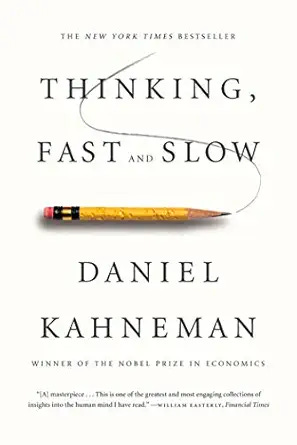
Part One: The Architecture of Two Minds
Chapter 1: The Characters of the Story
Kahneman opens not with theory but with invitation: look at an angry face, multiply seventeen by twenty-four, and discover that your mind operates on two distinct frequencies. System 1 delivers instant verdicts—the woman is furious, she will say unkind things—while System 2 labors through arithmetic. The distinction seems obvious until Kahneman reveals its implications: most of what we call thinking is actually System 1 generating suggestions that System 2 lazily endorses. The chapter establishes the book’s central architecture through the origin story of the heuristics and biases research program. In 1969, Kahneman invited Amos Tversky to speak to his Jerusalem seminar about whether humans are intuitive statisticians. Their spirited disagreement—qualified yes versus qualified no—launched a collaboration that would span fourteen years and fundamentally reshape how we understand judgment. The anecdote of statistical intuitions failing even among experts foreshadows a recurring theme: sophistication provides no immunity to bias. What emerges is a portrait of System 1 as simultaneously marvelous and flawed, capable of recognizing a friend’s face in a fraction of a second but equally capable of leading us astray through the very mechanisms that usually serve us well.
Chapter 2: Attention and Effort
The pupil becomes Kahneman’s window into mental effort. Working with Jackson Beatty, he discovered that cognitive strain manifests physically—pupils dilate during mental multiplication, reaching maximum size with the brutally difficult “add three” task, then contracting the moment the problem is solved or abandoned. The image is striking: consciousness has a metabolic cost that can be measured in millimeters of pupil diameter. The law of least effort emerges not as laziness but as biological design. System 2’s reluctance to engage isn’t a character flaw but an energy conservation strategy. Kahneman describes his daily walks in Berkeley, noting how thinking becomes impossible at maximum walking speed, not because ideas flee but because attention has only so much currency to spend. The chapter culminates in Roy Baumeister’s ego depletion research, revealing that self-control draws from the same limited budget as cognitive effort. The glucose studies are particularly elegant: volunteers who drank sugar-sweetened lemonade resisted intuitive errors that trapped those who drank artificially sweetened versions. Mental work literally consumes fuel.
Chapter 3: The Lazy Controller
System 2’s laziness reveals itself in the bat-and-ball problem, where “10 cents” leaps to mind and most people—even at Harvard, MIT, and Princeton—fail to check whether $1.10 minus $0.10 equals $1.00. The error isn’t computational incompetence but insufficient motivation to engage System 2’s supervisory function. Kahneman traces this failure across domains: logic problems where conclusion precedes argument, estimation tasks where Detroit’s existence in Michigan goes unmentioned despite its obvious relevance to the state’s murder rate. The distinction between intelligence and rationality emerges through Keith Stanovich’s work. Raw brainpower—the algorithmic mind—doesn’t prevent bias. What matters is rationality: the willingness to engage, to question first impressions, to resist cognitive ease. The bat-and-ball problem becomes a diagnostic instrument, separating those who accept superficially plausible answers from those who pause to verify. System 2’s true role crystallizes: not a reasoning engine but a monitoring system, often asleep at the switch.
Chapter 4: The Associative Machine
“Bananas” followed by “vomit” triggers a cascade: images, facial expressions, elevated heart rate, temporary aversion to bananas, primed associations spreading through memory like ripples on water. Kahneman demonstrates that System 1 constructs coherent narratives from minimal cues, treating juxtaposition as causation. The chapter accelerates through priming effects that threaten our sense of agency. Students who unscrambled sentences containing elderly-related words walked more slowly down the hallway—without awareness, without consent. The reciprocal effects are equally unsettling: forcing a smile genuinely improves mood, nodding while listening makes arguments more persuasive. Florida Effect, ideomotor effect, the names accumulate as the evidence mounts that our behavior is shaped by influences we neither notice nor control. The money-priming studies are particularly provocative. Mere exposure to currency-related stimuli—even Monopoly money in peripheral vision—increased self-reliance, reduced helping behavior, and promoted physical distance from others. The implications for a money-saturated culture remain uncomfortably unexplored.
Chapter 5: Cognitive Ease
Cognitive ease functions as a master dial that System 1 continuously monitors, ranging from “easy” (things are going well, no threats, relax vigilance) to “strained” (problems exist, mobilize System 2). The genius of the chapter is showing how diverse inputs—font clarity, repetition, mood, facial expression—all feed into this single signal, which then influences truth judgments, liking, and trust. The mere exposure effect demonstrates that repetition breeds affection even in the absence of conscious recognition. Turkish words shown repeatedly in Michigan newspapers were later rated more favorably, though participants had no memory of seeing them. Robert Zajonc’s elegant argument: repeated exposure without bad consequences becomes a safety signal, and safety is inherently positive. This explains phenomena from why familiarity breeds liking to how lies repeated become truths. The cognitive ease heuristic explains why clear fonts seem more truthful, why rhyming aphorisms feel more insightful (”woes unite foes” outperforms “woes unite enemies”), and why companies with pronounceable names outperform tongue-twisters in initial stock performance. The implications cascade: anything that reduces cognitive strain—good mood, prior exposure, simple language—makes people more likely to believe, less vigilant, more creative but also more gullible.
Chapter 6: Norms, Surprises, and Causes
System 1 maintains a continuously updated model of normalcy, which explains both why we’re surprised when lamps jump and why we’re unsurprised by events we never consciously predicted. Kahneman introduces two categories of surprise: active expectations (the door opening when your child arrives home) and passive expectations (events that are normal without being specifically anticipated). The second meeting with psychologist John in a London theater demonstrates how a single unusual event can reset norms. Despite being statistically more improbable than the first coincidental meeting, it felt less surprising because John had become “the psychologist who shows up when we travel abroad.” System 1 had constructed a category, however absurd, that normalized the encounter. The Moses illusion (”How many animals of each kind did Moses take into the ark?”) reveals that System 1 detects associative coherence so rapidly that it accepts biblical context without verifying the specific protagonist. Only George W. Bush replacing Moses would trigger the alarm. Causality, Kahneman argues, is perceived as directly as color, an insight from Albert Michotte’s experiments with moving squares that appear to launch each other. The implications are profound: we’re born prepared to see intention and agency, which explains both the universality of religious belief (immaterial divinity causing physical effects, immortal souls controlling mortal bodies) and our systematic failure to think statistically.
Chapter 7: A Machine for Jumping to Conclusions
Danny Kaye’s line—”Her favorite position is beside herself, and her favorite sport is jumping to conclusions”—becomes the governing metaphor for System 1’s operating principle. The system excels at constructing coherent stories from available information, never pausing to consider what’s missing. When introduced to “Will Mindic” as “intelligent and strong,” System 1 immediately delivers a verdict on her leadership potential without waiting to learn she’s also “corrupt and cruel.” The chapter systematically dismantles the adequacy of System 1’s approach through examples that demonstrate neglect of ambiguity (the bank-approach example where “bank” is never questioned), suppression of doubt (Gilbert’s argument that understanding requires provisional belief, which System 1 provides automatically), and confirmation bias (searching for evidence that supports current hypotheses rather than evidence that might refute them). The halo effect emerges as exaggerated emotional coherence. Asch’s demonstration—Alan (intelligent, industrious, impulsive, critical, stubborn, envious) versus Ben (same traits, reversed order)—shows how first impressions color everything that follows. Kahneman’s personal example of grading essay exams reveals the practical cost: when he graded all essays in sequence, the halo effect created spurious consistency; when he adopted the discipline of grading all students’ answers to question one before moving to question two, the uncomfortable truth of variable performance emerged.
Chapter 8: How Judgments Happen
System 1 continuously generates basic assessments without being asked: threat level, attractiveness, dominance, causality. These assessments are performed automatically, require no effort, and are immediately available when needed. The examples multiply: detecting that one object is more distant than another, orienting to sudden sounds, completing “bread and ___,” recognizing hostility in voice. Alex Todorov’s research on face-reading demonstrates that within a tenth of a second we extract two crucial facts from a stranger’s face—dominance (threat potential) and trustworthiness (intention)—and these snap judgments predict electoral outcomes. In 70% of Senate, Congressional, and Governor races, the candidate whose face earned higher competence ratings won. The finding is both remarkable and troubling: we judge leaders by a combination of strong chin and confident smile, features that have no demonstrated connection to actual performance. The mental shotgun metaphor captures System 1’s tendency to compute more than System 2 requests. Asked if words rhyme, subjects are slowed by spelling mismatches they were never asked to consider. Asked if sentences are literally true, they’re disrupted by metaphorical truth they should ignore. The system cannot be aimed precisely; it scatters its answers across related questions.
Chapter 9: Answering an Easier Question
Substitution is the master key that unlocks most of judgment’s mysteries. Faced with a difficult target question, System 1 answers an easier heuristic question instead, usually without noticing the switch. The pairs accumulate: “How happy are you with your life these days?” becomes “What is my mood right now?” “How much would you contribute to save an endangered species?” becomes “How much emotion do I feel when I think of dying dolphins?” “How popular will the president be six months from now?” becomes “How popular is the president right now?” The chapter makes explicit what had been implicit: the correlation between target and heuristic questions varies enormously. Sometimes substitution works well enough; often it produces systematic error. The intensity-matching mechanism translates across scales: if Julie read fluently at age four, what GPA will she achieve in college? System 1 matches the intensity of precocity to the intensity of academic achievement, producing predictions that are far too extreme because they ignore regression to the mean. The 3D heuristic—misjudging two-dimensional size because three-dimensional interpretation dominates—demonstrates that substitution occurs even in perception, not just in judgment. The man on the right appears larger not because you’re confused about the question but because System 1’s answer to “How tall are the figures in three dimensions?” overwhelms the correct answer to “How tall are the figures in two dimensions?”
Chapter 10: The Law of Small Numbers
The kidney cancer example is pedagogically perfect. Counties with lowest cancer incidence: rural, sparsely populated, Republican-leaning Midwest/South/West. Explanation: clean living, no pollution, fresh food. Counties with highest cancer incidence: rural, sparsely populated, Republican-leaning Midwest/South/West. Explanation: poverty, poor medical access, unhealthy diet. The punchline arrives with mathematical inevitability: small populations produce extreme results by chance alone, and rural counties are small. The statistics of random sampling are as predictable as eggs shattering under hammers, yet we persistently seek causal explanations for patterns that are purely artifacts of sample size. Kahneman’s collaboration with Amos begins from shared recognition that their own statistical intuitions are deficient. The survey of mathematical psychologists—sophisticated researchers, authors of statistics textbooks—reveals that even experts greatly exaggerate the likelihood of successful replication from small samples. The pattern appears everywhere: the hot hand in basketball (which doesn’t exist), successful schools (which are small partly because small schools vary more), the Gates Foundation’s $1.7 billion investment in small schools based on a statistical illusion. The law of small numbers is a manifestation of a general bias toward certainty over doubt, toward constructing coherent stories from inadequate evidence.
Chapter 11: Anchors
The wheel of fortune experiment remains shocking: students asked whether the percentage of African nations in the UN is higher or lower than the number where a rigged wheel stopped—10 or 65—subsequently estimated 25% and 45% respectively. An obviously random number, which participants knew was random, shifted estimates by 20 percentage points. The mechanism splits into two processes. Adjustment-as-deliberation (Tversky’s view): start from anchor, assess whether too high or low, adjust until uncertainty stops you, typically prematurely because System 2 is lazy. Anchoring-as-priming (Kahneman’s view): the anchor activates compatible associations, selectively biasing available evidence. German experiments confirmed the priming mechanism: asking “Is Germany’s temperature higher or lower than 20°C?” made “summer” words easier to recognize than asking about 5°C. Both mechanisms operate depending on context. The anchoring index—the ratio of change in estimates to change in anchors—typically hovers around 40-55%. Real estate agents denied that listing price influenced their valuations, yet showed a 41% anchoring effect, nearly matching business students (48%) who lacked expertise but acknowledged the influence. The practical implications proliferate: arbitrary rationing increases purchases (”limit 12 per person” doubled soup sales), asking prices in negotiations exert gravitational pull, judges sentencing shoplifters gave eight months after rolling a nine on dice, five months after rolling a three.
Chapter 12: The Science of Availability
The availability heuristic operates through cognitive ease: categories whose instances come to mind easily are judged more frequent. The error arises because many factors besides frequency affect retrieval ease—salience, personal experience, vividness, recent exposure. The divorce-celebrity connection Kahneman initially accepted (politicians divorcing more than physicians/lawyers) dissolved when he recognized that journalist selection of topics, not actual divorce rates, determined what he’d heard about. Slovic and Lichtenstein’s survey of death causes revealed systematic distortions: strokes cause twice as many deaths as all accidents combined, yet 80% judged accidents more frequent; tornadoes were seen as deadlier than asthma despite asthma causing 20 times more deaths; death by disease is 18 times likelier than accidental death, yet the two seemed equally probable. Media coverage, biased toward novelty and drama, warps the mental frequency table that System 1 consults. Norbert Schwarz’s paradoxical discovery: people who listed twelve instances of assertive behavior rated themselves less assertive than those who listed six, because retrieval difficulty trumped quantity retrieved. The mechanism: fluency serves as information. When twelve examples come to mind with unexpected difficulty, System 1 infers “I must not be very assertive.” The finding generalizes: people believe they use bicycles less after recalling many instances of use, are less confident in choices after producing more supporting arguments.
Chapter 13: Availability, Emotion, and Risk
Kahneman’s personal vulnerability to availability bias—driving away quickly when next to a bus during the suicide bombing campaign in Israel—demonstrates that knowing better doesn’t neutralize the emotional response. The availability cascade mechanism that Timur Kuran and Cass Sunstein identified shows how media stories about minor risks trigger public concern, which becomes news itself, generating more coverage and greater worry, eventually forcing policy response regardless of actual risk magnitude. The Love Canal affair and Alar scare serve as cautionary tales of how availability cascades can allocate resources inefficiently. The affect heuristic that Slovic developed completes the picture: Do I like it? substitutes for What do I think about it? This explains the implausibly high negative correlation between perceived benefits and risks of technologies—when people like nuclear power, they see high benefits and low risks; when they dislike it, benefits vanish and risks loom. The chapter stages a fascinating debate between Slovic (who argues the public has a richer conception of risk than experts, and their values deserve respect) and Sunstein (who sees populist excesses distorting rational cost-benefit analysis). Kahneman refuses to adjudicate, acknowledging the force of both positions while noting that irrational fears are painful regardless of their irrationality, and democratic governments must respond to citizens’ actual concerns, not just to objectively measured risks.
Chapter 14: Tom W’s Specialty
The Tom W problem—personality sketch of a nerdy, detail-obsessed, socially awkward graduate student—pits base rates against representativeness. When asked which field Tom W studies, people rank computer science first despite its tiny enrollment because he fits the stereotype perfectly. Base rates (humanities and education enroll far more students) are noted and immediately discarded. The substitution is complete: similarity to stereotype replaces probability. The Stanford business school doctoral students—all with extensive statistics training—committed the same error at an 85% rate. Even when the base rate and personality description appear side-by-side, representativeness dominates. The implication staggers: statistical training doesn’t cure the bias because the problem isn’t ignorance but the automatic operation of System 1 and the laziness of System 2. The frowning manipulation that reduced base-rate neglect among Harvard undergraduates suggests the error is at least partly motivational. When System 2 is artificially engaged (by frowning, which increases vigilance), base rates receive some weight. But such engagement requires effort that people don’t spontaneously mobilize.
Chapter 15: Linda: Less Is More
Linda—31, single, outspoken, bright, philosophy major, concerned with discrimination and social justice—becomes the most controversial figure in judgment and decision research. Asked to rank eight scenarios by probability, 85-90% of participants across multiple studies judge “Linda is a bank teller and is active in the feminist movement” as more probable than “Linda is a bank teller,” a violation of elementary logic so blatant it defines the conjunction fallacy. The within-subject version was supposed to make the error transparent—both outcomes appear in the same list—yet 89% of undergraduates and 85% of Stanford Decision Science doctoral students committed the fallacy. The less-is-more pattern appears when evaluation mode changes. In joint evaluation (comparing both options), people recognize that feminist bank teller is a subset of bank teller. In single evaluation (seeing only one scenario), feminist bank teller scores higher because it better fits Linda’s description. Representativeness creates coherence that overwhelms logic. The “how many of 100” representation reduced errors from 65% to 25% by evoking spatial imagery where inclusion relations become visible, demonstrating that the error isn’t fundamental confusion but a failure of System 2 to spontaneously apply knowledge it possesses.
Chapter 16: Causes Trump Statistics
The two cab problems reveal the asymmetric treatment of statistical and causal base rates. Version one: 85% of cabs are green, 15% blue; witness 80% reliable identifies blue cab. Most people answer 80%, ignoring the base rate entirely. Version two: equal numbers of cabs, but green cabs involved in 85% of accidents; same witness testimony. Now base rates matter because they evoke a causal story: green drivers are reckless. The stereotype makes the base rate relevant to the individual case. Ajzen’s exam difficulty manipulation showed students are sensitive to causal base rates (test where only 25% pass must be harder than test where 75% pass) but insensitive to purely statistical base rates (sample constructed by selecting students who failed). The helping experiment teaches a broader lesson about psychology pedagogy. When Nisbett and Borgida told students that most people don’t help a seizure victim when others are present, the base rate didn’t change predictions about individuals they saw on video. But when students were shown two non-helpers and asked to guess the overall helping rate, they immediately generalized correctly. As Nisbett and Borgida summarized: “Subjects’ unwillingness to deduce the particular from the general was matched only by their willingness to infer the general from the particular.” Statistics wash over us; vivid cases change our minds.
Chapter 17: Regression to the Mean
The flight instructor’s observation—praising good performance is followed by deterioration, criticizing bad performance is followed by improvement—leads to Kahneman’s eureka moment. The instructor attributed causal efficacy to his responses when the truth was pure regression to the mean. The demonstration using coins thrown at a target made the point visible: those who did best on throw one mostly did worse on throw two, those who did worst mostly improved, all without any intervention. Galton’s struggle with the concept in the 1880s, requiring years and help from brilliant statisticians to work out that correlation and regression are perspectives on the same phenomenon, reveals how deeply counterintuitive the idea remains. The mind demands causal explanations, and regression has an explanation but no cause. The depressed children who improve after drinking an energy drink (or standing on their heads, or hugging cats) demonstrate the pernicious real-world consequences: regression masquerades as treatment effect, and we fall for it because System 1 automatically constructs causal stories. Sports Illustrated jinx, second-day golf scores, sophomore slumps—all are regression effects that we compulsively but incorrectly explain causally. The chapter’s practical advice: extreme predictions should be regressive, moderated toward the mean in proportion to the uncertainty of the evidence.
Chapter 18: Taming Intuitive Predictions
Julie (read fluently at age four) becomes the vehicle for demonstrating non-regressive prediction. Asked to predict her college GPA, people match intensities: exceptional childhood achievement maps to exceptional college performance. The prediction is perfectly correlated with the evidence but ignores crucial uncertainty. The corrective procedure in four steps: (1) estimate average GPA (baseline), (2) determine GPA matching your impression of evidence, (3) estimate correlation between evidence and outcome, (4) move 30% of distance from baseline to matching GPA if correlation is 0.30. The formula produces unbiased predictions but at a psychological cost: you’ll never correctly call extreme outcomes unless evidence is extraordinarily strong, never experience the satisfaction of saying “I knew it!” when your most promising student reaches the Supreme Court or when a startup you believed in becomes the next Google. The venture capitalist who needs to identify the next Facebook faces a genuine dilemma: unbiased predictions that maximize accuracy overall will miss the rare extreme successes that matter most. Moderate predictions are correct on average but wrong where it counts. The academic hiring example—Kim (spectacular but unproven) versus Jane (excellent track record but less dazzling)—illustrates the practical difficulty. Intuition favors Kim, but the smaller sample size means greater regression expected. Statistical discipline might favor Jane, but overcoming the intuitive preference requires active System 2 engagement that feels unnatural.
Chapter 19: The Illusion of Understanding
Taleb’s narrative fallacy—constructing flawed but coherent stories of the past that shape expectations of the future—meets Kahneman’s catalog of biases that support it. The Google story illustrates how inevitability is retrospectively constructed from a sequence of lucky decisions that could easily have failed. The test of explanation is whether it would have made events predictable in advance; no Google story passes that test because no story can include the countless events that didn’t occur but could have derailed success. The halo effect contributes by making the CEO appear methodical and flexible when the firm succeeds, rigid and confused when it fails—same person, same behaviors, different outcome, reversed interpretation. Rosenzweig’s The Halo Effect demonstrates that business books claiming to identify success factors commit this error systematically. Companies identified in Built to Last and In Search of Excellence regressed sharply toward mean performance, and “most admired companies” subsequently earned lower returns than least admired firms. The pattern is regression disguised as cause. The hindsight bias makes the error permanent: once we know the outcome, we cannot reconstruct our prior uncertainty. Fischhoff’s experiment where participants misremembered their predictions about Nixon’s diplomatic initiatives after learning outcomes shows we revise history unconsciously. The outcome bias that follows makes fair evaluation of decisions impossible: we judge decisions by results, ignoring that bad decisions sometimes work out and good decisions sometimes fail.
Chapter 20: The Illusion of Validity
The Israeli Army officer evaluation story stands as Kahneman’s favorite example of cognitive illusion in his own professional life. Watching candidates navigate obstacle courses, he and colleagues felt they could see each soldier’s “true nature” revealed, generating confident predictions about leadership potential. The feedback sessions delivered brutal news: their predictions were barely better than random. Yet this knowledge had zero effect on their confidence when facing the next batch of candidates. The illusion of validity stems from substitution and coherence. The assessment question—How well will this soldier perform in officer training and combat?—is difficult and genuinely uncertain. System 1 substitutes: How impressive was his performance on the obstacle field? The coherent story System 1 constructs from one hour of artificial-situation behavior feels compelling, and System 2 accepts it despite possessing knowledge that predictions from such evidence are nearly worthless. The stockpicking evidence is even more damning. Terry Odean’s analysis of 163,000 trades showed individual investors systematically buying stocks that subsequently underperform those they sell by 3.2 percentage points annually. Barber and Odean’s follow-up: active traders perform worst, passive investors best; men trade more than women and consequently earn less. The mutual fund data that Kahneman analyzed for the Wall Street firm: 25 advisors over eight years, average correlation between successive years’ performance was 0.01—zero. The executives heard this, understood its implications, and continued rewarding luck as if it were skill because the alternative threatens the industry’s foundation.
Chapter 21: Intuitions vs. Formulas
Paul Meehl’s Clinical versus Statistical Prediction (1954) documented that simple formulas combining a few scores outperform expert clinical judgment across domains: predicting college grades, parole violations, pilot training success, criminal recidivism. The score in 200 subsequent studies: 60% show significant advantage for algorithms, 40% show ties (which count as algorithm wins because they’re cheaper). Exceptions convincingly documented: zero. The Apgar score—heart rate, respiration, reflex, muscle tone, color, each rated 0-1-2—demonstrates how a five-variable checklist can save hundreds of thousands of lives by replacing inconsistent clinical judgment with standardized assessment. Kahneman’s modification of Israeli Army interview procedure from global impressions to separate trait ratings, combined with a “close your eyes” intuitive judgment given equal weight to the six-trait sum, improved predictions substantially. The superiority of formulas traces to two causes: (1) they detect weakly valid cues humans miss, (2) they maintain consistency humans cannot achieve. Radiologists contradict themselves 20% of the time viewing the same x-ray on separate occasions; auditors show similar unreliability. Formulas, given the same input, always return the same answer. The hostile reaction to algorithms—”mechanical, atomistic, cut and dried, artificial, unreal, arbitrary” versus “dynamic, global, meaningful, holistic, subtle”—reflects deep preference for natural over synthetic, for human judgment over mechanical rule. Yet the rational argument is compelling: when an algorithm is available that makes fewer mistakes, relying on intuition is not just inefficient but arguably unethical.
Chapter 22: Expert Intuition: When Can We Trust It?
The adversarial collaboration with Gary Klein bridges the chasm between heuristics-and-biases researchers (focused on errors) and naturalistic decision-making scholars (focused on expertise). Klein’s firefighter commanders generate a single option, mentally simulate it, modify if necessary, implement if acceptable—pattern recognition followed by mental simulation, System 1 then System 2. Simon’s definition: “The situation has provided a cue; this cue has given the expert access to information stored in memory, and the information provides the answer. Intuition is nothing more and nothing less than recognition.” The consensus Kahneman and Klein reached: trust expert intuition when (1) environment is sufficiently regular to be predictable, (2) prolonged practice provided opportunity to learn regularities. Chess, bridge, poker, medicine, nursing, athletics, firefighting—all provide robust statistical regularities supporting skill. Stock-picking and long-term political forecasting operate in zero-validity environments where expertise is impossible. The distinction isn’t always obvious. Psychotherapists develop genuine skill in reading patients’ immediate reactions but lack feedback about long-term treatment effectiveness. Anesthesiologists get rapid, clear feedback; radiologists don’t. The critical point: experts often don’t know the boundaries of their expertise, and subjective confidence cannot be trusted to identify them. Even skilled intuitions are domain-specific—a chess master’s intuition about positions is valid; the same person’s intuition about investments may be worthless.
Chapter 23: The Outside View
The curriculum development story remains Kahneman’s most instructive professional embarrassment. When the team estimated completion time, answers clustered around two years. Then Seymour Fox, the curriculum expert, revealed comparable teams’ actual performance: 40% failed to finish, successful teams took seven to ten years, and their team ranked below average. The inside view forecast (two years, based on their specific plan and progress) collided with outside view base rate (seven to ten years, 40% failure rate). The team noted the discrepancy and continued as if nothing had happened, finishing eight years later—never used by the ministry that commissioned it. The pattern generalizes: Scottish Parliament building (£40 million estimated, £431 million actual), rail projects worldwide (90% overestimate ridership, 45% average cost overrun), kitchen renovations (expected $18,658, paid $38,769). The planning fallacy reflects optimistic bias compounded by inability to imagine unknown unknowns—the divorces, illnesses, coordination problems that cannot be foreseen but reliably occur. Bent Flyvbjerg’s reference class forecasting provides the remedy: identify appropriate reference class, obtain statistics on past outcomes, generate baseline prediction, adjust only if specific reasons exist to expect better or worse performance. The treatment works if decision-makers actually implement it, but the inside view exerts gravitational pull because (1) we have direct experience of our own case, (2) we lack information about reference class, (3) even when presented with outside view, System 1 dismisses statistics as not applying to us.
Chapter 24: The Engine of Capitalism
Optimism is adaptive—optimists are healthier, happier, more resilient, live longer—but it’s also costly. Survey of small business founders: they estimate 60% success rate for businesses like theirs (true rate: 35%), 81% rate their own chances at 7-in-10 or higher, 33% rate their failure chance as zero. The Canadian Inventors Assistance Program data shows consequences: 70% of inventions rated D or E (predicting failure) with remarkable accuracy, yet 47% of inventors given hopeless ratings persisted, doubling their losses before quitting. Persistence correlated with optimism scores. The hubris hypothesis for value-destroying mergers: CEOs who own more company stock (indicating optimism) assume more debt, overpay for acquisitions, and see their own company’s stock suffer more when mergers are announced. The market apparently identifies overconfident CEOs, yet they persist. Press awards to CEOs predict subsequent underperformance plus increased CEO compensation and time spent on outside activities. Competition neglect—the Disney executive’s candid explanation for releasing expensive films on the same dates: “If you only think about your own business... you don’t think that everybody else is thinking the same way”—illustrates how WYSIATI creates excessive market entry. The result: average outcome for entrants is loss, yet optimistic martyrs who fail signal opportunities to better-qualified competitors, possibly benefiting the economy overall while destroying individual wealth. The premortem—Klein’s technique of imagining the project has failed and writing its history—legitimizes doubt that group dynamics suppress, unleashing imagination in the needed direction.
Chapter 25: Bernoulli’s Errors
Bernoulli’s 1738 utility theory proposed that people evaluate wealth by its utility (logarithmic function where equal percentage increases yield equal utility gains), and choose gambles by expected utility rather than expected value, explaining risk aversion. The theory survived 250 years despite being obviously wrong. Jack and Jill (same current wealth, different starting points) demonstrate the flaw: utility theory says they’re equally happy; reality says Jack (who gained 4 million) is elated while Jill (who lost 4 million) is miserable. Happiness depends on recent change relative to reference point, not absolute wealth. Anthony and Betty (both offered gamble vs. sure thing with identical final states of wealth) show the second error: Anthony (starting with 1 million) sees chance to double wealth versus gain nothing, Betty (starting with 4 million) sees chance to lose 3/4 versus lose half. Anthony is risk-averse; Betty is risk-seeking. Same states of wealth, opposite preferences. The missing variable in Bernoulli’s model is the reference point. Theory-induced blindness—accepting a theory makes its flaws invisible—explains how such obvious counterexamples went unnoticed for centuries. The breakthrough came when Kahneman, ignorant enough not to be blinded by respect for utility theory, questioned experiments measuring utility of wealth by responses to penny gambles. Markowitz had proposed changes of wealth as carriers of value in the 1950s, but the idea attracted little attention until Kahneman and Tversky pursued it.
Chapter 26: Prospect Theory
The S-shaped value function in Figure 10 is prospect theory’s flag: steeper for losses than gains (loss aversion), diminishing sensitivity in both directions, kinked at reference point. Three operating characteristics distinguish it from Bernoulli: (1) evaluation relative to reference point (not absolute wealth), (2) diminishing sensitivity to changes as they increase, (3) losses loom roughly twice as large as equivalent gains. Problems 3 and 4 deliver the decisive blow to utility theory. Problem 3: given $1,000, choose 50% chance to win $1,000 more vs. $500 for sure. Problem 4: given $2,000, choose 50% chance to lose $1,000 vs. lose $500 for sure. Identical final states of wealth (certainty of $1,500 vs. equal chances of $1,000 or $2,000), yet large majorities prefer sure thing in Problem 3, gamble in Problem 4. The demonstrations accumulate: loss aversion explains endowment effect, status quo bias, reluctance to trade. The ratio of about 2:1 appears across domains—most people reject 50-50 gamble to lose $100 or win $150, demand roughly $200 gain to offset $100 loss. Matthew Rabin’s proof that small-stakes loss aversion implies absurd large-stakes risk aversion (rejecting 50-50 to lose $100/win $200 commits you to rejecting even 50-50 to lose $200/win $20,000) finally established that utility-of-wealth cannot explain loss aversion. The acknowledgment that prospect theory has its own blind spots—particularly inability to handle disappointment (90% chance to win $1 million, then winning nothing, feels like loss not neutral outcome) and regret (depends on option not chosen)—demonstrates intellectual honesty while revealing the challenge of building complete descriptive theory.
Chapter 27: The Endowment Effect
Richard Thaler’s observation of Professor R (wine collector who wouldn’t sell for less than $100 but wouldn’t buy for more than $35) identified the endowment effect: ownership increases subjective value. The mug experiments made it canonical: sellers demand roughly twice what buyers offer, choosers (who face identical decision to sellers but don’t yet own the mug) match buyers’ valuations. The asymmetry traces to loss aversion—giving up mug you own is a loss; failing to acquire mug you don’t own is foregone gain. Brain imaging confirms: selling activates regions associated with disgust and pain. The critical boundary: endowment effect appears for goods held for use (wine, Super Bowl tickets, leisure time), disappears for goods held for exchange (cash, trading inventory). John List’s baseball card experiments: experienced traders at conventions show no endowment effect even for new goods; novices show large effects. Mere physical possession before trading is mentioned is sufficient to trigger attachment. The drunk driving analogy List found: novices show large effects when trading cards; experienced traders treated them as pure exchange goods from the start. The implications for economics: Bernoulli’s indifference curves, which assume preferences depend only on current state not history, ignore reference points and therefore miss systematic patterns in labor negotiations (existing contract is reference point, concessions are losses that hurt), housing markets (sellers who bought at higher prices set higher selling prices and wait longer), and routine commercial transactions (buyer and seller both treating their goods as exchange proxies, no losses on either side).
Chapter 28: Bad Events
Negativity dominance has evolutionary roots: the amygdala responds to threatening eyes before conscious recognition occurs, processes angry faces faster than happy faces, detects threats in one-quarter second. Single cockroach ruins bowl of cherries; single cherry does nothing for bowl of cockroaches. Bad is stronger than good across domains: bad emotions, parents, feedback have more impact than good ones; bad information is processed more thoroughly; maintaining relationships requires five positive interactions for each negative one; friendships of years can be ruined by single action. The legal distinction between actual losses and foregone gains reflects this asymmetry. Merchants get compensation for goods lost in transit but not for lost profits. The asymmetry in contracts and negotiations creates friction: my concessions are my losses (heavily weighted), your gains (lightly weighted by you); your demanded concessions are your gains, my losses (heavily weighted by me). Neither side values the other’s concessions sufficiently. The fairness research that Kahneman, Thaler, and Knetsch conducted through the Canadian fisheries survey revealed dual entitlements: firms entitled to current profit (can pass losses to workers/customers when threatened), workers/customers entitled to current terms (firms can’t impose losses just to increase profit). The hardware store that raises snow shovel prices after blizzard exploits market power, which 82% call unfair. Employer who cuts existing worker’s wage gets 83% “unfair” rating, but paying replacement worker lower wage gets 73% “acceptable”—the entitlement is personal. Golf putting provides quantitative evidence: professionals are 3.6% more successful putting for par (avoiding bogey) than for birdie (achieving gain), a difference worth roughly $1 million per season to Tiger Woods at his peak.
Chapter 29: The Fourfold Pattern
The expectation principle (weight outcomes by their probability) fails psychologically. The improvement from 0% to 5% chance of winning $1 million feels much larger than 60% to 65%, though probability increase is identical. Two effects dominate: possibility effect (0% to 5% creates hope that didn’t exist) and certainty effect (95% to 100% eliminates worry that remains at 95%). Decision weights measured in experiments: 1% probability gets weight 5.5, 2% gets 8.1 (overweighting by factor of 4); 98% probability gets weight 87.1, 99% gets 91.2 (certainty effect reducing weight by 13% for 2% risk). The fourfold pattern emerges from crossing gain/loss with high/low probability. High probability gains: risk aversion (prefer sure $900 to 90% chance of $1,000). High probability losses: risk seeking (prefer 90% chance to lose $1,000 over sure loss of $900). Low probability gains: risk seeking (buy lottery tickets despite terrible odds). Low probability losses: risk aversion (buy insurance, pay more than expected value to eliminate risk). The civil litigation application: plaintiff with strong case (95% win probability) is risk-averse, defendant is risk-seeking, giving defendant bargaining advantage. Plaintiff with frivolous claim (5% win probability) is risk-seeking, defendant is risk-averse, favoring settlement above statistical expectation. The Allais paradox demonstrates certainty effect: choosing 100% chance of $500,000 over 98% chance of $520,000, while simultaneously preferring 63% chance of $520,000 to 61% chance of $500,000—logically inconsistent but psychologically coherent because 100% vs. 98% difference looms far larger than 63% vs. 61%.
Chapter 30: Rare Events
Kahneman’s bus-avoidance during suicide bombing campaign illustrates how availability cascade operates through individual psychology. Statistically negligible risk becomes emotionally dominant through vivid imagery constantly reinforced. System 2 knows probability is minuscule; System 1 generates discomfort that System 2 cannot eliminate. Terrorism and lottery both exploit the same mechanism: possibility overwhelms probability. Denominator neglect explains why “1 of 1,000 vaccinated children permanently disabled” seems much more dangerous than “0.001% risk”—the single child becomes vivid while 999 safely vaccinated fade. Disease killing 1,286 per 10,000 judged more dangerous than disease killing 24.14% despite latter being twice as deadly; also more dangerous than 24.4 per 100. Forensic psychologists twice as likely to deny discharge when told “10 of 100 patients like Mr. Jones commit violence” versus “10% probability.” Choice from experience reverses the pattern: rare events are underweighted or ignored because many participants never experience them. The asymmetry between description and experience may explain public’s slow response to long-term threats (climate change) where rare extreme events haven’t been personally experienced. Vivid outcomes reduce sensitivity to probability. When asked about “chance to win dozen red roses in glass vase,” people barely respond to probability variations; when told “chance to win $59,” they’re sensitive to probability because expected value provides anchor. The hypothesis: rich representation of outcome—whether emotional or merely vivid—makes probability seem less relevant.
Chapter 31: Risk Policies
The two-decision problem demonstrates narrow framing’s cost. Decision 1: get $900 sure or 90% chance of $1,000 (most choose sure thing). Decision 2: lose $750 sure or 75% chance to lose $1,000 (most choose gamble). Combining the choices yields 25% chance to win $240, 75% chance to lose $760—clearly inferior to alternative offering 50-50 chance of $240 or losing $760. Yet 73% of respondents chose the inferior combination because they evaluated decisions separately. Samuelson’s problem: refusing single 50-50 gamble (lose $100/win $200) but accepting 100 such gambles. The inconsistency becomes absurd when spelled out—100 such bets have expected return of $5,000 with only 1-in-2,300 chance of losing anything. The aggregation of favorable gambles rapidly reduces overall risk as extreme outcomes increasingly offset. The mantra “you win a few, you lose a few” works only when: (1) gambles genuinely independent, (2) possible loss not significant relative to wealth, (3) not long shots where winning probability is tiny. Traders who adopt broad frame and think of each trade as one of many avoid the emotional pain of individual losses that paralyzes narrow framers. The CEO confronting 25 division managers illustrates organizational solution: each manager refuses risky option with equal chances to lose or double capital; CEO wants all to accept because aggregation across 25 bets makes overall risk manageable. The recommendation: evaluate portfolios less frequently, reducing exposure to emotional responses to frequent small losses that exceed pleasure of equally frequent small gains.
Chapter 32: Keeping Score
Mental accounting creates narrow frames that produce predictable errors. The lost theater tickets problem: woman who lost $160 tickets less likely to buy replacements than woman who lost $160 cash, despite situations being economically identical. Different frames evoke different accounts—tickets posted to specific-play account where cost appears to double; cash posted to general revenue where wealth merely reduced slightly. The disposition effect in stock trading: investors sell winners and hold losers, reversing optimal tax strategy (selling losers reduces taxes, selling winners creates tax liability). They’re keeping mental accounts for each stock, wanting to close each as gain. Sunk cost fallacy: projects get continued because abandoning them would force closing mental account as loss. Organizations replace CEOs encumbered by past decisions not because successors are more competent but because they don’t carry the same mental accounts. Regret asymmetry: outcomes produced by action evoke stronger emotion than identical outcomes from inaction. Paul (considered switching from Company A to B, didn’t, would be $1,200 better off) versus George (switched from B to A, would be $1,200 better off if he hadn’t)—92% say George feels greater regret despite objective situations being identical. The pattern explains resistance to unconventional choices: making unusual decision risks both practical failure and intense regret; sticking with conventional choice distributes blame. Loss aversion escalates for transactions involving things not meant for sale (health, moral values). Volunteers demanded 50 times more to accept disease risk than they’d pay to eliminate it—not because monetary values differ but because selling health violates taboo and creates responsibility for outcome. The precautionary principle—prohibit any action that might cause harm—reflects this exaggerated loss aversion in policy domain, producing paralysis that would have prevented airplanes, antibiotics, vaccines, X-rays.
Chapter 33: Reversals
The burglary victim shot in regular store versus unfamiliar store: joint evaluation yields obvious answer (compensation should be identical), single evaluation yields large difference (victim shot in unusual location gets higher award because poignancy—”if only he’d shopped at regular store”—translates to dollars through intensity matching). Mock jurors shown pairs of cases (burned child vs. bank losing $10 million) awarded more to bank in single evaluation (anchoring on dollar loss), more to child in joint (outrage at negligence prevails). The preference reversal between bets: Bet A (11/36 to win $160, 25/36 to lose $15) versus Bet B (35/36 to win $40, 1/36 to lose $10). When choosing, people prefer safer Bet B; when pricing each separately, they set higher value on Bet A (anchoring on prize). The pattern: single evaluation guided by emotional System 1 response; joint evaluation engages comparative System 2 process. Evaluability hypothesis: number of dictionary entries (10,000 vs. 20,000) gets zero weight in single evaluation because numbers aren’t evaluable without comparison, dominates in joint evaluation where 20,000 obviously exceeds 10,000 and matters more than torn cover. Legal system’s prohibition on jurors considering other cases when assessing punitive damages favors single evaluation, contrary to psychological principle that comparative judgment produces more stable, thoughtful decisions. Administrative penalties across government agencies show same pattern: coherent within agency, incoherent globally—$7,000 maximum for serious worker safety violation versus $25,000 for Wild Bird Conservation Act violation makes sense only if agencies never compared.
Chapter 34: Frames and Reality
“Italy won” and “France lost” designate identical state of world—same truth conditions, interchangeable for e-cons—but evoke different associations, mean different things to System 1. The keep-$20/lose-$30 framing of objectively identical outcome (90% chance at £50, end up with £20 for sure vs. losing £30 from £50) produced opposite preferences and different patterns of brain activation: amygdala most active when choices conformed to frame (emotional response), anterior cingulate active when choices resisted frame (conflict and self-control), frontal areas active in rational participants (combining emotion and reasoning). The most rational subjects showed little conflict—they were reality-bound. The surgery-radiation example remains shocking: 84% of physicians chose surgery when outcomes framed as survival rates (90% one-month survival); only 50% chose surgery for identical statistics framed as mortality rates (10% one-month mortality). Medical training provided zero protection. Shelling’s tax code example: students reject both (1) larger child exemption for rich than poor and (2) equal surcharge for childless rich and poor—logically equivalent formulations of same question about actual tax differences. The indifference map for income and leisure (Figure 11) becomes instructive when reference point is added. Albert (got raise) and Ben (got vacation days) won’t trade because each experiences switching as loss (Albert loses salary, Ben loses leisure) that exceeds gain. Loss aversion creates status quo bias. The organ donation example: opt-out countries approach 100% donation, opt-in countries as low as 4%—entirely due to default option, manifestation of System 2 laziness rather than System 1 emotion.
Chapter 35: Two Selves
The experiencing self and remembering self have conflicting interests. The cold-hand experiment demonstrates the conflict in laboratory: short episode (60 seconds at 14°C), long episode (60 seconds at 14°C plus 30 seconds at slightly warmer 15°C). The experiencing self clearly prefers short episode (less total pain). The remembering self, following peak-end rule and duration neglect, prefers long episode (better ending). Result: 80% of participants chose to repeat the long episode, willingly accepting 30 seconds of needless pain because memory, not experience, governed choice. The pattern generalizes to colonoscopy patients whose retrospective evaluations were predicted by peak-end average, not by integral of pain over time. Duration played no role. Patient A (8 minutes, worst pain level 8, ending pain 7) left with worse memory than Patient B (24 minutes, worst pain level 8, ending pain 1) despite B experiencing strictly more pain. The implications challenge rational agent model at foundation. Preferences don’t reflect interests when they’re based on memories that systematically misrepresent experience. The injections puzzle from decades earlier finally makes sense: people willing to pay more to reduce from 6 to 4 injections than from 20 to 18 despite latter being same absolute reduction in pain. Decision utility diverges from experienced utility because of diminishing sensitivity, and there’s no obvious way to reconcile them. The remembering self keeps score, makes decisions, but is an unreliable witness to the experiencing self’s actual well-being.
Chapter 36: Life as a Story
La Traviata crystallizes the insight: we care immensely that the lover arrives before Violetta dies, not because those final ten minutes add duration to her life (learning she died at 27 instead of 28 wouldn’t move us) but because those minutes complete the story’s arc. Stories are about significant events and memorable moments, not time passing. Duration neglect is normal in narrative. The life-of-Jen experiments confirmed duration neglect for entire lives: doubling Jen’s very happy life from 30 to 60 years had zero effect on desirability ratings or total happiness judgments. Adding five pleasant-but-less-happy years to very happy life decreased rated total happiness—less is more because average prototype substitutes for sum. The pattern holds even in within-subject comparisons where the absurdity is transparent. The U-index (percentage of time in unpleasant state, determined by comparing positive and negative affect ratings) provides objective measure of time spent suffering. American women: 19% unpleasant time; French: 16%; Danish: 14%. Distribution is highly unequal—about half experience no unpleasant episodes in a day; small fraction experiences considerable distress most of the day. Situation dominates: morning commute 29%, work 27%, childcare 24%, housework 18%, socializing 12%, TV 12%, sex 5%. Attention is key: emotional state determined primarily by what we attend to. French women spent same time eating as Americans but eating was twice as likely to be focal activity, yielding more pleasure. Americans combined eating with other activities, diluting enjoyment.
Chapter 37: Experienced Well-Being
The marriage satisfaction graph from German socio-economic panel data shows surge around wedding day followed by steep decline, typically interpreted as adaptation but better understood through judgment heuristics. When asked about life satisfaction, recently married people are reminded of marriage (highly available, highly positive event), biasing global evaluation upward. As marriage becomes less salient over months and years, this focusing effect diminishes—not because happiness decreases but because attention shifts. The Day Reconstruction Method (DRM) allowed measurement of experienced well-being by having participants divide previous day into episodes, then rate feelings during each. Duration-weighted aggregation showed: American women in Midwestern city spent 29% of commute time in negative state, but only 5% of sex. Time with children (24% negative) was less enjoyable than housework (18%), though French women showed lower negative affect with children, possibly because more access to childcare. The income findings surprised everyone: being poor is miserable, but above roughly $75,000 household income (in high-cost areas), additional money produces zero increase in experienced well-being despite continued increase in life satisfaction. Interpretation: higher income reduces ability to enjoy small pleasures (priming wealth reduces pleasure from chocolate), but continues to increase evaluation of life. Educational attainment associated with higher life evaluation but not greater experienced well-being; more educated report higher stress. Physical health affects experience more than evaluation; living with children creates stress in daily experience but little reduction in life evaluation; religion provides no reduction in depression or worry despite other benefits.
Chapter 38: Thinking About Life
The focusing illusion—”nothing in life is as important as you think it is when you are thinking about it”—explains why Californians aren’t happier than Midwesterners despite far better climate. Students in both regions rated climate satisfaction very differently (Californians loved theirs, Midwesterners hated theirs) but showed zero difference in overall life satisfaction. Both groups believed Californians were happier, committing the same focusing error: when thinking about life in California, climate becomes salient; when actually living in California (long-term), climate rarely enters awareness, receives appropriate (small) weight. The paraplegic mood estimates reveal the mechanism: people who knew paraplegics personally estimated 41% time in bad mood one year post-accident; those imagining paraplegics estimated 68%. Personal acquaintance reveals that attention withdraws from condition over time, but those without such observation assume the disabled person is constantly thinking about disability, therefore constantly miserable. Exceptions where adaptation doesn’t occur: chronic pain, constant noise, severe depression (biologically designed to attract continuous attention). The affective forecasting errors compound: buying fancy car seems like it will bring lasting happiness (focusing illusion—you imagine the car, not the fact you’ll rarely think about it while driving), while joining book club gets underweighted (yet social interaction always demands attention, retains value). The goals-and-satisfaction study following 12,000 people who started college in 1976: those rating “being well-off financially” as essential at age 18 earned $14,000+ more per point on importance scale 19 years later (for physicians) and were significantly more satisfied when they achieved high income, significantly less satisfied when they didn’t. Goals shape both outcomes and evaluations.
Chapter 39: Conclusions: Two Selves
The chapter confronts the philosophical problem the evidence creates: which self’s interests should guide policy? The experiencing self (lives life moment-to-moment) and remembering self (keeps score, makes choices) have different priorities. Duration-weighted conception treats all moments equally, measuring well-being by area under the hedonic curve. But people identify with their remembering self, care about their story, want good endings. Neither can be dismissed. Practical implications: Should medical investments be determined by (1) how much people fear conditions, (2) suffering patients actually experience, or (3) intensity of patients’ desire for relief? Rankings might differ dramatically—colostomy patients show no difference in experienced well-being from healthy controls, yet would trade years of life not to return to colostomy. Their remembering self suffers from massive focusing illusion about the life their experiencing self tolerates. The proposal to include suffering index in national statistics alongside unemployment and income represents genuine policy innovation, though implementation faces obvious challenges. Kahneman acknowledges no easy solution but insists the tension is too important to ignore. The complexity of human well-being cannot be captured by single measure, whether experienced or remembered, and honest policy must grapple with both.
Bridge: From the Parts to the Whole
What emerges from these forty chapters is less a theory of irrationality than a map of the specific territories where human judgment systematically diverges from the rational agent model. Kahneman has documented the machinery, identified the bugs, and—crucially—shown that the bugs are features, not flaws to be eliminated. System 1’s automatic operations are what make us functional; its errors are the price we pay for speed and efficiency in a world that demands both. The question that occupied Kahneman and Tversky for decades wasn’t whether humans are rational but how to characterize the specific ways we’re predictably irrational, and whether those patterns reveal underlying cognitive architecture worth understanding. The answer, accumulated across thousands of experiments and millions of participants, is that they do. Loss aversion, anchoring, availability, representativeness, framing effects—these aren’t random quirks but systematic features of how System 1 processes information and how System 2 monitors (or fails to monitor) its suggestions.
What follows now is an attempt to think about what this all means—not as a summary of findings but as a reflection on what kind of project Thinking, Fast and Slow represents and what it asks of us.
The Literary Review Essay
On Being Wrong About Being Wrong
The first thing to understand about Daniel Kahneman’s Thinking, Fast and Slow is that it is not, despite appearances, a book about how other people think. It is a book about how you think, addressed to you personally, structured to make that fact inescapable. Every example invites self-recognition. Did you multiply seventeen by twenty-four, or did you know immediately it would require effort you weren’t prepared to invest? When you read about Steve—”very shy and withdrawn, invariably helpful, but with little interest in people or in the world of reality. A meek and tidy soul”—did librarian leap to mind before you’d considered that there are twenty male farmers for every male librarian in the United States? The bat-and-ball problem (bat and ball together cost $1.10, bat costs $1.00 more than ball, how much does ball cost?) was designed to make you complicit in your own error, and if “10 cents” arrived before “$0.05,” then you’ve experienced firsthand the phenomenon Kahneman spent fifty years documenting: the mind’s tendency to answer easier questions than the ones actually asked.
This is the book’s most subversive feature. Kahneman is a psychologist who won the Nobel Prize in economics for work that systematically dismantles the rational agent model on which economic theory rests, but he does not write as a critic addressing economists. He writes as a diagnostician addressing patients who don’t yet know they’re sick. The diagnosis is that we are all, constantly, under the governance of a system—he calls it System 1—that operates with such speed and confidence that we rarely notice it’s making mistakes. System 2, the slower, more deliberate mode of thought we identify with our conscious selves, believes it is in charge but mostly rubber-stamps System 1’s suggestions. The result is not chaos but a very specific pattern of errors, predictable enough to be named, cataloged, and in some cases, mitigated.
The taxonomy Kahneman provides reads like a naturalist’s field guide to cognitive fauna. Availability heuristic: judging frequency by ease of recall, which explains why people think shark attacks kill more people than falling airplane parts, and why living in a culture saturated with terrorism imagery makes the risk feel larger than statistics justify. Representativeness heuristic: judging probability by resemblance to stereotype, which explains why we think Linda (31, single, outspoken, philosophy major, concerned with social justice) is more likely to be a feminist bank teller than a bank teller, despite the former being a logical subset of the latter. Anchoring: the gravitational pull of any number mentioned in context, even numbers generated by spinning a wheel, which explains why real estate listing prices influence professional appraisers who insist they’re immune to such effects, and why judges’ sentencing recommendations tracked whether dice they rolled showed three or nine.
Each bias has a mechanism, each mechanism traces to features of System 1 that are usually adaptive. The availability heuristic works because things that happen frequently are generally easier to recall. Representativeness works because stereotypes, while crude, often contain valid information. Anchoring works because mentioned numbers are often relevant starting points. The problems emerge when these heuristics operate in contexts where their assumptions fail—when vivid but rare events dominate memory, when base rates overwhelm representativeness, when anchors are demonstrably random. System 1 cannot distinguish contexts; it applies the same tools everywhere. System 2 could correct these errors but rarely does, because recognizing situations that require correction demands vigilance that is exhausting to maintain.
The single sustained digression this essay permits should address the question that haunted Kahneman longest and remains least resolved: What do we do with the fact that the experiencing self and the remembering self want different things?
Consider the cold-hand experiment. Participants immerse one hand in painfully cold water (14°C) for 60 seconds, then remove it. Later, they immerse the other hand for 60 seconds at the same temperature, followed by 30 additional seconds as slightly warmer water flows in, raising temperature by roughly one degree. Which experience would you repeat? The experiencing self’s answer is obvious: the first, which involves strictly less pain. The remembering self, following peak-end rule and duration neglect, chooses the second because it ended better, even though this commits the experiencing self to 30 seconds of unnecessary suffering. Eighty percent of participants chose the long episode.
The pattern appears benign in laboratory but becomes morally complex when extended to real stakes. Colostomy patients show no difference in experienced well-being compared to healthy population—moment-to-moment, they’re fine, attention withdrawn from the condition, engaged in work, relationships, normal life. Yet they’d trade years of life for shorter life without colostomy, and those whose colostomy has been reversed remember it as awful, would give up even more to avoid returning. The remembering self suffers from massive focusing illusion about the life the experiencing self inhabits quite comfortably. Which self’s interests should govern medical policy? Should resource allocation follow (1) intensity of patients’ aversion to conditions, (2) actual suffering experienced, or (3) willingness to trade life-years for relief?
Kahneman doesn’t resolve this. He can’t. The question requires weighing incommensurable values: Should we dismiss experienced well-being because people identify with their remembering selves and care about their stories? Should we dismiss life satisfaction because it’s based on memories that misrepresent experience? The duration-weighted conception has compelling logic—treat all moments of life equally, memorable or not—but it violates how people actually think about their lives. We are not neutral about duration. A twenty-four-hour labor is genuinely worse than six hours because the mother is more depleted at the end. Six days at a resort genuinely beats three because the vacationer is more restored. The experiencing self’s cumulative time in pleasant states matters in ways the remembering self’s snapshot summary misses.
But there’s an asymmetry in how the two selves fail. The experiencing self’s preferences are straightforward: more pleasure, less pain, appropriately weighted by duration. The remembering self’s preferences are susceptible to systematic manipulation through peak-end rule and duration neglect, producing choices that don’t serve even its own interests coherently. Adding mildly happy years to very happy life shouldn’t decrease its rated desirability, yet it does. Paying more to extend painful colonoscopy because extra time improved the ending shouldn’t make sense even to the remembering self that makes the choice, yet people do it. The remembering self’s preferences aren’t just different from the experiencing self’s; they’re often incoherent on their own terms.
The tension plays out in vacation planning. Choose relaxing week at familiar beach (experiencing self oriented: maximizes pleasant moments) or adventurous trip to collect memories (remembering self oriented: maximizes future narrative richness)? Kahneman’s thought experiment sharpens the dilemma: Suppose at vacation’s end, all photos deleted, all memories chemically erased. What becomes of the trip? Most people report the amnesia clause would radically reduce the vacation’s value or eliminate it entirely—they care only about their remembering self, care less about amnesiac experiencing self than about amnesiac stranger. But ask about operation where you’ll suffer intensely, beg surgeon to stop, then receive complete amnesia of the episode, and the same people show remarkable indifference to their experiencing self’s pain. The asymmetry suggests we identify with the remembering self when it comes to narrative (the story must be preserved) but retreat to experiencing self when facing immediate suffering (the pain must be avoided).
Where does this leave us? With the uncomfortable recognition that evolution has not equipped us with a coherent answer to the question “What do I want?” We want both to enjoy experience and to accumulate good memories, and when the two conflict—as they inevitably do when duration neglect and peak-end rule systematically distort memory—there’s no master preference to arbitrate. Kahneman advocates for hybrid approach: experienced well-being and life satisfaction both matter, neither can be dismissed, and policy should attend to both while recognizing they sometimes point different directions. It’s an honest position that refuses false clarity, acknowledging genuine complexity in human well-being that no simple theory captures.
Return now to the book’s central claim, the one Kahneman spent fifty years establishing: We are not the rational agents that economic theory requires us to be, nor could we be. The computational demands are too great, the information available too limited, the time available too short, and System 2 too lazy to enforce consistency even when inconsistency is made explicit and the stakes are high.
The evidence accumulates past the point of deniability. Prospect theory’s demonstrations—identical final states of wealth producing opposite preferences depending on whether options are framed as gains or losses, conjunction fallacy where feminist bank teller judged more probable than bank teller by 85% of sophisticated respondents, Asian disease problem where 200 lives saved for sure versus one-third chance of 600 saved evokes risk aversion while 400 deaths for sure versus two-thirds chance of 600 deaths evokes risk seeking despite the formulations being logically identical—all reveal that preferences are frame-bound, not reality-bound. We don’t have stable utility functions. We have emotional responses to descriptions that vary with irrelevant features of how options are presented.
The planning fallacy demonstrates the pattern at organizational scale. Every team believes their project will finish faster and cheaper than similar projects have finished historically. The curriculum development disaster where Kahneman’s own team heard seven-to-ten year baseline (with 40% failure rate) for similar projects, noted this information, and continued expecting two-year completion shows that even psychologists who study planning fallacy commit it enthusiastically. They eventually finished in eight years. The book was never used. The Scottish Parliament building budgeted at £40 million, completed at £431 million, exemplifies the pattern at national scale. Optimism is pervasive, stubborn, costly, and probably essential—Kahneman acknowledges that without some delusion, paralysis would follow.
But the central achievement of the book lies not in documenting irrationality but in explaining its architecture. System 1 operates by heuristics—substitution, representativeness, availability, anchoring—that usually work well enough. Most of the time, salient events are frequent events, representative instances do belong to probable categories, anchors contain relevant information, and current mood reasonably predicts life satisfaction. The machinery that produces systematic error in controlled experiments is the same machinery that lets us navigate complexity without drowning in it. We couldn’t function if we tried to be rational in the way economic theory demands. The errors are the cost of a system designed for a different problem: survival in ancestral environments where speed mattered more than accuracy, where missing a predator was costlier than false alarms, where social cohesion required confidence even in uncertain judgments.
What Kahneman offers, finally, is not a cure but a vocabulary. He doesn’t expect readers to overcome cognitive biases through willpower—he’s tried for fifty years and failed, by his own admission, his intuitive thinking “just as prone to overconfidence, extreme predictions, and the planning fallacy” as before he started researching these topics. What improved was his ability to recognize situations where errors are likely, and more so, his ability to detect others’ errors. The book is “oriented to critics and gossipers rather than to decision-makers” because organizations and teams can implement procedures that individuals cannot: checklists, reference class forecasting, premortems, decorrelated expert judgments, broad framing that aggregates decisions.
The conversation between Kahneman and Gary Klein about expert intuition resolves itself, after years of adversarial collaboration, in a principle anyone can apply: Trust intuition when (1) environment is regular enough to be predictable, (2) prolonged practice provided opportunity to learn those regularities. Chess masters, firefighters, nurses—yes. Stock-pickers, political pundits forecasting long-term—no. The distinction isn’t about intelligence or training but about whether the domain provides valid cues and reliable feedback. In zero-validity environments, confident intuition is self-delusion.
The book ends where it began: with gossip. Kahneman’s hope is for “water cooler conversations: prove the ability to identify and understand errors of judgment and choice in others, and eventually in ourselves.” The language of biases—anchoring effect, planning fallacy, what you see is all there is, sunk cost fallacy—functions like medical terminology, attaching to each label everything known about the condition: causes, symptoms, likely errors, possible remedies. Richer vocabulary enables more precise diagnosis, which enables better decisions, not by making individuals more rational but by creating social environment where others watch for our biases as we watch for theirs.
There’s an honesty in this humility that makes the book’s six hundred pages feel earned rather than exhausting. Kahneman describes his own failures—the curriculum project he should have abandoned, the stock-picking firm whose executives heard definitive evidence their methods were worthless and carried on unchanged, the persistent inability to override System 1 even when he knows better. The tone throughout is one of discovery rather than denunciation, the voice of someone who has spent a career being surprised by data that kept refusing to conform to theories he’d trusted. The surprise never quite fades. That highly intelligent, statistically sophisticated people commit the conjunction fallacy at near-identical rates to undergraduates remains astonishing to him after decades. That rewards feel less effective than punishments because regression to mean makes improvement follow punishment and deterioration follow praise continues to strike him as remarkable psychological fact despite being elementary statistical necessity.
This is an incredible deep dive, Professor Brown. What struck me most is the cold-hand experiment and the experiencing vs. remembering self tension — it maps so well onto how we evaluate our own academic and career journeys. We remember the peaks and endings, not the countless hours of steady grind. As someone in graduate school right now, I catch myself doing exactly this: a single bad exam looms larger in memory than weeks of productive learning. The vocabulary Kahneman gives us doesn't cure the bias, but naming it feels like the first step toward building better mental frameworks.