

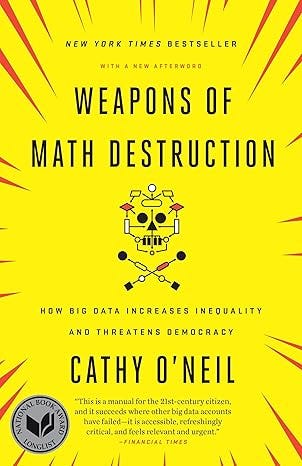
Part I: Chapter Summaries
Introduction: When Algorithms Attack
O’Neil opens with Sarah Wysocki, a teacher fired based on a value-added model that scored her performance at 6 out of 100—despite glowing reviews from principals and parents. The following year, teaching similar students elsewhere, an identical algorithm rated her 96. This whiplash reveals the book’s central argument: mathematical models, marketed as objective and fair, often encode human prejudice while operating at devastating scale. O’Neil coins the term “weapons of math destruction” (WMDs) to describe models that are opaque, unaccountable, and harmful—distinguishing them from beneficial algorithms like baseball’s defensive positioning systems. The introduction establishes three defining characteristics: opacity (we can’t see inside them), scale (they affect millions), and damage (they harm people’s lives). What makes these models particularly insidious is their self-perpetuating nature: they define their own reality and use it to justify results, creating feedback loops that punish the same people repeatedly. The Washington DC school district never questioned whether firing Wysocki was correct; the model had determined she was a failure, and that became truth.
Bomb Parts: What Is a Model?
O’Neil grounds abstract mathematics in the familiar: Lou Boudreau shifting his defense against Ted Williams in 1946, her own mental model for cooking family meals. Models, she explains, are simply abstract representations of processes—they take what we know and predict responses. Baseball models work because they’re transparent (everyone sees the stats), rigorous (immense relevant datasets), and constantly updated (immediate feedback from game results). By contrast, the LSI-R recidivism model fails on every count. It judges prisoners partly on whether their friends and family have criminal records—a circumstance of birth, not behavior, and one highly correlated with poverty and race. Someone raised in a struggling neighborhood scores higher risk than a tax fraudster from the suburbs, yet receives no feedback proving this assessment correct. The chapter dismantles the notion that racist predictive models are new, revealing racism itself as perhaps the oldest WMD: “powered by haphazard data gathering and spurious correlations, reinforced by institutional inequities, and polluted by confirmation bias.” O’Neil demonstrates that creating useful models requires choosing the right objective and including the right variables—choices that reveal the modeler’s values, not mathematical inevitability.
Shell Shocked: My Journey of Disillusionment
O’Neil narrates her own transformation from true believer to whistleblower. At D.E. Shaw, the “Harvard of hedge funds,” she discovered that mathematical models weren’t discovering truth—they were manufacturing it. The 2008 crash revealed that finance had created WMDs at civilizational scale: mortgage-backed securities rated by compromised agencies, synthetic CDOs that multiplied risk twentyfold, all built on fraud disguised as sophisticated mathematics. The math could “multiply the horseshit, but it could not decipher it.” Moving to risk management, she found that even post-crash, banks viewed risk assessments as party-pooping rather than essential—because models that claimed to measure risk were really designed to maximize profit. Her final position, at an e-commerce startup, completed the pattern recognition: the same talent pool, the same pursuit of “success” measured in dollars, the same assumption that whatever made money must be adding value. What distinguished her trajectory was witnessing how financial WMDs devastated millions while tech WMDs were just beginning their expansion. Both industries attracted brilliant people who convinced themselves their work was neutral, even beneficial, when their models were actually optimizing for extraction from the most vulnerable.
Arms Race: Going to College
The US News college ranking, O’Neil argues, transformed higher education into a destructive monoculture. Before 1988, colleges competed along multiple dimensions—some emphasized athletics, others research, still others teaching quality or community service. The ranking collapsed this diversity into a single column of numbers, creating what amounts to a mandatory national diet. Universities began optimizing for fifteen metrics chosen by journalists, not educators: SAT scores, acceptance rates, alumni giving. The result: an arms race where Texas Christian University spent $434 million on facilities and football to climb from 113th to 76th place. Students and parents spent billions on consultants gaming the admissions process. Former “safety schools” began rejecting excellent candidates statistically unlikely to attend, sacrificing actual education for the appearance of selectivity. Meanwhile, the model’s most devastating omission was cost. By ignoring tuition in the formula, US News handed universities a “gilded checkbook”—permission to spend unlimited amounts on climbing the rankings while students shouldered exploding debt. The chapter concludes with the Obama administration’s abandoned attempt to create an alternative ranking, suggesting that the solution isn’t better rankings but transparent data that lets individuals ask their own questions about what matters to them.
Propaganda Machine: Online Advertising
Predatory advertisers, O’Neil reveals, have perfected the art of targeting desperation at scale. For-profit colleges like the University of Phoenix spent $50 million annually on Google ads, hunting for what Vatterott College’s recruiting manual called “welfare moms with kids, pregnant ladies, recent divorce, low self-esteem, low income jobs” and “recent incarceration.” These institutions charged $68,800 for online degrees worth less than $10,000 at community colleges, targeting people desperate for upward mobility while their diplomas proved worthless in the job market. The system works through mathematical precision: identify pain points (a mother worried about providing for her children), offer false solutions (an expensive degree), extract maximum revenue ($2,225 per student on marketing versus $809 on instruction), and move on before the feedback catches up. Lead generators create fake “Obama asks moms to return to school” ads, harvesting phone numbers worth $85 each to diploma mills. The result is $3 trillion in student debt, much of it held by people who gained nothing but deeper poverty. O’Neil exposes how e-scores—unregulated proxies for creditworthiness—target the vulnerable while the wealthy receive personalized service from humans who consider context and complexity.
Civilian Casualties: Justice in the Age of Big Data
O’Neil dissects how predictive policing models like PredPol—originally promising and potentially beneficial—curdle into WMDs through mission creep. When departments include “nuisance crimes” (loitering, panhandling, small drug possession) alongside violent felonies, geography becomes a ruthless proxy for race. More police patrol poor neighborhoods, witness more nuisance crimes, arrest more people, generating more data that justifies more policing—a “pernicious feedback loop” that fills prisons with hundreds of thousands guilty of victimless crimes. The LSI-R recidivism questionnaire asks about family criminal records and neighborhood crime rates, punishing people for circumstances of birth while claiming scientific objectivity. Stop-and-frisk in New York exemplifies the human cost: 85% of those stopped were young African-American or Latino men, only 0.1% connected to violent crime. But efficiency-focused models don’t measure what they destroy—sleep-deprived workers, children growing up without routines, communities learning that authority means harassment. O’Neil asks the crucial question: what if police ran zero-tolerance campaigns in Greenwich, Connecticut, arresting bankers for securities fraud with the same fervor they arrest teenagers for possessing joints? The asymmetry reveals that these models don’t discover crime—they define which populations society chooses to criminalize.
Ineligible to Serve: Getting a Job
Kyle Behm, a Vanderbilt student recovering from bipolar disorder, couldn’t land a minimum-wage job at Kroger. The Kronos personality test had red-lighted him. Similar tests, now used by 60-70% of American employers, lack predictive validity—they’re one-third as effective as cognitive exams and far below reference checks—yet they’ve become gatekeepers. When employers screen 72% of resumes with algorithms that favor keywords over substance, those with resources learn to game the system while the poor remain locked out. Credit checks worsen the spiral: bad credit prevents employment, unemployment destroys credit further, creating what O’Neil calls a “poverty trap” that disproportionately affects minorities (white households hold 10 times the wealth of black and Hispanic households). The chapter exposes how St. George’s Hospital Medical School in the 1970s pioneered discriminatory algorithms, teaching computers to reject women and foreigners based on historical patterns. Modern systems are more sophisticated but equally harmful. Guild’s algorithm for identifying programming talent rewards those who spend evenings on Japanese manga sites—a proxy that privileges certain demographics while ignoring caregivers, parents, or anyone with offline obligations. The pattern repeats: models optimized for efficiency at scale systematically disadvantage those who most need opportunities.
Sweat Bullets: On the Job
Scheduling software transforms workers into “just-in-time” inventory, optimizing corporate efficiency while destroying lives. Janet Navarro, a Starbucks barista and single mother, faced “clopening”—closing at 11 PM, reopening at 5 AM—with schedules posted days in advance that made childcare impossible and college attendance a fantasy. The software analyzes weather, pedestrian patterns, even high school football schedules to staff at bare minimum, ensuring workers earn just enough to survive but not enough to escape. Companies deliberately keep hours below 30 per week to avoid providing health insurance, maximizing profits while externalizing costs. When The New York Times exposed these practices, Starbucks promised reform—but within a year, had fallen back to old patterns because efficiency metrics remained unchanged. O’Neil traces the lineage to operations research and Just-in-Time manufacturing, revealing how techniques designed to optimize supply chains now optimize human beings. The irony: while corporations claim data-driven management, they refuse to study what might actually improve outcomes—prison systems won’t research whether solitary confinement increases recidivism, schools won’t test whether smaller class sizes help teachers. Instead, WMDs like Cataphora judge workers by email patterns, creating scores that survive layoffs while remaining statistically meaningless—another case of models defining reality rather than measuring it.
Collateral Damage: Landing Credit
The FICO credit score represents mathematics at its best—transparent, regulated, based on relevant behavior (do you pay bills?), with clear feedback loops. But e-scores, its unregulated evil twins, have metastasized throughout the economy. Insurance companies use credit scores to set auto premiums, charging a Floridian with a DUI and excellent credit less than someone with a clean record but poor credit—punishing poverty more than dangerous driving. All-state pioneered “price optimization,” analyzing 100,000 microsegments to charge customers not by risk but by how unlikely they are to shop for better rates—discounts of 90% for the savvy, penalties of 800% for the desperate. Data brokers compile dossiers mixing truth and fiction: Catherine Taylor missed a Red Cross job because tenant screening services confused her with a meth dealer born the same day. When she applied for federal housing, only a conscientious human (Wanda Taylor, no relation) caught the error by checking her ankle for the other Catherine’s “Troy” tattoo. Most victims never encounter such diligence. O’Neil reveals that the unregulated data economy is far more dangerous than regulated credit reports, yet consumers have no right to see or correct e-scores. Facebook has even patented social-network-based credit ratings—your unemployed friends could soon lower your score.
No Safe Zone: Getting Insurance
Frederick Hoffman’s 1896 report declared black Americans “uninsurable,” confusing causation with correlation in ways that would echo through WMDs for the next century. Modern insurance faces a paradox: as surveillance technology enables individual risk assessment (driving monitors, health trackers, genome analysis), insurance stops being insurance—it becomes prepayment for anticipated costs rather than society pooling risk. Auto insurers already offer 5-50% discounts for accepting black boxes; soon, privacy will be a luxury only the wealthy can afford. Meanwhile, employer wellness programs disguise wage theft as health initiatives. CVS demanded employees report body fat, blood sugar, and cholesterol or pay $600 yearly. Michelin penalizes workers $1,000 for failing to meet targets including waist size—all based on the discredited Body Mass Index, a 19th-century formula designed for populations, not individuals, that systematically discriminates against women and athletes (LeBron James qualifies as “overweight”). The cruelty doubles when O’Neil reveals wellness programs don’t work: they fail to lower blood pressure or cholesterol, rarely lead to sustained weight loss, and don’t reduce health spending. The real savings come from penalties assessed on workers. As employers gain unprecedented health data, nothing prevents them from developing health scores to reject job applicants—another WMD waiting to be born.
The Targeted Citizen: Civic Life
When Facebook’s “voter megaphone” increased 2012 turnout by an estimated 340,000 people, it demonstrated that a single algorithm could swing entire states—George W. Bush won Florida by 537 votes. The company’s 2012 experiment went further: tweaking newsfeeds to show more “hard news” to 2 million politically engaged users, increasing self-reported turnout from 64% to 67%. Separately, Facebook proved it could manipulate emotions by filtering positive or negative updates, changing users’ moods “without their awareness.” What frightens O’Neil isn’t the research—it’s the opacity. These platforms wield immense power in darkness, and 62% of users don’t even know Facebook curates their feeds. Meanwhile, political micro-targeting has evolved from direct mail to algorithmic precision. Obama’s 2012 data team, led by Rayid Ghani, created hundreds of voter tribes, testing thousands of messages to optimize engagement. The Cruz campaign used Cambridge Analytica’s psychographic profiles of 40 million voters to place targeted ads visible only in specific venues (hotel lobbies during Republican Jewish Coalition meetings). This destroys democratic discourse: neighbors receive radically different messages from the same politician, preventing them from joining forces or holding candidates accountable. O’Neil notes the bitter irony—while rich and poor alike suffer disenfranchisement from micro-targeting, the financial 1% underwrites campaigns targeting the political 1%, swing voters in swing states, leaving the rest of us ignored except for fundraising appeals.
Conclusion: Disarming the Weapons
O’Neil returns to her internship at New York City’s housing department, where data revealed an uncomfortable truth: homeless families with Section 8 vouchers didn’t return to shelters, while those in Mayor Bloomberg’s “Advantage” program (designed to encourage self-sufficiency) cycled back repeatedly. When researchers prepared to present this finding, officials demanded the slide be removed—the data contradicted policy. This crystallizes the book’s central tension: models are only as good as their objectives, and powerful interests often prefer efficiency over justice. O’Neil proposes solutions: data scientists should take a Hippocratic oath (”I will not sacrifice reality for elegance”), algorithms with significant life impact should be transparent and auditable, and regulations must expand to cover e-scores, personality tests, and health data. She highlights positive models—Mira Bernstein’s slavery detector scanning supply chains, Eckerd’s child abuse prevention system—showing that predictive analytics can serve rather than exploit the vulnerable. But voluntary reform won’t suffice; corporations won’t sacrifice profits for fairness unless forced. The comparison to early industrial revolution is deliberate: just as society eventually demanded worker protections and food safety, we must now regulate the data economy. Her hope is that WMDs will be remembered like deadly coal mines—”relics of the early days of this new revolution, before we learned how to bring fairness and accountability to the age of data.”
Bridge
What emerges from O’Neil’s methodical destruction of algorithmic authority is less a Luddite manifesto than a plea for mathematical humility. She’s not attacking data science—she’s one of its practitioners—but rather the dangerous conflation of efficiency with justice, correlation with causation, and profit with progress. The models she dissects aren’t failed experiments awaiting better data; they’re working exactly as designed, extracting maximum value from those least able to resist. The question hovering over every chapter—can data processing defeat human indifference?—resolves into something more troubling: these systems don’t just fail to defeat indifference, they industrialize it, encoding prejudice into self-justifying loops that punish the poor for being poor. What follows attempts to sit with that discomfort, to examine what it means when our most powerful institutions stop making decisions and start executing algorithms.
Part II: Literary Review Essay
There’s a particular mathematics to modern humiliation. You apply for a job at Kroger, desperate for minimum wage and flexible hours to work around college classes and bipolar medication schedules. A computer asks whether you agree or disagree: “Sometimes I need a push to get started on my work.” You choose an answer—damned either way, lazy or high-strung—and receive nothing. No callback, no explanation, just algorithmic silence that smells like failure but feels like something darker, more final. Three months later you discover from a friend that you’ve been “red-lighted,” marked by invisible scores as too risky, too expensive, too broken to stock shelves. The mathematics is perfect in its cruelty: it transforms human suffering into efficiency gains, measures desperation with precision, and optimizes for profit while calling itself fair.
This is the world Cathy O’Neil excavates in Weapons of Math Destruction, a book that arrives with the urgency of investigative journalism and the rigor of a mathematician who’s seen too much. O’Neil spent years as a quant at D.E. Shaw, watching brilliant people build models that would eventually help destroy the global economy. She left finance for data science at tech startups, hoping for cleaner work, and found instead that the same extractive logic had metastasized across every domain of American life. By the time she quit to write this book, she’d mapped an entire shadow infrastructure of algorithms that sort us, price us, predict us, and punish us—usually in that order.
The term she coins, “weapons of math destruction” or WMDs, initially sounds like activist rhetoric. But O’Neil earns the metaphor through disciplined taxonomy. A WMD must meet three criteria: opacity (we can’t see inside), scale (it affects millions), and damage (it destroys lives). More crucially, these models create “pernicious feedback loops”—they don’t just reflect inequality, they amplify it. A poor person gets targeted for predatory payday loans because of their zip code. The loans drive them deeper into debt, lowering their credit score. The lower score increases their insurance premiums, reduces their job prospects, and qualifies them for more predatory offers. The algorithm watches this spiral and concludes: the model was right, poor people are risky. The punishment becomes its own justification.
What makes O’Neil’s analysis cut deeper than adjacent critiques—Eubanks’ Automating Inequality, Noble’s Algorithms of Oppression—is her insider’s understanding of how these systems justify themselves to their creators. She knows the seduction of elegant math, the rush of finding patterns in chaos. She remembers factoring license plates as a child, loving how prime numbers unlocked the world’s structure. That early faith in mathematics as refuge from messiness never fully dies, even as she catalogs its weaponization. This gives the book an elegiac quality rare in tech criticism: she’s not attacking math but mourning its corruption, and that grief authenticates every accusation.
Consider the teacher evaluation models that cost Sarah Wysocki her job. The District of Columbia hired Mathematica Policy Research to measure teacher quality through “value-added modeling”—comparing students’ test scores year over year to isolate the teacher’s contribution. The impulse seems reasonable: administrators can’t be trusted (they have favorites), test scores are objective, let the numbers speak. But O’Neil demonstrates that the numbers are screaming nonsense. Wysocki scored 6 out of 100 one year, 96 the next, teaching similar students in similar schools. An analysis of New York’s teachers found one in four registering 40-point swings between consecutive years. This isn’t measuring teaching; it’s measuring noise.
The statistical problem is that value-added models rely on error terms—the gap between predicted and actual scores—which are “guesses on top of guesses.” You’re not measuring a teacher against objective standards but against other teachers’ students’ projected trajectories, adjusted for demographics, learning disabilities, prior scores, all filtered through algorithms that remain opaque to the teachers being judged. A class of 30 students provides nowhere near enough data for reliable conclusions (Google tests ad colors on 10 million people), yet districts fire teachers based on these scores. When Tim Clifford, a 26-year veteran, received his 6, he felt ashamed. His 96 the following year didn’t restore confidence—it revealed the absurdity. As he told O’Neil: “I knew that my low score was bogus, so I could hardly rejoice at getting a high score using the same flawed formula.”
What transforms this statistical malpractice into a WMD is the complete absence of feedback. The system never learns whether fired teachers were actually ineffective. It never discovers that Wysocki went on to excel elsewhere, or that Clifford’s wildly variant scores measured nothing about his teaching. The model is “self-perpetuating, highly destructive, and very common.” It defines reality—these teachers are failures—and that definition becomes truth, reproduced in personnel files and whispered in faculty lounges until it hardens into fact.
O’Neil traces this pathology to the 1983 “Nation at Risk” report, which blamed teachers for falling SAT scores. The report itself rested on a spectacular statistical error: yes, average scores had dropped, but that’s because far more students—including poor students, minorities, women—were taking the test. When researchers broke the data into income cohorts, every single group’s scores were rising. This is Simpson’s Paradox: aggregate data showing one trend while every subgroup shows the opposite. The commission missed it, or ignored it, launching three decades of teacher-blaming that persists because it’s easier than funding schools or addressing child poverty.
Here O’Neil’s argument opens into its deepest register, the one that carries past education into recidivism models, credit scores, insurance algorithms, and political micro-targeting. These WMDs don’t fail because they’re badly coded or need more data. They fail—or rather, they succeed at the wrong objectives—because American society has chosen to optimize for punishment rather than help, extraction rather than support, efficiency rather than justice. A model that identified high-risk students could connect them with tutors, counselors, summer programs. Instead it identifies “low-performing” teachers to fire. A model that spots families likely to return to homeless shelters could direct them to Section 8 vouchers (which data proves work). Instead it’s buried when the results contradict the mayor’s preferred policy.
The pattern repeats with numbing consistency. PredPol, the predictive policing software, could theoretically reduce crime by positioning officers where they’re most needed. But when departments feed it “nuisance crime” data—loitering, panhandling, small drug possession—the algorithm sends more cops to poor neighborhoods, where they witness and arrest people for the crimes that would go unrecorded in wealthy areas. More arrests generate more data justifying more policing. Geography becomes a perfect proxy for race in our segregated cities, and the model criminalizes poverty while congratulating itself on scientific objectivity. Meanwhile, as O’Neil asks with barely controlled rage, where are the PredPol boxes on Wall Street? Finance committed “enormous crimes” that “devastated the global economy for the best part of five years,” yet remains “underpoliced” because bankers are “viewed as crucial to our economy.” The asymmetry isn’t a bug in the system—it is the system, now optimized by algorithms that encode society’s cruelest choices as mathematical inevitability.
What rescues Weapons of Math Destruction from becoming merely an catalog of algorithmic atrocities is O’Neil’s insistence on solutions, even modest ones. She’s clear-eyed about the limits: dismantling these weapons one by one won’t work because “they’re feeding on each other.” A poor person already struggling faces predatory ads (for-profit colleges, payday loans), biased hiring algorithms (credit checks, personality tests), aggressive policing (stop-and-frisk in their neighborhood), harsher sentences (recidivism scores), higher insurance rates (zip code penalties), limited job prospects (scheduling chaos), and political disenfranchisement (micro-targeting ignores non-swing-voters). “It’s a death spiral of modeling,” she writes, and you can’t fix that by tweaking one model’s coefficients.
Instead, O’Neil proposes treating algorithms like we treated early industrial capitalism—with regulation born from recognizing that efficiency unchecked produces horror. Coal mines killed 3,242 workers in 1907 alone; the free market didn’t fix that, government intervention did. Similarly, we need to expand the Fair Credit Reporting Act to cover e-scores, update the Americans with Disabilities Act to prohibit discrimination based on predictive health models, require transparency for any algorithm affecting life opportunities, and most radically, measure models’ human costs, not just their financial efficiency.
Some of this is already happening at the margins. Princeton’s Web Transparency and Accountability Project deploys software robots to detect bias in hiring sites. A few cities have banned credit checks in employment. Researchers are building auditing tools that can expose racial disparities in mortgage lending or educational access. But O’Neil is blunt about the obstacles: companies like Google and Facebook guard their algorithms as trade secrets, researchers face legal threats for creating fake profiles to test bias, and most crucially, the victims of WMDs—the poor, the imprisoned, the desperate—lack the political power to demand change.
The book’s most haunting moment comes when O’Neil describes working as an unpaid intern for New York City, building models to help homeless families find stable housing. Her team discovered that Section 8 vouchers worked spectacularly—families who received them left shelters and didn’t return. But Bloomberg’s administration had replaced Section 8 with a program designed to wean people from “dependence,” and when researchers presented data showing it failed, officials demanded the slide be removed. The data threatened the narrative. This crystallizes what separates beneficial models from WMDs: not their mathematical sophistication but their objective function. Change the goal from “maximize profit” or “optimize efficiency” to “reduce human suffering,” and a weapon becomes a tool.
You could argue, and some reviewers have, that O’Neil overstates her case, that not every algorithm is malevolent, that some predictive models genuinely help (she acknowledges this, highlighting Mira Bernstein’s slavery detection system and Eckerd’s child abuse prevention model). You could note that her proposed regulations face political impossibility in our current climate, or that the European Union’s data protection regime she admires has its own problems. You could observe that she underestimates how quickly these systems evolve, that the specific WMDs she catalogs in 2016 may already be obsolete, replaced by even more sophisticated and opaque versions.
All true, and all beside the point. What Weapons of Math Destruction accomplishes is exposing the con at the heart of algorithmic governance: the claim that math is neutral, that data is objective, that automated systems are fairer than biased humans. O’Neil spent a career inside these systems and emerges to testify that the opposite is true. Every model encodes choices—which data to collect, which variables to weight, which outcomes to optimize—and those choices are profoundly moral. When we pretend otherwise, when we treat algorithmic verdicts as inevitable rather than constructed, we “abdicate our responsibility.” The WMDs proliferate not because they’re good at what they claim to do (predict teacher quality, reduce recidivism, assess creditworthiness) but because they’re excellent at what they’re actually designed to do: sort people into winners and losers, then extract maximum value from each group while providing cover for that extraction through mathematical authority.
The real crime isn’t that these models are sometimes wrong. It’s that even when they’re right according to their metrics—predicting that a formerly incarcerated person from a poor neighborhood will reoffend, that a student with low credit will struggle to repay loans, that a teacher in a failing school will show poor value-added scores—they mistake correlation for causation, prediction for justification. They observe that poverty predicts bad outcomes, then use that observation to deny poor people the resources that might change those outcomes. The algorithm becomes a self-fulfilling prophecy, “defining reality and using it to justify results,” until the model’s victims internalize their scores as truth, asking themselves as Kyle Behm did after multiple personality test rejections: “If I can’t get a part-time minimum wage job, how broken am I?”
Perhaps the deepest insight in O’Neil’s indictment is this: WMDs don’t just punish individuals, they fracture solidarity. When Facebook’s algorithm shows different users different versions of political candidates, when insurance companies charge wildly varying rates to people in adjacent zip codes, when hiring software rejects qualified candidates without explanation, we lose the ability to recognize shared experiences or organize collective responses. The opacity is strategic. As she writes about political micro-targeting, it’s “similar in many ways to a common tactic used by business negotiators. They deal with different parties separately, so that none of them knows what the other is hearing. Asymmetry of information prevents the various parties from joining forces, which is precisely the point of democratic government.” The WMDs reverse that equation: e pluribus unum becomes one carved into many, atomized into algorithmic silos where we can’t see each other’s suffering or identify common cause.
What haunts, finally, is how ordinary these weapons seem. They arrive wearing the bland mask of human resources software, credit monitoring, dynamic pricing, scheduling optimization. They promise to make life easier, fairer, more efficient. And for some people—those already winning capitalism’s lottery—that promise delivers. Amazon’s algorithms find you better deals, Google’s search surfaces useful information, Waze routes you around traffic. You might hardly notice you’re living in the golden age of data except for the vague sense that everything just... works. Meanwhile, a few blocks or zip codes away, someone who looks at the same platforms sees a different internet entirely: predatory ads for overpriced degrees, higher prices for the same goods, rejected applications and inexplicable denials, police stops and mounting debt. Two Americas, increasingly invisible to each other, optimized for opposite destinies.
O’Neil’s achievement is making that bifurcation visible, tracing the code that sorts us into tribes and the mathematics that makes our fates feel inevitable. Her hope—expressed with the kind of qualified optimism you’d expect from someone who’s seen these systems from inside—is that we can recognize WMDs as “relics of the early days of this new revolution, before we learned how to bring fairness and accountability to the age of data.” That learning requires treating algorithms not as neutral arbiters but as powerful engines requiring steering wheels and brakes. It requires admitting that some things—justice, democracy, human dignity—resist quantification and demand human judgment. Most of all, it requires recognizing that when machines seem to be making decisions, human beings are really just hiding behind math.
The question isn’t whether we can build better models. Of course we can. The question is whether we’ll demand they serve better masters.
The detail that stopped me cold was the housing data incident—researchers finding that Section 8 vouchers actually worked, and city officials demanding the slide be removed. That single moment says more about WMDs than any technical breakdown could. The problem was never that we lacked good data; it's that good data is politically inconvenient. You can build the most transparent, well-audited model in the world, and it still gets buried the moment it tells power something it doesn't want to hear.
This reframes the whole conversation for me. We spend a lot of energy debating algorithmic bias, fairness metrics, and auditability—all important—but O'Neil is pointing at something upstream of all that. The corruption starts at the objective function, before a single line of code is written. Who decides what the model optimizes for, and who's absent from that room when the decision gets made? The people scored by the LSI-R don't get a seat at that table. Neither did Wysocki. Neither do the Starbucks baristas whose sleep schedules are someone else's efficiency gain.
What also stood out is how these systems quietly dismantle the possibility of proving them wrong. Baseball models self-correct because the outcome is visible the next day. But when a teacher gets fired or a prisoner gets a longer sentence, there's no follow-up, no mechanism for the model to learn it was wrong. A system that can never be falsified isn't science—it's doctrine. And we've handed that doctrine the power to decide who eats and who doesn't.
This goes beyond summary into a clear, sustained argument about power. What’s especially strong is your through-line: these systems don’t malfunction—they optimize for the wrong objectives. By returning to feedback loops, objective functions, and the confusion of correlation with causation, you show that O’Neil’s examples form a coherent architecture of harm rather than isolated failures. The progression from individual cases to systemic design feels deliberate and persuasive.
The second half stands out for grounding abstraction in lived experience. The idea of a “mathematics of modern humiliation” makes algorithmic opacity feel personal, not just technical. Your point about how these systems fracture solidarity is particularly sharp, and the conclusion reframes the issue effectively: the real question isn’t whether we can build better models, but whether we will demand they serve justice instead of efficiency.