

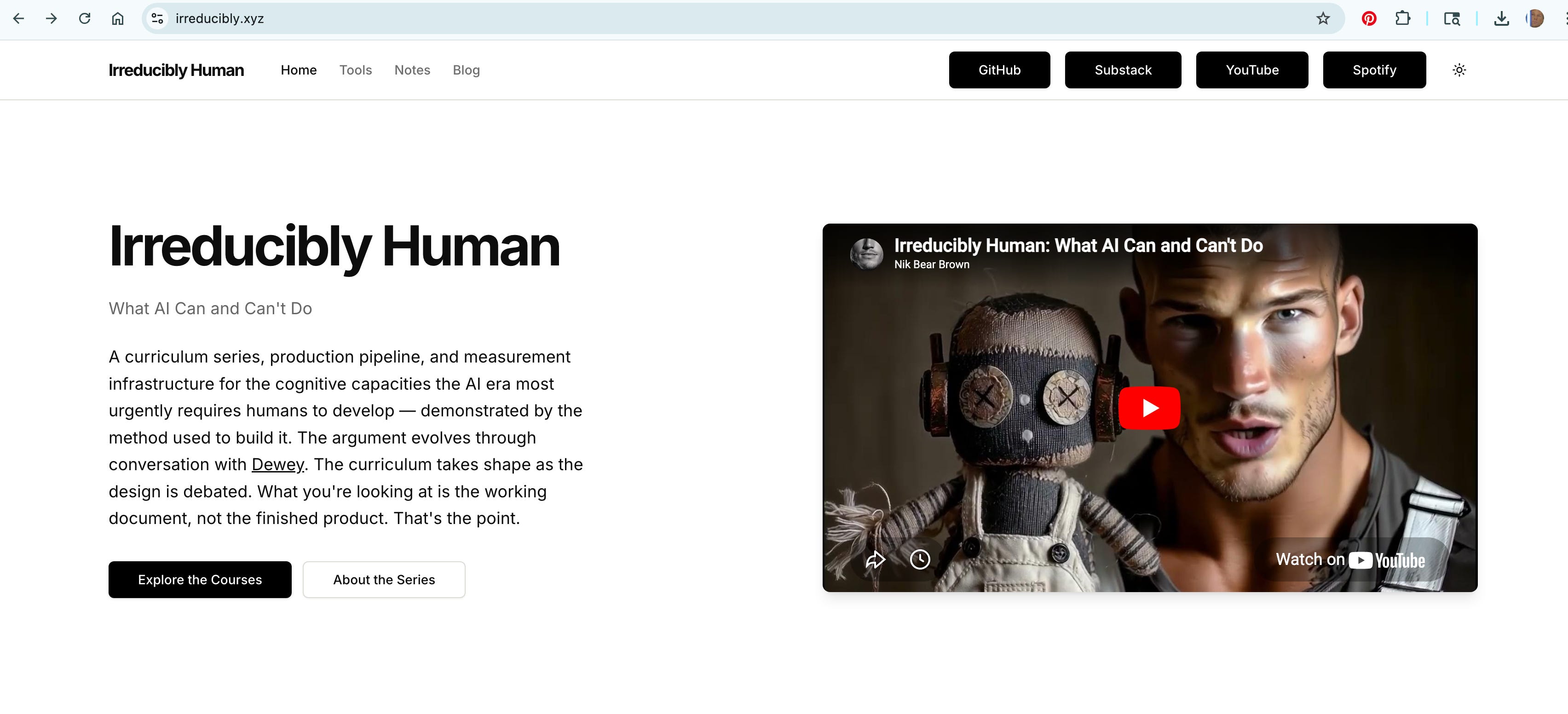
Irreducibly Human: https://www.irreducibly.xyz/
The panic arrived in the wrong order.
When ChatGPT went public in November 2022, schools declared a crisis. Students were cheating. Essays were being written by machines. Arithmetic was being performed by algorithms. The question administrators asked — urgently, in emergency faculty meetings, in policy documents rushed into existence over winter break — was how to detect this. How to prevent it. How to put the genie back in the bottle.
Nobody asked the prior question.
Why are we assigning work a machine can do?
Here is what the panic missed: AI didn’t break education. It exposed a failure that was already there, running quietly for decades, producing graduates optimized for exactly the tasks that software now performs better, faster, and cheaper than any human being alive. The curriculum we built — and built deliberately, and defended with genuine belief in its value — was a curriculum for a world that no longer exists.
Machines arrived. And we could finally see what we had been training people to do.
The Curriculum We Built
To be clear: the failure was not malicious. Institutional inertia is not stupidity. Schools change slowly because they were built to transmit what is known, not to respond to what is new. That feature is now a bug. For most of the twentieth century, arithmetic speed and fact retrieval were genuinely valuable human capacities. An accountant who could run numbers in her head was worth hiring. A lawyer who had memorized case law was difficult to replace. An engineer who could recall formulas without looking them up got work done faster.
That world is gone.
The intelligent response to the invention of the forklift is not to practice lifting heavier objects. It is to learn to operate the machine, understand what it can and cannot lift, and — most crucially — develop the judgment to know what needs lifting in the first place. The question the forklift raises is not about strength. It is about what the work actually is, now that strength is no longer the constraint.
Irreducibly Human: What AI Can and Can’t Do is a six-book curriculum series built around that question. It does not teach students to compete with AI. It teaches them to supply the reasoning that AI tools require humans to provide — the reasoning no tool can supply on their behalf.
The series organizes human intelligence into seven tiers by a single criterion: what machines can and cannot do. Where AI is strongest — pattern recognition, fact retrieval, syntactic correctness, encyclopedic recall — the curriculum doesn’t train humans to compete directly. That would be malpractice. Where AI is weakest — causal reasoning, metacognitive oversight, collective intelligence, practical wisdom — the curriculum rebuilds from scratch.
The name changed recently. It was called The Human Half: What AI Can’t Do. The rename matters. “What AI can’t do” is a defensive posture — we are mapping a shrinking territory, waiting to see how much ground we lose. “Irreducibly human” says something different. There are capacities that are not merely outside AI’s current capability. They are outside its fundamental nature. Not gaps waiting to be filled. Structure.
The Gardner Trap
In 1983, Howard Gardner published Frames of Mind and cracked something open.
Multiple intelligences, he argued. Not one general intelligence but several: linguistic, logical-mathematical, spatial, musical, bodily-kinesthetic, interpersonal, intrapersonal. The framework was a genuine provocation. It said that the student who couldn’t sit still and parse grammar might have an intelligence the school wasn’t measuring. It said that the child who couldn’t add fractions might still understand the geometry of a room in her body before she crossed it.
Schools responded. Enthusiastically. “We teach to all the intelligences,” they said. And then, largely, they kept doing what they had always done.
Forty years later, there is still no validated assessment for intrapersonal intelligence. The curriculum that was supposed to follow the framework never fully arrived. What arrived instead was vocabulary. Teachers learned to say “multiple intelligences” the way they learned to say “growth mindset” — as a description of what they believed, not as a specification of what they would do differently on Monday morning.
This is the Gardner Trap: naming a thing so well that the naming feels like the work.
Gardner’s framework was built before machines became capable, which means it didn’t need to ask which intelligences technology endangered. It also didn’t name three tiers the series considers essential: the supervisory layer (knowing when an answer is wrong before recomputing it, knowing which tool to deploy and whether to trust what it returns), the causal layer (not just observing that X follows Y but reasoning about what happens if you intervene, about what would have happened if you had not), and the collective layer (the intelligence that emerges from groups working together in ways that exceed the sum of individual ability — the intelligence of science, of markets, of democracy, of any collaborative practice that generates knowledge no single person could generate alone).
None of these are properties of individuals. You cannot have supervisory intelligence in a vacuum — it requires a tool to supervise, a context in which the supervision matters, stakes. You cannot do causal reasoning without a question worth asking. Collective intelligence is definitionally not possessed; it is accomplished together.
An algorithm has access to the literature. It is absent from the practice that generates new knowledge. That absence is not a temporary limitation. It is a structural one.
Irreducibly Human is explicitly Stage 1 of a three-stage sequence: Name it. Teach it. Measure it. Gardner did Stage 1 brilliantly. Forty years passed. The series is an attempt to hold Stage 1 more honestly — to name only what can be defined clearly enough to teach, and to be transparent about where the measurement infrastructure doesn’t yet exist. Stages 2 and 3 are in development, in collaboration with the Center for Curriculum Redesign. The series is not claiming to have completed them. It is claiming that Stage 1 done honestly — with specific learning outcomes, sequenced exercises, and defined criteria for success — is rarer than it sounds, and more necessary than the field has acknowledged.
What the Series Actually Is
Six books. Two companions. A complete production infrastructure.
AI Literacy, Fluency, and Trust is the entry point — how to operate the machine without being replaced by it. Causal Reasoning is the identification layer — what causes what, and why no algorithm can answer that for you. AImagineering is post-AI design thinking — one week on ideation, the rest on the judgment that makes ideation matter. Ethical Play asks students to build a game that makes a player feel moral weight, then survive an AI audit proving the ethics are in the mechanics and not just in the documentation. Conducting AI teaches the five supervisory capacities no algorithm possesses — hearing the wrong note, choosing the piece, directing the sections. The Collective addresses the intelligence that cannot be possessed. Only accomplished. Together.
The companion books extend the series into domains the core texts cannot reach. A teacher’s guide addresses fifteen fields where the body knows things that language models do not: lab science, woodshop, nursing simulation, surgical training, studio art, dance, trades. A practitioner’s guide for experiential learning addresses the co-op coordinators, clinical placement directors, and study abroad advisors who send students into the world to learn — because practical wisdom, the Aristotelian capacity to know when and how to apply what you know and when not to, cannot be taught in a classroom. It can be scaffolded in the field.
The series is being built with the same tools it teaches. That is not an accident. Every book in the series was produced using an AI-assisted production infrastructure — a chapter drafting engine, an assertion verification system that scans claims and flags suspect ones for expert review, a figure generation protocol, a custom case study generator, a peer review framework, a game design document consultant. A 38-chapter textbook in cancer biology was written in approximately one month using this infrastructure and is currently in production in an NIH program. The Boyle System — a documentary infrastructure for scientific reproducibility — reduced the time senior researchers spent reviewing mentee work from sixty percent of each meeting to twenty, across more than 150 fellows in applied AI humanitarian contexts.
The thesis is demonstrated by the method used to build it. The forklift is being operated. What the forklift cannot lift is being named, precisely, in each chapter.
What This Is Not
It is not a book about AI.
This distinction is harder to hold than it sounds, because AI is everywhere in the series — as the subject of study, as the production infrastructure, as the adversary the ethics course must survive. But AI is not the center of gravity. Humans are. Specifically, the capacities that make humans irreplaceable not in spite of AI but because of it — because the tools require human judgment to operate, human values to direct, human stakes to make the outputs matter.
An algorithm has no stakes. It cannot commit because it cannot lose. The series is built for people who can lose, who are mortal and situated in time, who will have to live with the decisions the tools help them make. Those people need a curriculum that prepares them for the work the tools cannot do. That work is not shrinking. It is expanding.
The schools that spent the last two years trying to detect AI-generated student essays were asking the wrong question. The right question is what we are asking students to do with their irreducible minds, now that the machines have taken everything else.
Irreducibly Human is an attempt to answer that.
Tags: Irreducibly Human curriculum series, AI education reform, Howard Gardner multiple intelligences critique, causal reasoning pedagogy, human capacities AI cannot replace